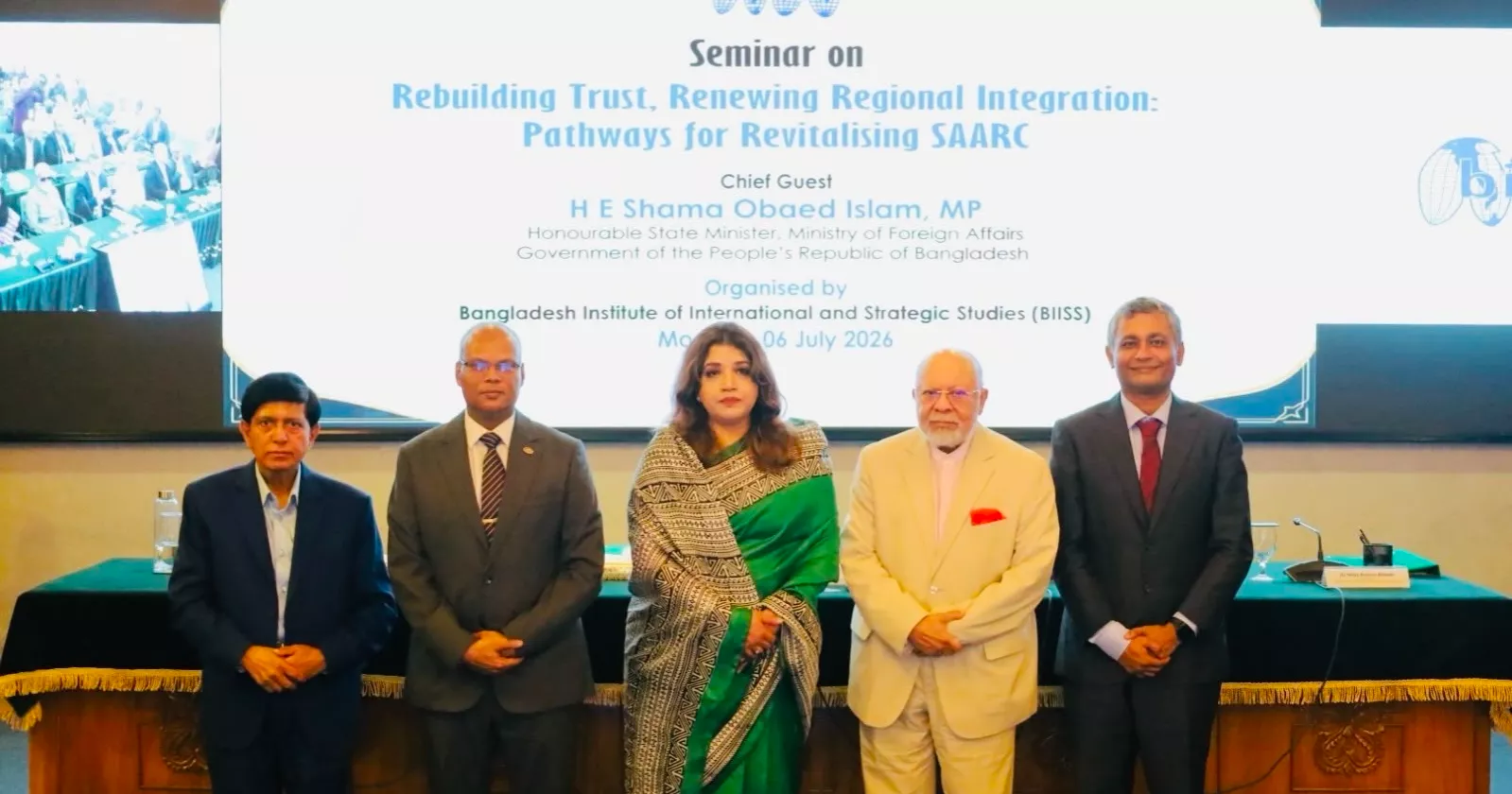
Seeking efforts to create a cooperative future worthy of South Asia’s peoples, former Ambassador Tariq A. Karim on Monday said if there is one domain where South Asia cannot afford paralysis, it is ecological security.
“Rivers, monsoons, glaciers, deltas, forests, air quality, disease patterns, food systems, and climate risks do not obey political borders. Bangladesh, as a lower riparian deltaic country, understands this reality with particular urgency,” he said, describing ecological security as the most practical starting point.
Dhaka doesn’t need to choose between SAARC, BIMSTEC: Shama Obaed
Ambassador Karim, Advisor, Centre for Bay of Bengal Studies, Independent University, Bangladesh, and visiting Research Fellow, Institute of South Asia Studies, National University of Singapore, made the remarks while delivering keynote address at a seminar.
The Bangladesh Institute of International and Strategic Studies (BIISS) organised the seminar titled “Rebuilding Trust, Renewing Regional Integration: Pathways for Revitalising SAARC.”
Speaking as the chief guest, State Minister for Foreign Affairs Shama Obaed Islam reaffirmed Bangladesh’s longstanding commitment to regional cooperation and highlighted the importance of revitalising SAARC as a platform for promoting peace, stability, economic prosperity, and sustainable development in South Asia.
She emphasised that renewed regional dialogue and strengthened institutional cooperation are indispensable for addressing shared challenges and unlocking the region’s vast economic and strategic potential.
Ambassador Karim said SAARC may be comatose, but the idea of South Asian cooperation is not dead. He said it waits for political courage, intellectual honesty, and institutional patience.
“The costs of delay are rising: climate shocks, water insecurity, food stress, public health risks, economic fragmentation, and strategic vulnerability. Cooperation is difficult, but delay is dangerous,” he said.
“Let us therefore move beyond asking only why SAARC failed. Let us ask, instead, what must be done - patiently, pragmatically, and urgently - to rebuild trust, renew regional integration, and create a cooperative future worthy of South Asia’s peoples,” said the former diplomat.
Former Additional Foreign Secretary (SAARC & BIMSTEC), Ministry of Foreign Affairs, and CEO, Coders Trust Bangladesh, Md Shamsul Haque, and Prof, Department of International Relations, University of Dhaka, Dr Niloy Ranjan Biswas, spoke as discussants, while Director General, BIISS, Major General A. S. M. Ridwanur Rahman delivered the welcome and closing remarks.
Ambassador Karim said the 1996 Ganges Water Sharing Treaty between Bangladesh and India showed that cooperation is possible even on sensitive issues.
“But the treaty is due to expire in December 2026, and its renewal will test whether the region can adapt old agreements to new hydrological and climatic realities,” he said.
The former diplomat who served as Bangladesh High Commissioner to India and Bangladesh Ambassador to the USA said the Teesta remains unresolved, and Bangladesh and India share 52 more transboundary rivers.
“Across the wider region, water, food, energy, health, disaster management, and climate resilience are regional public goods. No country can secure them alone,” he said.
The former diplomat said the compulsions of ecological integrity may therefore be South Asia’s strongest argument for renewed cooperation.
He said the region should consider shared river-basin management, early-warning systems, climate adaptation financing, joint research, and a regional ecological security dialogue.
“Such cooperation would not require states to surrender sovereignty. It would require them to recognise that sovereignty in an age of climate stress is strengthened - not weakened - by cooperation achieved through its pooling,” said the foreign affairs expert.
He said South Asia’s dilemma is not the absence of shared destiny. “It is the inability, so far, to organise and embrace that destiny through trust, institutions, and imagination.”
Ambassador Karim said the peoples of South Asia remain connected by rivers, mountains, monsoons, cultures, labour, migration, markets, music, memory, and vulnerability.
“The question is whether our states can learn to treat those connections not as liabilities, but as foundations for cooperation,” he said.
An interactive open discussion followed the keynote presentation and panel discussion. Participants exchanged views on the structural limitations that have constrained SAARC’s effectiveness, the impact of regional geopolitical dynamics, and opportunities for advancing functional cooperation despite existing political differences.
Senior officials from different ministries and government agencies, ambassadors, high commissioners, former diplomats, senior civil and military officials, representatives from regional and international organisations, members of academia, researchers, university faculty members and students, media representatives, and policy practitioners participated in the seminar.