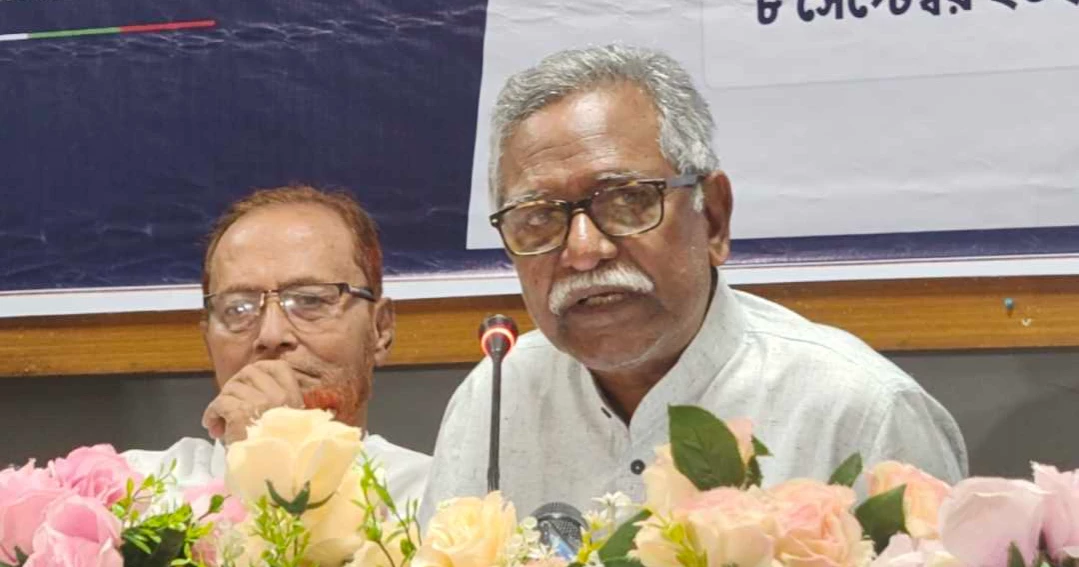
Economist Prof Anu Muhammad on Tuesday said the government’s proposed handover of the New Mooring Container Terminal (NCT) at Chittagong Port to a foreign operator without a tender could put the state at risk, describing the argument that Bangladesh lacks the capacity to operate strategic infrastructure as a “54-year-old deception.”
“It is a matter of shame for the current government that the name of DP World, the same company that surfaced in the name of investment at Chittagong Port during the Awami League era, has resurfaced,” he said.
Although the slogan “Bangladesh First” is being voiced, Anu Muhammad said, “in reality, the old vulture has taken control over the port.”
He made the remarks while speaking at a round-table discussion titled “Chittagong Port and National Interest”, organised by the Media and Civil Rights Society (MCRS) at the Jatiya Press Club.
Anu Muhammad said the phrase “we lack the capacity” has been used to deceive Bangladesh’s youth for the past 54 years.
He said DP World is a state-owned enterprise and that handing over the port to the company without any kind of tender will be an act of recklessness that could put the state at risk.
The economist cited the Rooppur and Matarbari projects as examples, saying there is no one to answer questions surrounding those “overly ambitious” ventures.
NCT built with state funds, paper says
The keynote paper at the event was presented by Sohag Kumar Biswas, Chittagong bureau chief of the daily Amar Desh.
The paper drew attention to three structural changes being proposed.
First, it said the nature of responsibility will shift from “operator” to “concessionaire”, meaning toll revenue will no longer be credited directly to the port’s own accounts.
Second, a fixed per-TEU revenue will be replaced with a tiered royalty system, under which the port’s earnings will depend on whatever figure is reported as “average revenue”.
Third, although the financial model was originally prepared on a 15-year basis, the proposed demand now stands at 30 years, it said.
Proposed concession could reduce port earnings
According to figures cited from the concept paper, net port earnings per container could fall from $65.25 to $17.18, a drop of about 74 percent based on the same $120 revenue figure.
The $48.07 difference per container will translate into roughly Tk 800 crore per year, about Tk 12,000 crore over 15 years and about Tk 24,000 crore over 30 years, it said.
By comparison, the proposed foreign investment stands at $205 million, equivalent to about Tk 2,500 crore, with the investment sector left unspecified.
The domestic company offered $5 more at every revenue tier along with an advance fee of $25 million — $98.50 per TEU – exceeding even the upper limit of the foreign proposal at $97.50, according to the paper.
During negotiations, the minimum concession fee was reduced from $99.54 to $94.96. The paper said this single adjustment alone amounts to about $6.3 million in annual concessions.
It also said the court has ruled only on the legality of the process and has never examined the terms of the contract itself because those terms remain undisclosed to this day.
Data security concerns
The paper further said the most valuable asset of a modern terminal is not the crane but data, including cargo manifests, shipper and consignee information, export flows and berthing schedules.
“Whoever controls this data effectively holds the full picture of Bangladesh’s foreign trade,” it said.
The paper referred to a cyberattack on the Australian operations of the global operator in November 2023, saying the attack shut down operations at four ports and left more than 30,000 containers stranded.
It also warned that if the same operator is to run both the NCT and the Chittagong Container Terminal (CCT), users will have no alternative when it comes to tolls and berthing priority.
MCRS proposes seven safeguards
The concept paper put forward a seven-point proposal, saying the recommendations are not directed at any specific company, whether domestic or foreign, and should apply equally to any operator.
First, one process: Long-term transfer of strategic national infrastructure should take place only through an open, international and competitive tender, with no direct negotiation based on unsolicited proposals.
Second, mandatory joint venture: For foreign investment in all strategic infrastructure, domestic companies should hold a minimum of 51 percent ownership, while foreign partners should be capped at a maximum of 49 percent. Technology transfer should also be mandatory.
Third, term and scope: The maximum term should be 15 years, tied to the actual investment and repayment period. The same operator should not be allowed to run more than one container terminal at the same port.
Fourth, ownership and control: The 51/49 structure must be ensured in practice, not merely on paper. Domestic majority ownership should be maintained at all three levels — shares, dividend rights and board voting rights — with mandatory disclosure of beneficial ownership.
Fifth, data and strategic security: Ownership of the TOS and all operational data should remain with the state. Data should be stored within the country, independent cybersecurity audits should be conducted, and there should be clear limits on access to restricted areas and surveillance infrastructure.
Sixth, transparency and accountability: Draft contract terms should be published before signing and presented to the parliamentary standing committee. Local agents, partners and beneficial owners should also be disclosed.
Seventh, labour and domestic industry: Jobs and service conditions of the existing workforce should be protected. Domestic berth operators and service providers should be brought in as partners rather than reduced to subcontractors. Non-discrimination in berthing should be guaranteed for domestic-flagged and feeder vessels.
The roundtable was moderated by Baten Biplob, Executive Director of the Media and Civil Rights Society.
Dr Harun Or Rashid, general secretary of the Maulana Bhashani Parishad; Abdullah Kafi Ratan, general secretary of the Communist Party of Bangladesh; Satyajit Biswas, general secretary of the Garments Workers Union Parishad; Sayedul Haque Nishan, president of the Chhatra Council; Dilip Roy, president of Biplobi Chhatra Moitree; Sheikh Nurullah Bahar, a top leader of the Chittagong Port Protection Committee, Professor Moshahida Sultana Ritu of Dhaka University; and Sakib Anwar, organising secretary of Nagorik Oikya, among others, spoke.
The speakers said the real question was not “local versus foreign”, but “on what terms, for how many years, with what degree of transparency, and who ultimately stands to benefit”.
They said a flawed tender could be cancelled and a flawed investment could be restructured, but withdrawing from a 30-year international concession agreement could mean years of fighting in arbitration tribunals.
“There should therefore be no haste. The questions must be answered first, and the signing must come after,” they said.