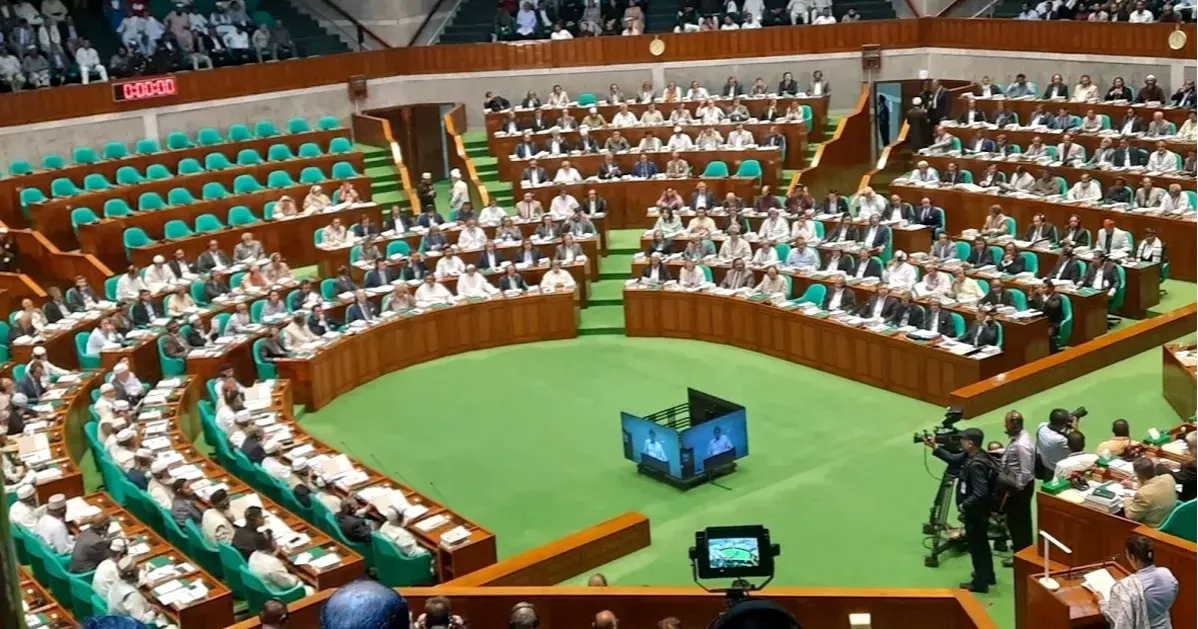
A private member's bill proposing amendments to the Code of Criminal Procedure (CrPC), 1898 to ensure gender-sensitive post-mortem examinations and allow families to forgo autopsies in certain accidental deaths was withdrawn in Parliament on Thursday after the government assured that similar provisions would be incorporated into a broader amendment to the law.
The proposed legislation, titled The Code of Criminal Procedure (Amendment) Bill, 2026, was tabled by opposition lawmaker Shahjahan Chowdhury, MP from Chattogram-15.
The bill sought to amend Section 174(3) of the Code of Criminal Procedure, 1898 by inserting two new provisions relating to post-mortem examinations.
Under the proposal, the post-mortem examination of a deceased male would be conducted by a male doctor, while that of a deceased female would be carried out by a female doctor, provided a female physician is available at a government hospital in the district headquarters where the death occurred.
The bill said the provision was intended to ensure greater dignity and respect for the deceased, particularly women, during post-mortem examinations.
It also proposed exempting certain accidental deaths from mandatory post-mortems. Under the draft law, no post-mortem would be required in cases where death resulted from accidental collisions on roads, waterways, railways or other public places if the deceased's father, mother, son or daughter submitted a written declaration confirming that the death was accidental and that the family did not consider a post-mortem necessary.
Presenting the bill, Shahjahan Chowdhury sought the Speaker's permission to introduce the legislation.
Responding to the proposal, Law Minister Md. Asaduzzaman said the Code of Criminal Procedure contains 565 sections, many with sub-sections, and that Parliament had already amended 29 sections during the first session of the 13th Parliament.
He informed the House that the government had already written to Parliament on June 30, notifying that it was preparing a comprehensive amendment to the CrPC, which would include the issues raised in the private member's bill along with several other proposed changes.
"The proposal raised by the honourable member is valid. We do not disagree with it in principle. As we are already bringing a comprehensive amendment, I request him to withdraw the bill for the time being," the minister said.
Shahjahan Chowdhury recalled that he had first introduced a similar proposal in Parliament in 2004 and withdrew it after receiving an assurance from the then government that the matter would be addressed through an executive order.
Expressing disappointment that the issue had remained unresolved for more than two decades, he said families of people killed in road accidents, drowning incidents and other accidental deaths continued to suffer because of mandatory post-mortem procedures.
He urged the government to incorporate all eight of his proposed amendments into the forthcoming legislation, including provisions ensuring that female bodies are examined by female doctors wherever possible and allowing families to decline post-mortems in specified accidental deaths.
In reply, the Law Minister Md. Asaduzzaman said many of the proposed practices, including conducting post-mortem examinations of women with due dignity and, where available, by female doctors, were already being followed administratively.
He also noted that an executive order on the matter had been issued during the tenure of former Prime Minister Begum Khaleda Zia, although implementation remained constrained in some areas due to the shortage of female doctors.
Leader of the Opposition Dr Md Shafiqur Rahman welcomed the proposed reforms but said the practice of ensuring female doctors conduct post-mortems of women had not yet been implemented uniformly across the country.
He urged the government to ensure effective implementation of the measure.
Following the government's assurance that his proposals would be considered in the planned amendment to the CrPC, Shahjahan Chowdhury withdrew the bill.
He said he was doing so in good faith, expressing hope that the government would honour its commitment by incorporating the proposed reforms into the forthcoming legislation.
Another bill from the same opposition MP seeking to prohibit alcohol consumption and gambling in Bangladesh, except in a limited number of specified cases, was withdrawn by him getting assurance from the Law Minister.