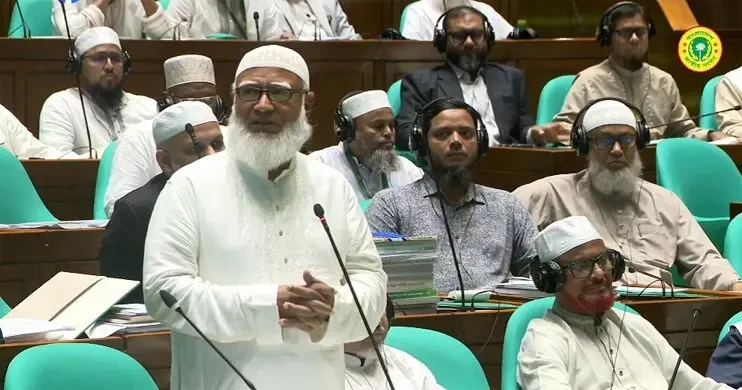
The Opposition in Parliament on Monday proposed forming a high-level cell to find a lasting solution to the country's ongoing power and energy crisis, offering to place its technical expert team at the government's disposal to work jointly on the issue.
Leader of the Opposition Dr Shafiqur Rahman made the offer during a nearly 90-minute discussion under Rule 68 in Parliament, where five treasury and opposition MPs took part.
He said the crisis needs a long-term, effective energy cell, and that his party has no objection to the government taking full credit for any resulting solution, as its only interest is in resolving the problem.
Responding on behalf of the government, State Minister for Power, Energy and Mineral Resources Aninda Islam Amit said short -, medium- and long-term plans, branded "We Have a Plan", have been drawn up to tackle the crisis, which he attributed to past policy mistakes, corruption and mismanagement.
He said the government is targeting some relief by next year, further improvement by 2028, and an end to the crisis by 2030.
The state minister did not directly respond to the opposition's proposal but asked that any formal suggestions be submitted to the ministry.
Outlining measures already underway, he said an offshore gas exploration bidding round launched on May 24 will run until November 30, with foreign oil and gas firms being approached directly.
Drilling has begun on 30 of 150 planned gas wells, with a target of adding 2,320 million cubic feet of gas to the national grid by 2031, Amit said.
Against current gas demand of 3,800 million cubic feet, supply stands at only 2,600 million cubic feet, he said, adding that deals for two new floating storage regasification units (FSRUs) have been planned this year along with a further FSRU in the south-west, targeting 2,800 million cubic feet of additional supply by 2030. “Work is also underway on a land-based LNG terminal at Matarbari.”
On power generation, the state minister said Tk 6,000 crore has been allocated to raise output from furnace oil-based plants to a maximum of 4,000 megawatts, while a 660MW unit at the closed Rampal plant was expected to resume soon.
He also pointed to renewable energy incentives, including a 1 percent duty concession on rooftop solar installation and a buy-back rate of Tk 10.55 per unit for surplus power, alongside plans for a 70MW solar and windmill project in Matarbari.
Amit said the Middle East crisis has pushed spot-market LNG costs up by around Tk 15,350 crore, and waiving meter rent entirely will cost the exchequer Tk 29,000 crore.
Shafiqur Rahman, however, said none of the government's proposed fixes addressed the "ghost billing" problem and accused successive administrations, including the current one, of failing to ensure transparency and accountability.
He said rural areas often go without electricity for 12 to 14 hours a day and cited his own experience during a recent long march, when power was available only intermittently.
The opposition leader also referenced the escape of former Inspector General of Police Benazir Ahmed from custody in the United Arab Emirates as evidence of weak accountability.
Home Minister Salahuddin Ahmed said the crisis has been compounded by the Gulf conflict and blamed the previous Awami League government for building single-source, gas-dependent power plants to benefit favoured business groups without adequate exploration.
He said a new 620MW coal-based plant has been planned at Barapukuria and defended the continuation of the Adani power deal, warning that scrapping it abruptly could trigger international arbitration and the loss of 1,600MW of supply.
State Minister for Planning Zonayed Abdur Rahim Saki and Jamaat MP Nazibur Rahman also spoke, with the latter proposing an emergency energy cell under top-level government supervision and calling for an end to what he termed "digital extortion" through meter and demand charges.
Opposition proposes high-level cell to tackle power, energy crisis