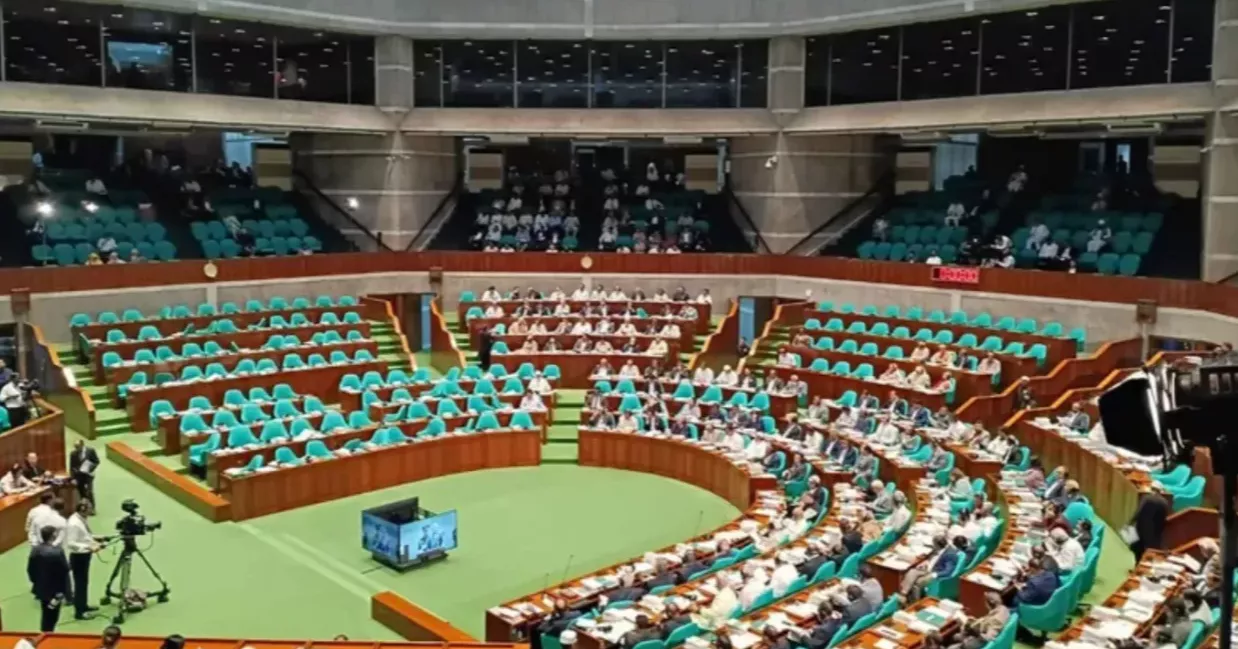
A debate erupted in Parliament on Wednesday night between treasury and opposition bench members over reports submitted by parliamentary standing committees on the National Human Rights Commission Bill and the Enforced Disappearance Prevention and Redress Bill, with the opposition objecting to references to its participation in the committee proceedings.
The relevant parliamentary standing committees submitted reports after scrutinising the two bills as well as the Transfer of Property (Amendment) Bill, with the committee on the Ministry of Law recommending several changes to the Human Rights Commission Bill.
The three bills were introduced separately in Parliament on August 27 and subsequently sent to the respective parliamentary committees for scrutiny.
Opposition members boycotted discussions on the enforced disappearance and human rights commission bills at the committee meetings.
Chairman of the Parliamentary Standing Committee on the Law Ministry Barrister Muhammad Nawshad Zamir placed the committee’s report on the Human Rights Commission Bill in the House.
At one point, opposition MP Nazibur Rahman objected to the motion for placing the report, saying the report contained contradictory references to their participation in the committee’s proceedings.
He said the opposition members explained in detail why they did not participate in the committee discussions and also submitted their views in writing.
However, those explanations were not reflected in the report, while another section said they actively participated in the scrutiny.
Committee Chairman Nawshad Zamir replied that the opposition members made statements before the committee but left the room before the detailed discussion began.
Law, Justice and Parliamentary Affairs Minister M Asaduzzaman said, “Inaction is also action,” arguing that the opposition members expressed their opposition to the bill by leaving the meeting.
Home Minister Salahuddin Ahmed said a walkout from a parliamentary standing committee meeting appeared to be unprecedented. He said if the opposition members submitted their views as a note of dissent, those views could have been included in the report.
Nazibur Rahman replied that “inaction is also action” was a matter for the courts, not Parliament.
He reiterated that they submitted their views in writing and demanded their inclusion in the report.
Opposition Deputy Leader Syed Abdullah Mohammad Taher also said the opposition members submitted their written views and read them out to the committee, and that the views should therefore be reflected in the report.
Salahuddin later told the Speaker that committee reports normally did not contain details of what individual members said during meetings. He suggested that the Speaker could remove the word “actively” from the report.
Deputy Speaker Kayser Kamal said members of both the treasury and opposition benches will have an opportunity to discuss the bill clause by clause before its passage.
Later, Chairman of the Parliamentary Standing Committee on the Home Ministry Zainul Abedin placed the report on the Enforced Disappearance Prevention and Redress Bill.
Jamaat MP Nurul Islam Bulbul, a member of the committee, objected, saying they explained at the committee meeting why they walked out and that the word “actively” used in the report was inappropriate.
The Speaker said the report mentioned the walkout and declared the report placed before the House.
Salahuddin later said the word “actively” was an expression used by the Parliament Secretariat and that the Speaker will decide whether it should remain. He said the opposition could raise its objections when the bill is taken up for passage.
Meanwhile, the Parliamentary Standing Committee on Law Ministry recommended several substantive changes to the National Human Rights Commission Bill.
Under the bill, the commission will be comprised of a chairperson and four commissioners, including at least one woman. The committee has recommended that, in addition to a woman, at least one member of an ethnic minority or disadvantaged community be included.
The committee also recommended including the President of the Jatiya Press Club, or a journalist nominated by him or her with experience in human rights journalism, in the selection committee responsible for recommending appointments to the commission.
Another significant recommendation concerns the commission’s investigative powers.
The bill states that during or after an investigation into an allegation of human rights violations, the commission may question any person and, with the approval of the appropriate authorities, inspect any place, office, court, lock-up or detention centre.
The parliamentary committee recommended deleting the words “with the approval of the appropriate authorities.”
If adopted, the amendment will mean that the commission will not require prior approval from the relevant authorities to inspect such places while conducting an investigation.