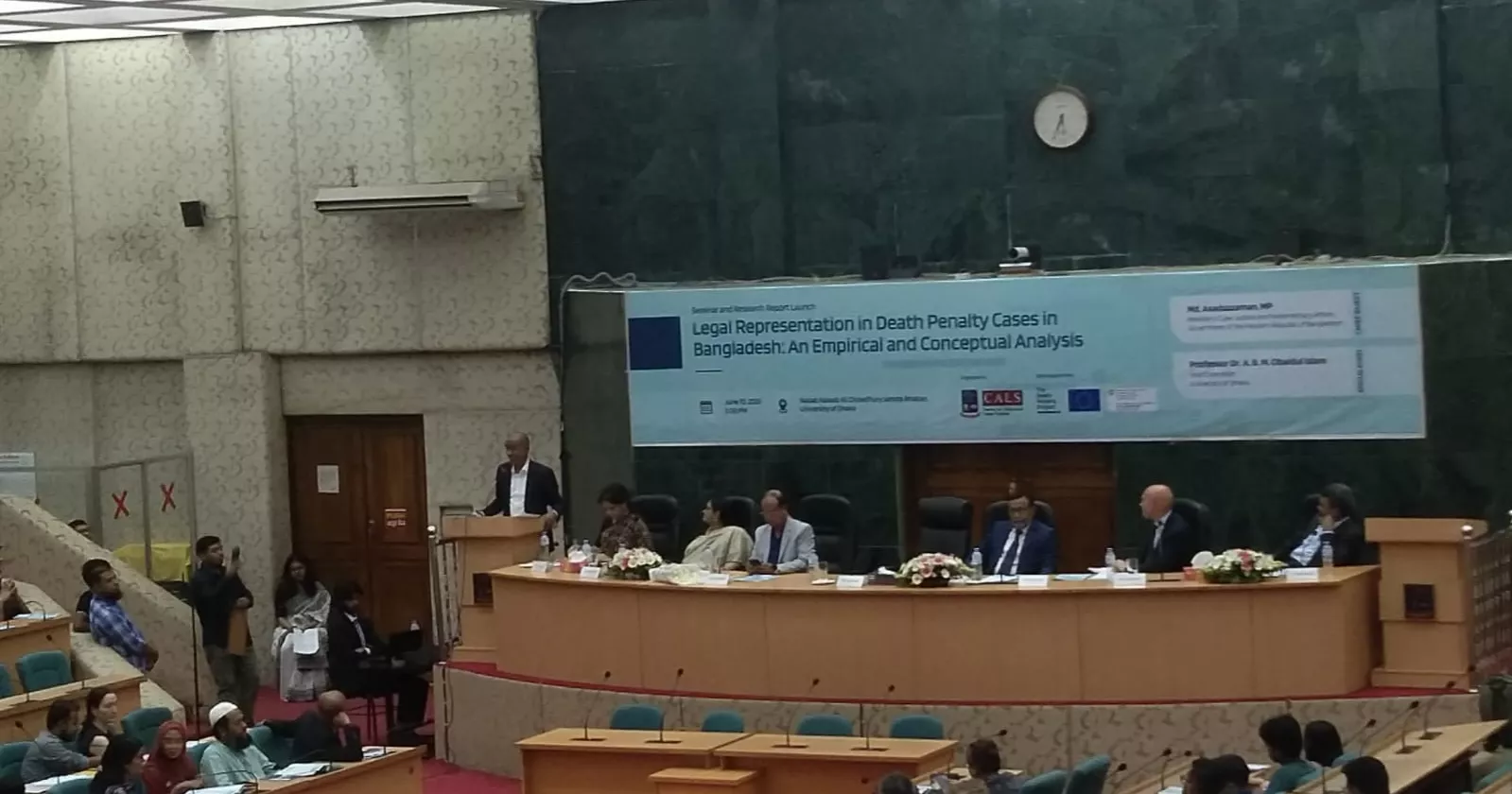
Speaking at a seminar at the nation's premier institute of learning, Law, Justice and Parliamentary Affairs Minister Md. Asaduzzaman spoke of his personal opposition to the death penalty from a human rights perspective, before adding that even so, the Ramisa rape-and-murder case hit him differently.
“Personally, I am against the death penalty," the minister said. "It is part of my campaign in support of human rights. However, when we see the way an eight-year-old child is murdered, in this social reality, if we move to abolish the death penalty right now, it could create a social backlash for us. We have to keep that in mind.”
He made the remarks today at a seminar titled ‘Legal Representation in Death Penalty Cases in Bangladesh: An Empirical and Conceptual Analysis’ held by the Centre for Advanced Legal Studies, Faculty of Law, Dhaka University at Senate Building.
The minister said, “When I see that an eight-year-old child was raped and murdered, and even after that the perpetrator was not satisfied, cutting off the child’s genitals and washing the body with water in an attempt to destroy all evidence, then as a member of this society and as a human being, I also feel why such people need trial.”
Referring to the Ramisa and Asiya murder cases, he said, “When an attempt is made to rape a five-year-old child, and when demands emerge from society for the perpetrators to be hanged, there is often no social, political or legal reality that allows people to stand against those demands. Even moral considerations bow down before such realities. This is the reality we live in.”
Mentioning that the accused in the Ramisa murder case was arrested within seven hours, the minister said, “We treated the case as a top priority and conducted DNA testing within 72 hours. The test report was corroborative. Even then, we could not proceed directly towards the death penalty, because we must uphold the rule of law.”
“On June 1, the court fixed a date for framing charges. Then the issue arose that the accused had not been able to appoint a lawyer. We appointed a state defence lawyer in order to comply with the process of law. The state defence lawyer, for defending the client in this case, had to face humiliation on social media. Everybody was blaming him for taking part in such a trial. But under the general principles of the administration of justice, every accused person has the right to be defended. In the history of Bangladesh, we completed a fair trial in accordance with the law within only six working days.”
Asaduzzaman said, the problem is that when cases reach the High Court Division and the Appellate Division, they often remain pending there for years. The paper books in death penalty cases are not prepared on time because of the backlog. “We are also trying to find a solution to that problem.”
He said, “We can sometimes make popular or populist decisions. But our decisions must be the right decisions. Many times, when we bypass popular decisions and move towards the correct decision, we become victims of yellow journalism.”
The minister said that every accused person has the right to be defended, not only in death penalty cases. “To that end, we have already strengthened the Legal Aid Directorate. We have established Legal Aid Committees in every district of Bangladesh. Under the supervision of the District Judge, these committees will begin functioning under the leadership of a Joint District Judge. We have also incorporated legal aid lawyers into the system.”