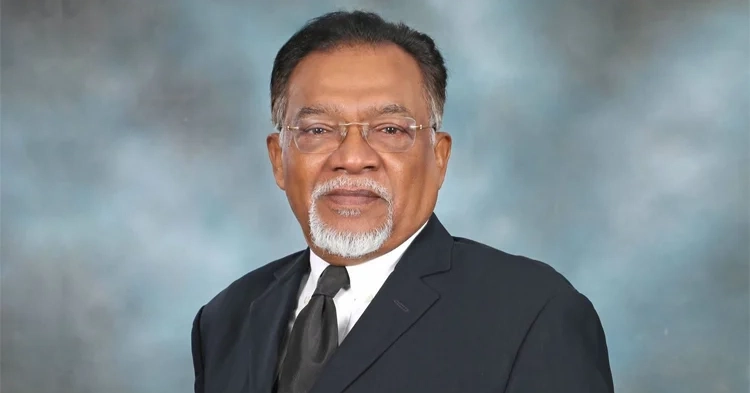
Adviser to the Prime Minister on the Ministry of Public Administration Md Ismail Zabihullah on Monday called for concerted efforts by the government, NGOs, local government institutions, development partners and field administration to achieve the Sustainable Development Goals (SDGs) ahead of the target.
“Cooperation of all stakeholders is essential for making the SDGs successful before the target,” he said while addressing a plenary session titled “Reflection on SDG Localization and SDG Village Piloting Programme” at the Bangladesh-China Friendship Conference Centre (BCFCC) here.
Dr Monzur Hossain, Member (Secretary) of the General Economics Division (GED), moderated the session.
Representatives of the Bangladesh Bureau of Statistics (BBS), GED and UNDP made presentations on SDG localisation, data management, the three SDG pilot village programme and lessons learned from two selected villages.
Professor Dr S M Abdul-Awal, Principal Coordinator (SDG Affairs) at the Prime Minister’s Office, also spoke.
Zabihullah said Bangladesh had a strong track record in implementing the Millennium Development Goals (MDGs) and expressed optimism that the country would achieve the SDGs by drawing on its experience, institutional capacity and coordinated efforts.
He said Bangladesh’s development partners had confidence in the country because of its implementation efficiency and repayment capacity.
“We need our development partners, and at the same time they also need to support us. I welcome this mechanism and spirit,” he said, urging government officials to maintain the spirit of cooperation.
Referring to the government’s election manifesto, the adviser said implementation of the SDGs and the political commitments made to the people were closely interconnected.
“If we are implementing the five-year strategic framework for implementation of the SDGs, I would read it as implementation of our election manifesto and the promises we made to the people before the election,” he said.
He said commitments in the election manifesto that fall outside the SDG framework would also have to be implemented as part of the government’s political pledge to the people.
Zabihullah appreciated the initiative to pilot SDG localisation in selected villages, saying the pilot villages could serve as “laboratories” to test whether SDG-oriented development interventions work at the grassroots level before replicating them nationwide.
He also suggested considering the inclusion of a village from an underprivileged char area in the pilot programme to reflect the development challenges faced by disadvantaged communities.
The adviser stressed that development should ultimately be measured by its impact on ordinary people’s daily lives rather than only through large infrastructure projects or economic statistics.
“The real measure of development is written in the everyday lives of ordinary people. This is exactly where the localisation of the SDGs becomes important,” he said.
He said people primarily assess development by whether education for children has become easier, proper treatment is available during illness, farmers receive better prices for their crops, household incomes have increased and families remain safe during disasters.
Zabihullah said SDG localisation should be a bottom-up process, with development policies adapted to the country, society and individual villages.
He urged divisional commissioners, deputy commissioners, upazila-level officials and local government institutions to work closely with NGOs and other stakeholders to ensure successful implementation of the SDGs.
Principal Coordinator on SDG Affairs Dr S M Abdul-Awal stressed the need for long-term, people-oriented policies to address socio-economic challenges and ensure sustainable development.
He said sustained policy initiatives over five to 10 years were necessary to bring lasting changes in areas such as employment, water management and agriculture.
Referring to the government’s Family Card initiative, he said increased demand for essential goods could help expand production and create employment opportunities.
He also highlighted the ongoing canal excavation programme as an example of a long-term development initiative.
Abdul-Awal recalled that Shaheed President Ziaur Rahman had undertaken canal excavation programmes to support agricultural development, saying continuation of such initiatives could have helped prevent the gradual depletion of groundwater.
He said water levels were declining and shortages were emerging in different parts of the country, particularly in northern Bangladesh.
PM Tarique inaugurates three pilot SDG villages
“If we can create a large number of natural water reservoirs, we can use the surface water for irrigation, while water recharge can gradually raise the underground water level,” he said.
Lawmakers Dipen Dewan and Md Sadique Reaz, NGO Affairs Bureau Director General Dr Mohammad Zakaria, senior government officials and representatives also participated in the discussions.
Divisional commissioners of Chattogram, Khulna and Rangpur and an additional secretary of the Cabinet Division also took part in the session.
The plenary discussed experiences, challenges and prospects of SDG localisation and the SDG Village Piloting Programme.