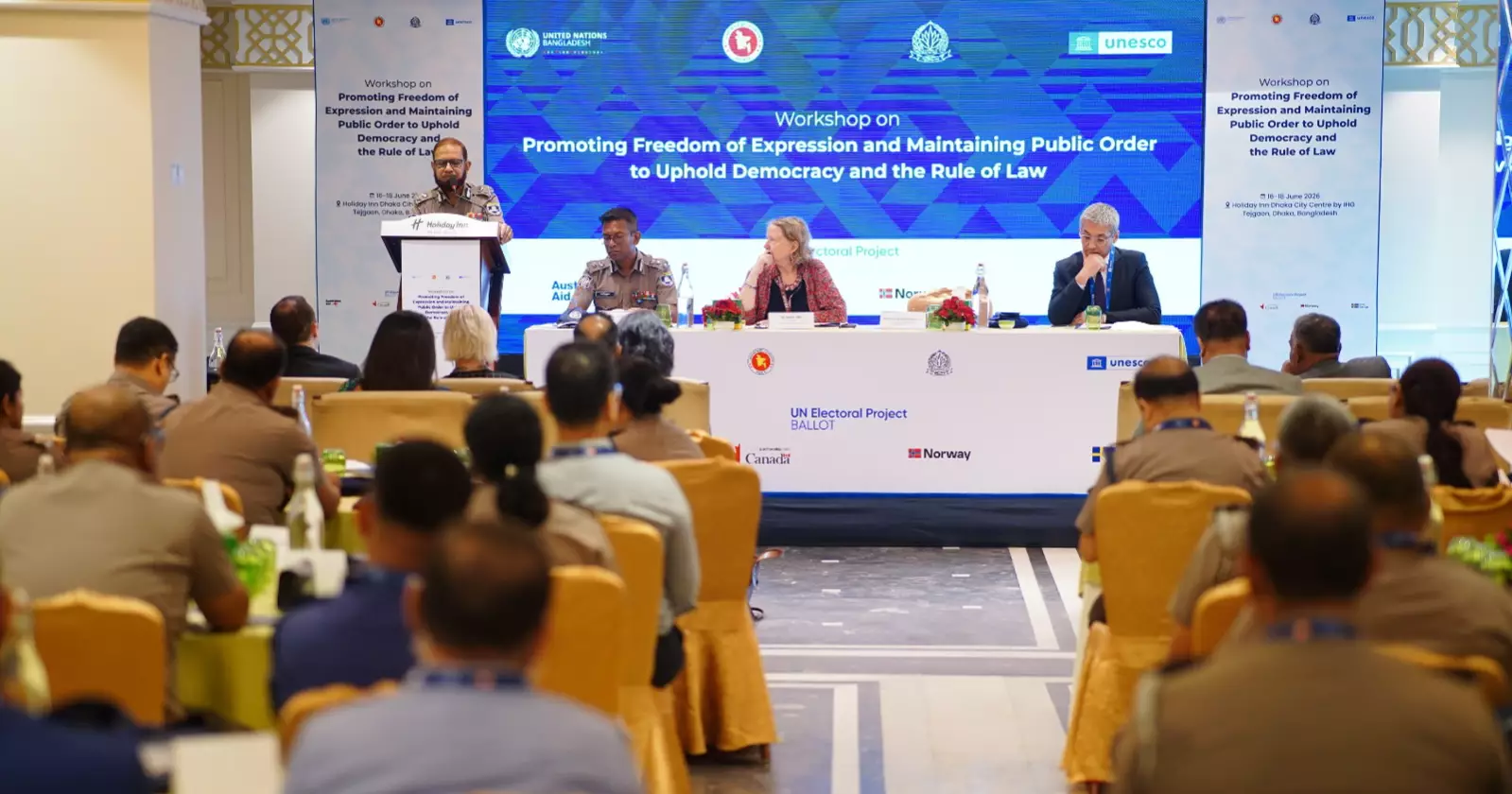
Police officials and journalists from across the country have joined a three-day workshop in Dhaka aimed at strengthening cooperation between law enforcement agencies and the media while promoting freedom of expression, journalist safety and public order.
Titled “Promoting Freedom of Expression and Maintaining Public Order to Uphold Democracy and the Rule of Law,” the workshop began on Tuesday at a city hotel under the UN Electoral Assistance Project BALLOT.
The programme is being organised by UNESCO in association with Bangladesh Police Headquarters.
A total of 27 police officials and 16 journalists are participating in the June 16–18 workshop, which seeks to enhance professional cooperation between law enforcement personnel and media practitioners while promoting freedom of expression and effective public order management.
Addressing the opening session, Khandokar Rafiqul Islam, BPM, PPM, Additional Inspector General of Police (HRM), Bangladesh Police Headquarters, highlighted the complementary roles of police and the media in society.
“Freedom of expression and maintaining public order are both fundamental to a democratic society. The challenge is to ensure that these objectives reinforce rather than contradict each other,” he said. “Police and media have different but complementary roles, and both contribute to a safe, stable and prosperous society.”
In her remarks, Dr. Susan Vize, Head of Office and UNESCO Representative to Bangladesh, emphasised the importance of constructive engagement between law enforcement agencies and media professionals. “Strong institutions and strong media ecosystems should not be adversaries. They are partners in supporting citizens and promoting freedom of expression and the rule of law,” she said. “This workshop provides an opportunity for police and media professionals to strengthen communication, build trust and work together more effectively.”
The session was moderated by Mohammad Saiful Islam, Additional DIG (Training-1), Bangladesh Police Headquarters, who welcomed the participants and guests and highlighted the significance of the workshop in strengthening democratic institutions, human rights and accountable governance.
The first day of the workshop focuses on the fundamentals of freedom of expression, journalist safety and police-media relations, including international standards on freedom of expression, the role of law enforcement in protecting journalists and approaches to strengthening cooperation between security forces and media professionals.
On the second day, journalists will join the workshop for joint discussions with police officials on lived experiences, communication challenges and professional engagement. Participants will also take part in practical exercises on media relations, crisis communication, information integrity, social media engagement and interactions between law enforcement agencies and the press during public events.
The final day will focus on strengthening cooperation between police and journalists during situations that may affect public order. Through scenario-based exercises and group discussions, participants will explore ways to balance freedom of expression and public safety, enhance the protection of journalists, including women journalists and identify practical recommendations for improving police-media relations in Bangladesh.
The workshop is expected to generate practical recommendations for strengthening cooperation between law enforcement agencies and media professionals while promoting freedom of expression, access to information and the safety of journalists.
Since 2013, UNESCO has worked with law enforcement agencies worldwide to strengthen protection for freedom of expression, access to information and the safety of journalists. Through its training programmes and partnerships, UNESCO and its partners have engaged more than 13,000 law enforcement officers on issues related to freedom of expression, journalist safety and professional police-media relations.