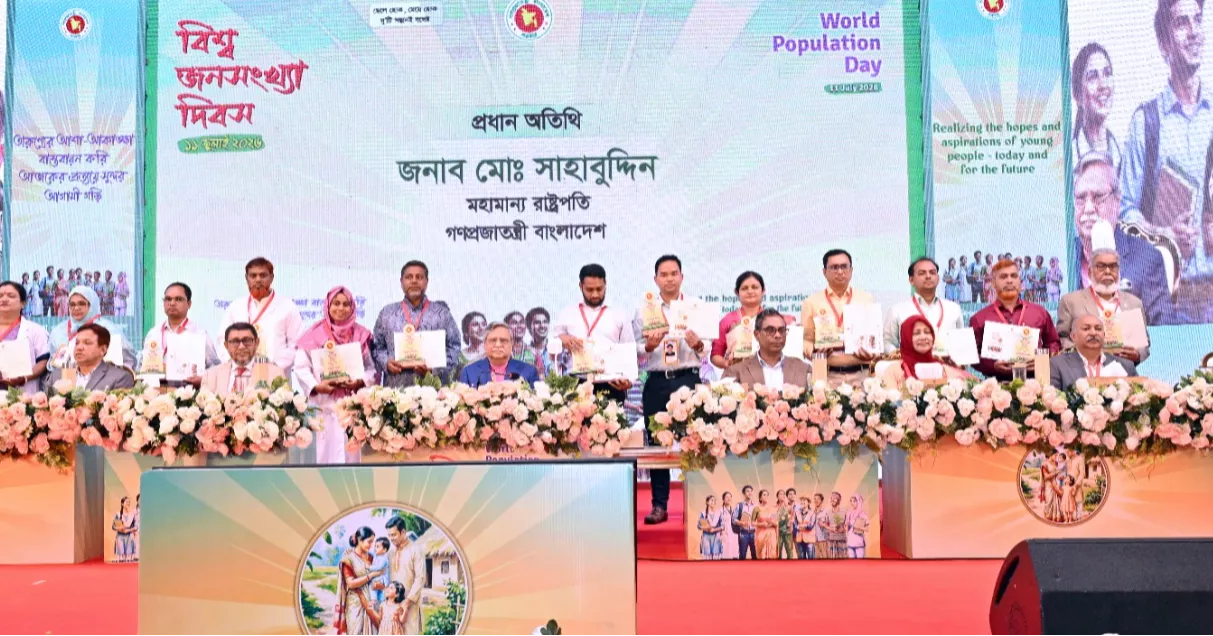
President Mohammed Shahabuddin on Sunday called for greater investment in education, healthcare, skills development and employment generation to transform Bangladesh's large youth population into productive human resources while stressing the need to bring down the country's fertility rate for long-term population stability.
Addressing a programme marking World Population Day 2026 at the Osmani Memorial Auditorium, the President said the true strength of a nation lies not in the size of its population but in the quality of its human resources, including education, health, skills, employment and productivity.
Describing Bangladesh's demographic dividend as a time-bound opportunity, he said a planned and skilled population is a nation's greatest asset, while an unplanned and unskilled population creates significant challenges.
Referring to this year's World Population Day theme, "Realising the Aspirations of Youth: Building a Better Tomorrow through Today's Commitment," Shahabuddin said the country's policies and development programmes must reflect the aspirations of its young people.
He noted that nearly one-third of Bangladesh's population is young, describing it as the country's greatest opportunity to reap the demographic dividend.
Drawing examples from Japan, South Korea, Singapore and China, the President said those countries have achieved remarkable economic progress by effectively utilising their demographic advantage.
He stressed the need to equip young people with quality education, science, technology, engineering and mathematics (STEM) knowledge, technical and vocational skills, innovation capacity and life skills to remain competitive in both domestic and global labour markets.
Highlighting Bangladesh's achievements in family planning, maternal health, child survival and public health, Shahabuddin said the country has made notable progress in reducing population growth but still faces several major challenges.
Despite a decline in the population growth rate, Bangladesh's total population continues to increase because of its large population base, with a significant number of children being born every year, he said.
The President said the country's Total Fertility Rate (TFR) has remained at around 2.3 over the past one and a half decades, stressing that bringing it closer to the replacement level of 2.0 and sustaining it there is essential for achieving long-term population stability.
He also noted that birth rates remain comparatively higher among less-educated and disadvantaged families, underscoring the need to revamp family planning programmes to improve outreach and ensure wider access to reproductive health services.
The President identified stabilising the fertility rate, reducing birth rates among disadvantaged communities, preventing child marriage, increasing the average age of marriage and ensuring education and healthcare for adolescents as key national priorities.
He underscored the importance of strengthening healthcare services and expanding quality family planning services, particularly in remote and underserved areas.
Warning of the consequences of failing to invest in young people, Shahabuddin said unemployment and a lack of skills among a growing population could place additional pressure on education, healthcare, housing, the labour market, the environment and public services.
He said the government remains committed to ensuring healthcare as a fundamental right and implementing the vision of "Health for All", alongside the goal of preventing deaths due to lack of treatment.
The President called for coordinated efforts involving the government, private sector, development partners, voluntary organisations, educational institutions, the media and the public to transform the country's population into productive human capital.
Congratulating the recipients of the national awards for outstanding contributions to population and family planning services, he said their dedication and professionalism will inspire others to serve the nation.
Paying tribute to past initiatives, Shahabuddin said the foundation of Bangladesh's journey in population control, family planning and human resource development after independence was laid by Shaheed President Ziaur Rahman.
He said one of the key components of Ziaur Rahman's 19-point programme for socio-economic emancipation was preventing a population explosion. Under his leadership, the National Population Council was formed in 1976 and a national population policy was formulated.
He said Ziaur Rahman also introduced extensive programmes, including taking family planning services to people's doorsteps, to address the country's population challenges.
The President said former Prime Minister Begum Khaleda Zia later attached special priority to family planning programmes to maximise the benefits of the demographic dividend.
According to him, her government expanded family welfare programmes among all sections of society, including slum dwellers and low-income communities, and launched initiatives to increase girls' participation in education, contributing to lower child marriage rates, greater awareness among women, increased female employment and wider acceptance of family planning.
Shahabuddin also praised the government initiatives to prepare a healthy population by taking the health services to the people doorsteps. "I warmly welcome the decision of the government to install the dialysis facilities at the upazila-level health complexes,” he said.
Earlier, the President handed over crests and certificates to the institutions and people who contributed to the health sector.
Health and Family Welfare Minister Sardar Md Sakhawat Husain, State Minister Dr MA Muhit and UNFPA Bangladesh Representative Catherine Breen Kamkong also spoke at the event with Health Services Division Secretary Md Quamruzzaman Chowdhury in the chair.