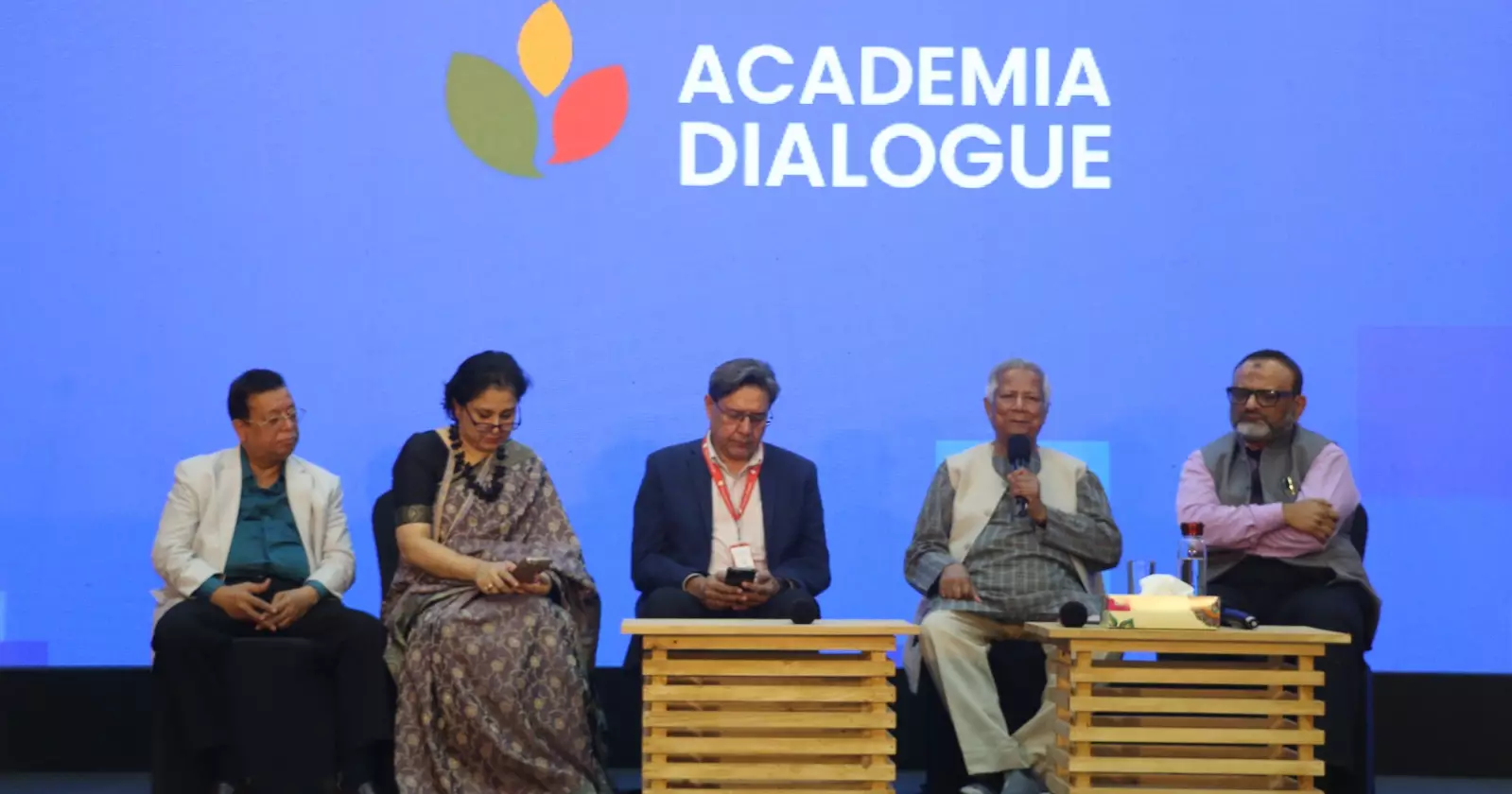
Nobel Peace Prize laureate Prof Muhammad Yunus has urged universities to make social business an integral part of education, research and innovation.
Academic leaders, researchers and social business practitioners gathered on Monday at the Telecom Building in Mirpur for Academia Dialogue 2026, a flagship session of Social Business Day exploring how universities can embed social business more deeply into curricula and institutional practice.
Prof Yunus delivered both the opening and closing remarks at Academia Dialogue 2026.
The dialogue, held in two panel sessions followed by closing remarks, brought together representatives of the global Yunus Social Business Centre (YSBC) network alongside scholars from Bangladesh, Japan, Taiwan, Mexico, Italy, Spain and Thailand.
The first panel, moderated by Dr Farhana Ferdousi of Southeast University, examined how universities can move social business from the margins of business schools into the mainstream of academic life.
Prof Muhammad Ibrahim of Grameen University argued that institutions must reorient around value-creating entrepreneurship rather than treating it as the preserve of a single faculty, proposing a dedicated "Master of Entrepreneurial Arts" in place of a conventional MBA.
Prof Dr Abdur Rab of IUBAT called for at least three core courses on social business within entrepreneurship programmes, noting that while microfinance has already transformed lives across Bangladesh, academia's task is now to help make socially driven business models explicitly profitable and build broader public confidence in the concept.
Prof Dr Rafiuddin Ahmed of North South University pointed to the democratizing effect of platforms such as Canva, Udemy and edX in connecting students directly to world-class instruction and income opportunities, arguing that entrepreneurship education should begin as early as age 10.
He warned that universities slow to adapt risk irrelevance, citing an estimated four million Bangladeshi master's degree holders who remain unemployed even as informal, home-based ventures continue to thrive.
Alex Counts of the Grameen Foundation reflected on how academic-nonprofit partnerships create space to ask deeper questions about the societal value of new services, while Santos Judith Martinez Ramos of Universidad Autónoma de Baja California framed international collaboration as a genuine exchange of knowledge, with university laboratories in both Mexico and Bangladesh positioned to tackle community challenges and climate change together.
The second panel, moderated by Dr Ashir Ahmed of Kyushu University, Japan, focused on the global YSBC network. Dr Ahmed announced that the network now comprises 116 centres worldwide, with the 117th to be established at Grameen University.
Dr Yusnidah Ibrahim of Albukhary International University described efforts to formalize social business studies through a dedicated curriculum and an international research paper network.
Prof Chien-wen Mark Shen of National Central University, Taiwan, called on city governments to fund local social businesses through microloan models and stressed that ESG metrics and certification will become central to how YSBCs demonstrate their value over the next decade.
Prof Naoko Oishi of Ryukoku University, Japan, shared how community demand led to the creation of a Social Business Exposure Program for younger learners, pointing to Grameen Euglena as a model of cross-sector collaboration.
Prof Giuseppe Torluccio of the University of Bologna and Prof Alicia María Rubio Bañón of the University of Murcia discussed the role of artificial intelligence and new institutional competencies in reshaping how universities teach and measure social impact.
Prof Dra Ana Fernández Laviada of the University of Cantabria highlighted an ongoing global initiative to build comprehensive data on social business outcomes - virtually nonexistent before 2015 - as essential to demonstrating the network's collective impact.
The discussion also turned to leadership development, with Alex Counts arguing that leaders are made rather than born through faculty members who coach students to learn from failure instead of merely complaining about it.
In his closing remarks, Dr Faiz Shah of AIT/Yunus Thailand likened academic training to teaching someone to ride a bicycle: necessary, but no guarantee of resilience when conditions become volatile.
He called on universities to better integrate real-world experience with industry knowledge and metrics-driven publishing, while acknowledging that funding for innovation must be actively pursued rather than expected to materialize on its own.
Prof Niaz Ahmed Khan of Grameen University underscored the need for continuous faculty development, localized contextualization in Bangladesh and stronger peer-to-peer support across the YSBC network as the foundation for community outreach.
Lamiya Morshed, Executive Director of the Yunus Centre, said the network's efforts will continue to expand, with the next global YSBC gathering scheduled for October 2026.
She also announced plans to establish a dedicated venture team to carry forward the initiatives discussed at this year's dialogue.