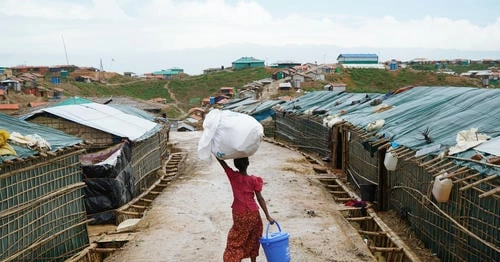
At least 15 Rohingya refugees, mostly children, have died and over 26,000 others have been affected as relentless monsoon rains triggered landslides, flash floods and wind-storms across the refugee camps in Cox's Bazar over the past five days, according to the Rohingya Coordination Platform (RCP).
The Inter-Sector Flash Situation Update, released on Thursday, said a cumulative 286 weather-related incidents were recorded between July 4 and July 9, affecting 26,119 individuals from 5,518 households. The toll includes 18 injured and 4,307 people temporarily displaced.
The deaths include two children who drowned on July 5 in Kutupalong Registered Camp and Camp 4 Extension, eight people killed in landslides on July 6 across Camps 7, 11 and 15, mostly children, and five more children killed in a major landslide in Block A-3 of Camp 5 on July 8.
According to the Camp-in-Charge (CiC) report, the Camp 5 landslide struck around 2:10 pm, killing five refugees and leaving eight others hospitalised.
The severe weather has partially damaged 2,809 shelters and completely destroyed 13 others, while 742 facilities, including 37 learning centres, 163 latrines and four mosques and 974 infrastructure components such as retaining walls, pathways and bridges have sustained damage, the report said.
Camp 10 recorded the highest number of affected individuals (3,818), followed by Camp 12 (2,472) and Camp 1W (1,952), while Camp 6 saw the largest displacement with 1,085 people forced from their homes.
The Bangladesh Meteorological Department (BMD) said rainfall in Cox's Bazar ranged between 69mm and 240mm daily through the week and forecast heavy to very heavy rain to persist until July 11. A special BMD warning has projected a further 200-500mm of cumulative rainfall between July 9 and 11, keeping landslide risk high in Teknaf, Ukhiya and Cox's Bazar Sadar.
The Needs Assessment Working Group has identified Cox's Bazar as among Bangladesh's highest-risk districts for flash flooding, with an estimated 504,500 people across eight upazilas and 74 unions, including the refugee camps, exposed to the threat as upstream flows from northeastern India add to saturated ground conditions.
Humanitarian agencies, working with the Refugee Relief and Repatriation Commissioner (RRRC), Fire Service and Civil Defence, and the Armed Police Battalion, have stepped up emergency operations across shelter, health, nutrition, education, food security, WASH and protection sectors.
The Shelter-CCCM sector, led by IOM and UNHCR, said 1,169 households were affected as of the latest reporting, with 266 households relocated to safer ground and 327 households temporarily displaced. Nearly 1,000 shelters have been hit, along with 111 slope protection structures and dozens of pathways, stairways and bridges.
The WHO-led Health Sector said all 13 medical hubs, 17 mobile medical teams and its 33-ambulance referral network remained fully operational despite the disruption, with no interruption to essential health services.
On Bhasan Char, continuous rainfall has disabled solar streetlights due to prolonged cloud cover, and authorities reported a rise in theft linked to the resulting nighttime outages, though no movement restrictions or major disruptions have been recorded.
The RCP warned that funding gaps are constraining the emergency response, with the Shelter-CCCM Sector's overall appeal only 42 percent funded, leaving a US$73.9 million shortfall. Its Access & Safety and Disaster Risk Management component is just 40 percent funded, with a US$23.2 million gap against a US$38.8 million requirement.
Humanitarian partners have called for urgent additional funding to scale up slope stabilisation, drainage management and access improvements, and reiterated the need for more camp space to enable safer relocation from high-risk areas.
END/UNB/MM/ssk