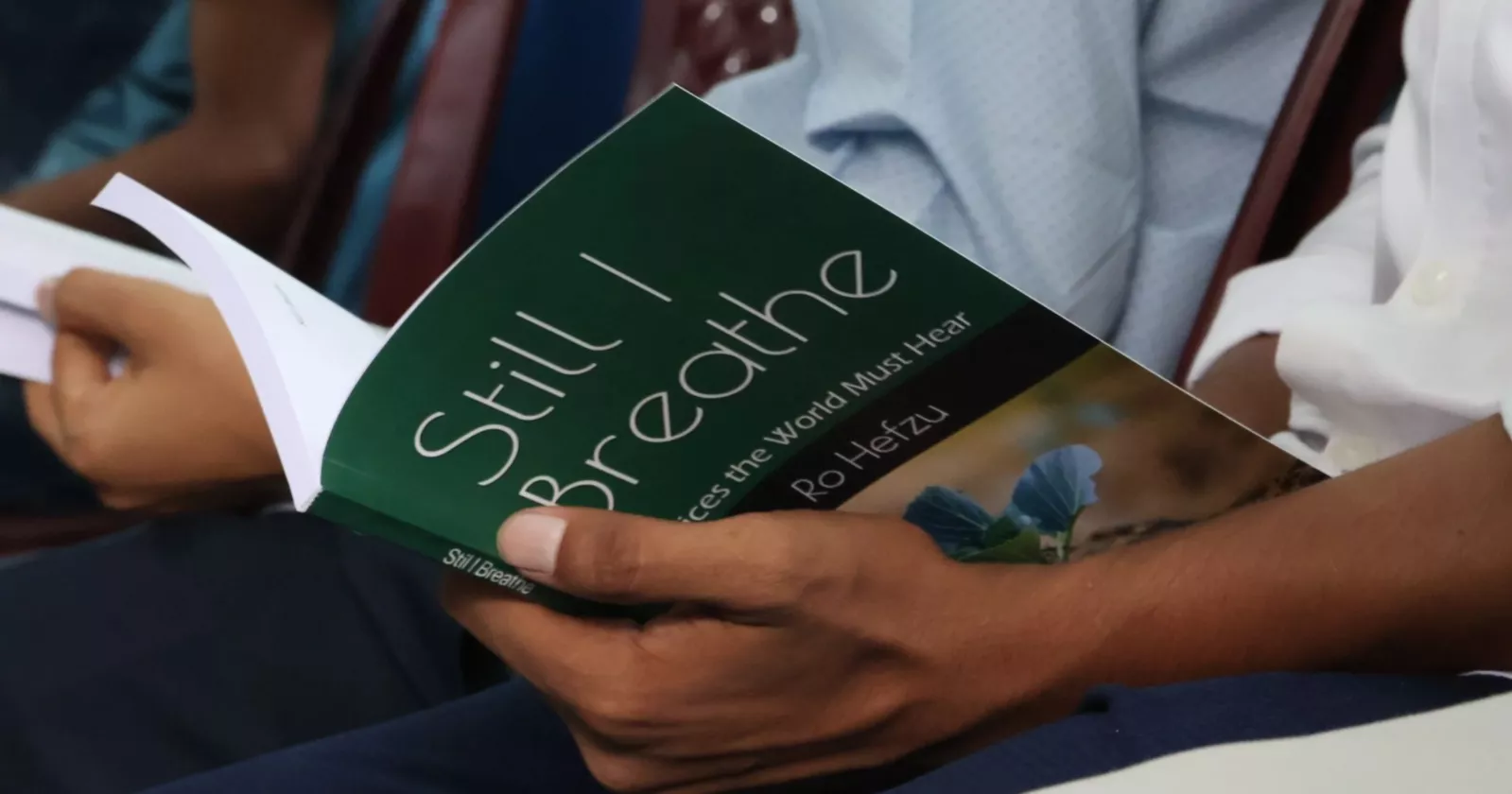
A 22-year-old Rohingya poet and teacher living in Bangladesh’s vast refugee camps has published his debut poetry collection, offering a poignant look at displacement, memory, and everyday life for a generation growing up with few opportunities to leave the camps or pursue higher education.
Ro Hefzu’s Still I Breathe: Voices the World Must Hear, a 148-page collection published earlier this year, was officially launched at a literary gathering in Cox’s Bazar on August 14, backed by PEN International and its Young Writers Committee.
Originally from Kyaung Taung village in Myanmar’s Buthidaung Township, Rakhine State, Hefzu now resides in the refugee settlements of southeastern Bangladesh, where he teaches local Rohingya children and youth. While his poems touch on exile and persecution, they also celebrate friendship, love, education, cultural festivals, and efforts to preserve the Rohingya language.
The collection was brought to light with support from researcher Dr Ronan Lee through Rohingya Futures, a project dedicated to publishing works by Rohingya authors.
Hefzu previously connected with the Tomorrow Club, a platform associated with PEN International that spotlights emerging young writers and creative witnesses worldwide, which later featured his poetry and a personal interview.
After the book was published, Hefzu reached out to PEN International because he couldn't afford copies for friends and community members in the camps. PEN stepped in to sponsor the Cox’s Bazar launch event, where physical copies were printed and distributed with help from Rohingya writer Mayyu Ali.
Ege Dündar, a writer, activist, and the youngest member elected to PEN International’s board, addressed the gathering remotely.
Dündar, who leads the revived Tomorrow Club—a platform uniting young voices writing through conflict, displacement, and repression—highlighted creative writing as a powerful way for young people to connect across borders.
“By writing, you resist cultural erasure,” Dündar told Hefzu during the event, emphasizing that literature can serve both as storytelling and a means to sustain community.
Redwan Ahmed, a Bangladeshi journalist and Tomorrow Club collaborator working with young Rohingya writers, noted that Hefzu’s milestone is especially meaningful given how rarely Rohingya refugees get to share their own narratives directly.
“For years, much of the world has encountered the Rohingya through the language of crisis — refugees, camps, persecution, aid,” Ahmed said. “What writers like Hefzu remind us is that behind those words are people with memories, humour, love, ambition and stories of their own. Publishing a book from inside a refugee camp is not just a literary achievement. It is a way of saying: we are still here, and we can speak for ourselves.”
Hefzu belongs to a generation shaped by one of the world’s most protracted refugee crises.
Over 750,000 Rohingya fled Myanmar for Bangladesh following a military crackdown in Rakhine State that began in August 2017, joining earlier waves of displaced families. citeturn600391search0
That population has continued to grow. Records from the Government of Bangladesh and UNHCR logged roughly 1.2 million Rohingya refugees in Bangladesh by late June 2026, with over 1.16 million residing in Cox’s Bazar.
For young Rohingya, displacement has meant years of interrupted schooling and slim prospects outside the camps. UNICEF estimated in early 2026 that more than 235,000 refugee children aged five to 17 were out of school, despite learning programs run by aid agencies and local teachers. citeturn359063search2
Older students face particularly steep hurdles.
UNHCR has repeatedly highlighted the lack of recognised pathways for young Rohingya to transition from camp learning to formal higher education. Hefzu has managed to pursue online studies and is currently an undergraduate business administration student at the University of the People.