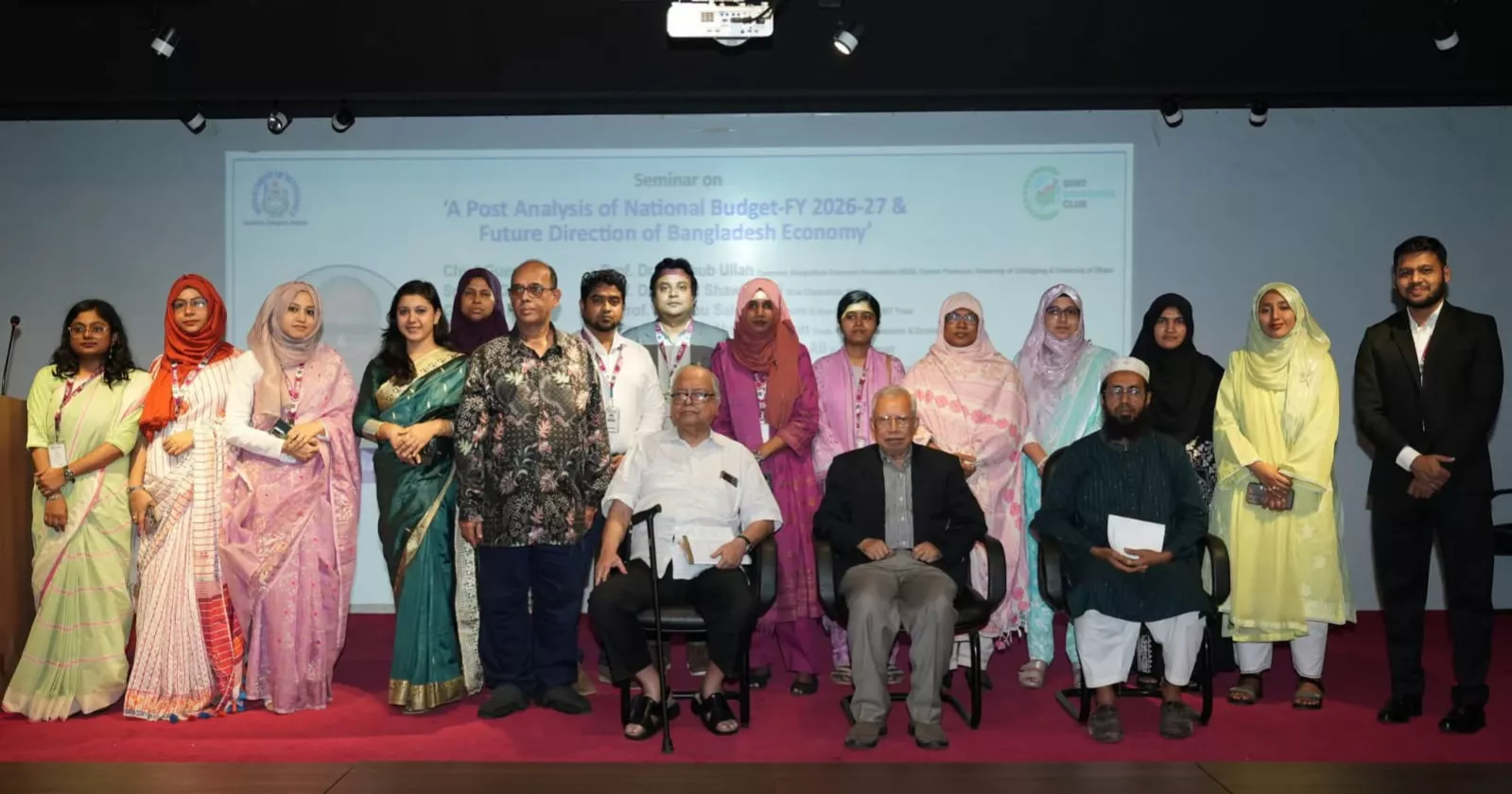
Economists and academics on Wednesday stressed that the success of the FY2026-27 national budget will depend on effective implementation, stronger institutions and preparing the country’s workforce with advanced technological skills.
The seminar, titled ‘A Post Analysis of National Budget-FY 2026-27 & Future Direction of Bangladesh Economy’, was organised by the BUBT Economics Club at the university’s International Conference Hall.
Speaking as the chief guest, National Professor Dr Mahbub Ullah said Bangladesh should now focus on strengthening domestic value addition instead of relying heavily on external financing after five decades of development.
He emphasised the importance of identifying investable capital to support economic growth and said the country’s ready-made garment sector must improve sustainability and adopt advanced technologies to remain globally competitive.
“The country must ensure that export earnings contribute to building domestic economic strength,” he said.
Prof Dr Syed Masud Husain, Dean of the Faculty of Business and Economics at BUBT, said post-budget analysis is essential for evaluating policy priorities and guiding the country’s long-term development.
Presenting the keynote paper, Prof Dr Muhammad Mahboob Ali of the Department of Economics analysed the FY2026-27 budget, highlighting the importance of effective implementation of the Annual Development Programme (ADP) and maintaining quality standards in development projects.
He said electricity distribution should remain under the existing public system but be managed transparently and free from corruption.
Referring to current economic challenges, Prof Ali pointed to inflationary pressure, revenue shortfalls and sluggish private investment, while noting that the budget places emphasis on human capital development and social protection.
He also called for compulsory technology education across all university disciplines, proposing the inclusion of artificial intelligence, the Internet of Things (IoT), blockchain and deep learning in undergraduate curricula to equip graduates with skills needed in the post-Least Developed Country (LDC) graduation era.
The session was chaired by Prof Dr Md Mahmudul Hassan, Chairman of the Department of Economics at BUBT, who said such academic discussions contribute to informed policymaking and the country’s long-term economic development.
Other speakers included Tareq Imam Zahid, Assistant Professor of Economics; Md Rakibul Islam, Assistant Professor of Economics; and Prof Dr Munshi Mahbubur Rahman, Dean of the Faculty of Sciences and Engineering.
Participants agreed that although the FY2026-27 budget presents a positive vision, its success will ultimately depend on efficient execution, stronger institutional capacity and creating employment opportunities for the country’s growing youth population.