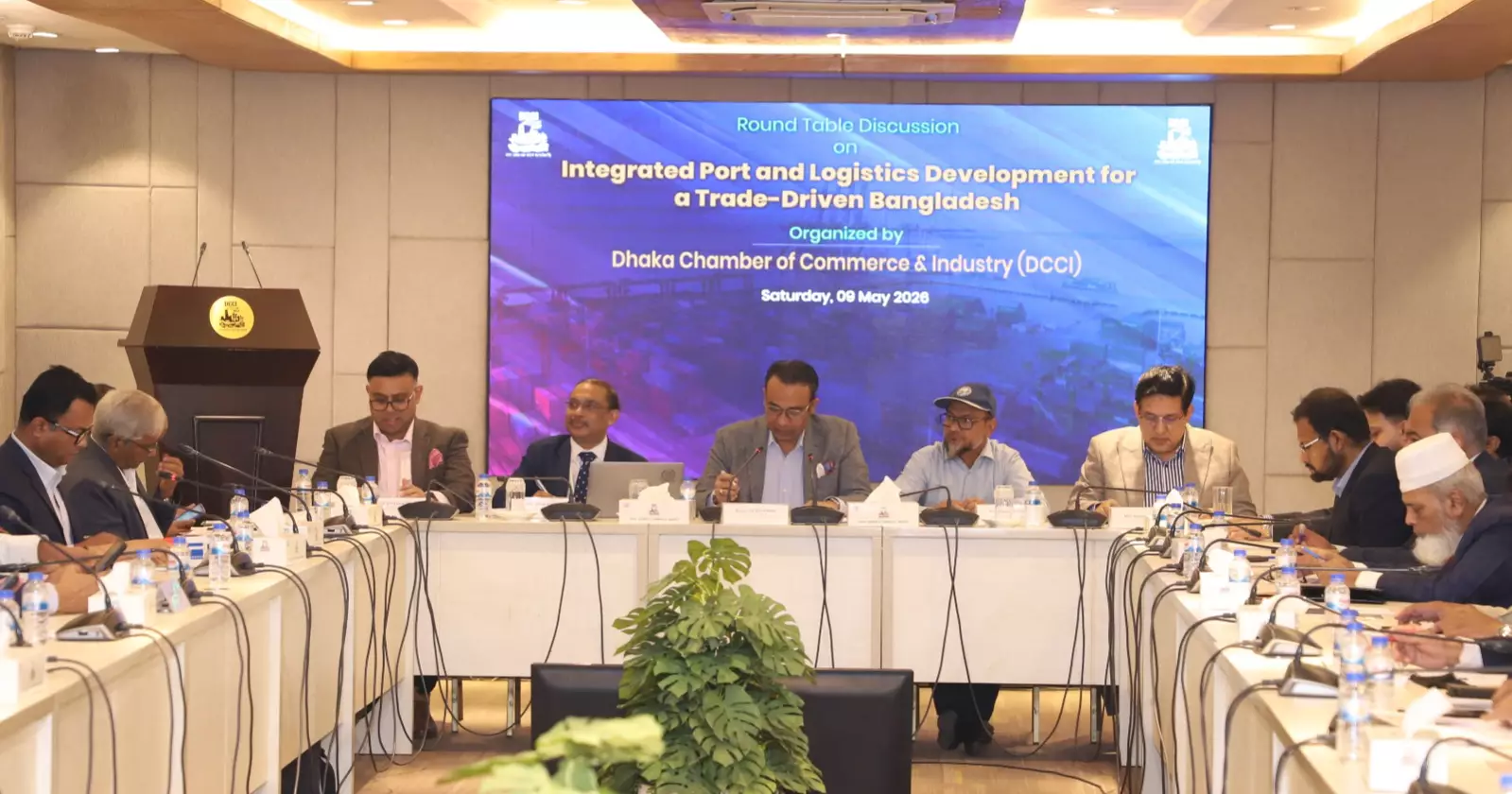
Industry leaders, policymakers and development partners on Saturday stressed the urgent need for structural reforms, railway-port connectivity and private sector involvement in port operations to overhaul Bangladesh's costly and fragmented logistics system.
The call came at a roundtable titled ‘Integrated Port and Logistics Development for a Trade-Driven Bangladesh,’ organised by the Dhaka Chamber of Commerce and Industry (DCCI) at its auditorium in the capital.
In his welcome address, DCCI Senior Vice President Razeev H Chowdhury said Bangladesh's export competitiveness is being severely undermined by infrastructural bottlenecks and poor institutional coordination in the logistics sector, leaving the country behind its regional rivals.
He pointed to lengthy cargo clearance procedures at ports, slow road and rail freight movement, and inadequate cold-chain infrastructure as key drivers of supply chain inefficiency.
He called for paperless automated port systems, PPP-based infrastructure investment and expanded cold-chain capacity to attract both local and foreign investment.
Md. Salim Ullah, Director General of Bangladesh Institute of Management (BIM), who attended as special guest, said the country remains significantly behind in integrated port and logistics management, with the gap continuously pushing up the cost of doing business.
He urged coordinated action among all stakeholders to accelerate sector development.
Md Habibur Rahman, Additional Secretary and former Member (Admin and Planning) of the Chittagong Port Authority, said there is little room left to expand the Dhaka-Chattogram highway and that railway connectivity is the only sustainable long-term solution.
He proposed dedicated rail links to ports for faster, lower-cost cargo movement and recommended allowing the private sector to operate at least one seaport, a move he said would inject competition into a government-dominated sector, raise service standards and potentially bring down tariffs.
Md. Shamsul Hoque, Professor of Civil Engineering at BUET, said development planning in Bangladesh often lacks practical grounding, preventing projects from delivering expected outcomes.
He stressed that communication infrastructure must be integrated rather than built in silos and called for deeper structural reforms within government institutions.
SK Masadul Alam Masud, Managing Director of Shahariar Steel Mills Ltd., flagged the absence of scanning equipment at Pangaon Port as a deterrent for entrepreneurs and said inadequate inland waterway infrastructure is driving up industrial transportation costs.
Nusrat Nahid Babi, Senior Transport Specialist at the World Bank Bangladesh, said customs clearance in Bangladesh has yet to be fully modernised, with digital systems remaining largely unimplemented at land ports, prolonging clearance times and increasing business costs.
Humayun Kabir, Senior Project Officer (Transport) at the Asian Development Bank, said ADB is currently developing the Dhirashram Inland Container Depot and a multimodal logistics hub.
He also underscored the importance of end-to-end digitisation and automation across logistics services.
DCCI Vice President Md. Salem Sulaiman, members of the DCCI Board of Directors and representatives from government and the private sector also attended the event.