In a milestone initiative to preserve Bangladesh's cultural heritage and modernise its labour-intensive handloom industry, the National Skills Development Authority (NSDA) has validated a comprehensive competency standard to develop highly skilled artisans for Tangail Saree weaving.
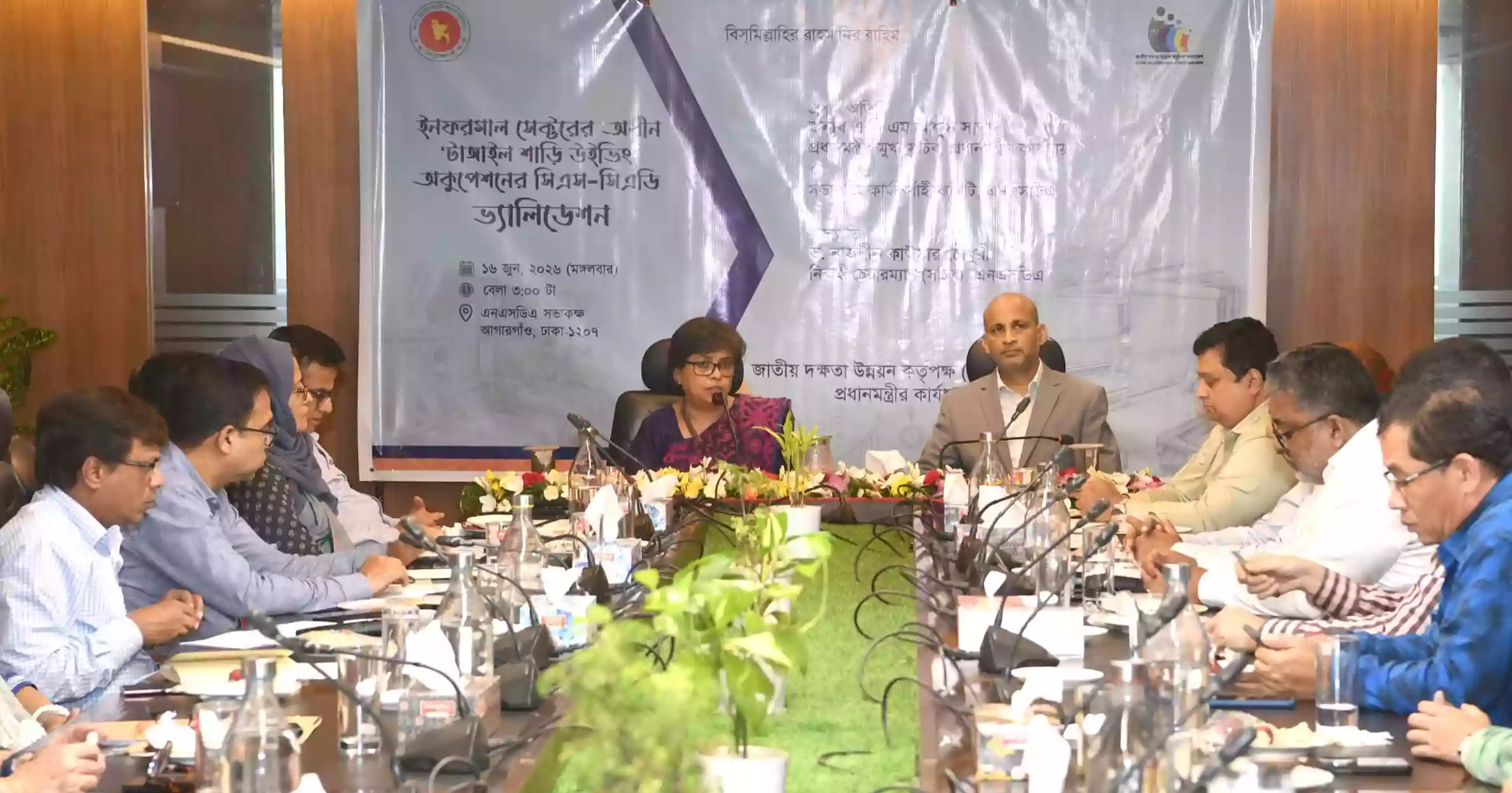
The validation workshop for the 'Tangail Saree Weaving (Level-2)' occupation’s Competency Standard (CS) and Course Accreditation Document (CAD)—developed under the Bangladesh National Qualifications Framework (BNQF)—concluded at the NSDA conference room in the capital on Tuesday.
NSDA Executive Chairman (Secretary) Dr. Nazneen Kawshar Chowdhury presided over the session. Abu Ahmed Siddique, NDC, Chairman (Additional Secretary) of the Bangladesh Handloom Board, and Mirza Nurul Ghani Shovon, Chairman of the Informal Sector Industry Skills Council (ISC), attended the event as special guests.
Addressing the session, Dr. Nazneen Kawshar Chowdhury stated that the NSDA is actively working to bring traditional, informal, and labour-intensive sectors under the umbrella of the national skills framework alongside modern technology-driven professions.
"The newly developed competency standards and course accreditation for Tangail Saree weaving will expand skill development, official recognition, and formal employment opportunities for the workers in this historic sector," she said.
The NSDA chief revealed that over the last 10 months, the authority has developed and reviewed 85 demand-driven competency standards and training curricula across various sectors. This includes structural training frameworks for traditional crafts like Jamdani and Tangail sarees to protect cultural identity and maximize export potential.
Highlighting the global success of the national certification system, Dr. Chowdhury disclosed that according to the NSDA tracking system, workers holding the National Skills Certificate (NSC) have successfully secured employment in 58 countries. Additionally, the framework has facilitated domestic employment for nearly 70,000 certificate holders and helped create over 20,000 new entrepreneurs.
To expand international market reach, she mentioned that the NSDA is initiating Mutual Recognition Agreements (MRAs) and joint certifications with foreign institutions, including Saudi Arabia's Takamol, Japan's Technogram and Nexus Group, and Australia's TAFE.
Furthermore, to cater to global labor market demands, six country-specific competency standards targeting South Korea, the USA, Japan, Singapore, and Saudi Arabia have recently been introduced along with Japanese and English language curricula. The NSDA is also moving toward issuing digitalized certificates featuring QR codes and digital signatures to enhance global acceptability.
Special Guest Abu Ahmed Siddique termed the standardisation a vital milestone for the country's weaving community. He announced that the Bangladesh Handloom Board will soon register its Tangail-based training institute with the NSDA to formally roll out the specialized Tangail Saree weaving courses.
Industry representatives, textile experts, academics, and senior government officials attended the workshop to finalize the curriculum, which analysts believe will significantly scale up productivity, product quality, and the global competitive edge of traditional Bangladeshi apparel.