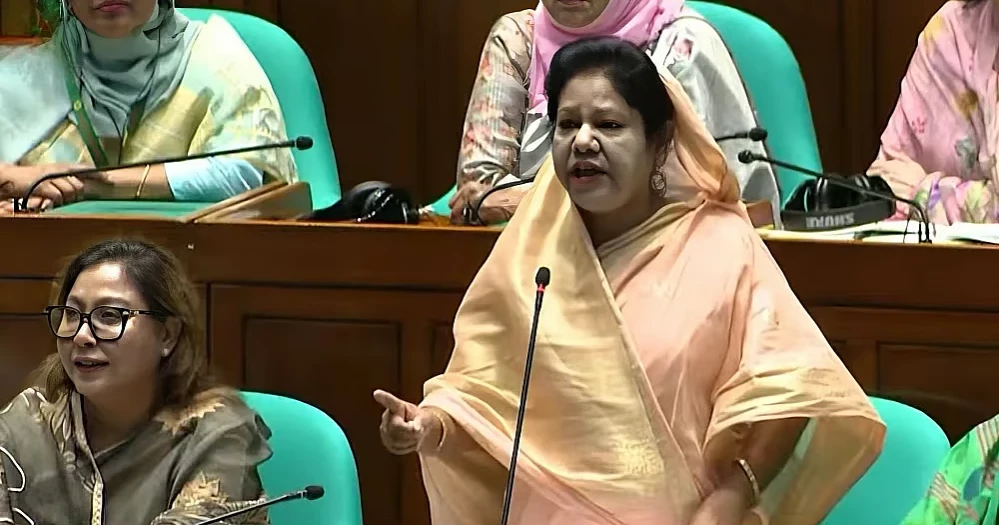
BNP MP Rehana Akter Ranu on Monday urged the government to take immediate steps to ensure that no Bangladeshi citizen is lured into or used in foreign war zones, describing it as an administrative and moral responsibility of-0 the state.
Drawing the attention of the Expatriates’ Welfare Minister to the issue, she demanded the immediate repatriation of Bangladeshis currently trapped in the Russia-Ukraine war.
Ranu raised the issue on Monday under Rule 71 of the Rules of Procedure in Parliament, chaired by Deputy Speaker Kaiser Kamal.
She said a group of Bangladeshis had travelled to Russia after taking high-interest loans and selling their homesteads, lured by false promises of guaranteed jobs and better lives.
Instead of providing the promised employment, the traffickers handed them over to the Russian military, where they were deployed to fight in the Russia-Ukraine war after receiving training, she said.
Citing the deaths of 54 Bangladeshis over the past three years, Ranu said many others had been left disabled. Families were still waiting to receive the bodies of those killed on the battlefield.
She said the families were facing immense suffering, dealing not only with the loss of their loved ones but also with mounting pressure from lenders.
Referring to media reports, the MP said human traffickers were increasingly using modern technologies, including AI-generated deepfakes, social media and cryptocurrency, to deceive and trap people.
To tackle the growing threat, she called for coordinated technological and diplomatic initiatives involving the ministries of Expatriates’ Welfare, Home Affairs and Foreign Affairs.
She also demanded that human traffickers be brought to justice and affected families receive compensation.
Speaking on the same occasion, Chattogram-12 MP Sarwar Jamal Nizam suggested that ministers should take local MPs along when visiting their respective constituencies to strengthen public confidence in the government and the ruling party.
In response, Deputy Speaker Kayser Kamal said complaints had been received that ministers often visited different areas without involving the local MPs.
He said local lawmakers, irrespective of whether they belonged to the ruling party or the opposition, should be included in ministerial visits to their constituencies.
Meanwhile, reserved women’s seat MP Nilofer Chowdhury Moni expressed concern over pollution in the Dhanmondi, Crescent, Gulshan and Banani lakes in the capital.
She said the lakes, once considered the lungs of Dhaka for their role in reducing air pollution, had now become sources of environmental degradation.
The pollution was destroying aquatic biodiversity, causing fish deaths and affecting surrounding trees and wildlife, she said.
Moni also warned that polluted water was creating breeding grounds for mosquitoes and exposing nearby residents to health risks. People visiting the lakes for morning and evening walks were also being forced to breathe unhealthy air.
She alleged that household and industrial waste was being dumped into the lakes, while some factory owners were ignoring instructions to install effluent treatment plants (ETPs).
Calling for urgent action, she stressed the implementation of the WASA master plan and empowering the relevant authorities to tackle the pollution.
Madaripur-3 MP Anisur Rahman called for the early repair of damaged roads in his constituency, saying heavy rainfall had rendered many previously usable roads dilapidated.
He said delays in allocating funds and inviting tenders had slowed down repair work, with tenders issued for only three roads so far.
Warning that hurried tendering towards the end of the fiscal year often compromised construction quality, he urged the Local Government Minister to invite tenders for damaged roads by December and January.
Cumilla-9 MP Md Abul Kalam demanded the prompt release of a Tk 60,000 crore incentive package or low-interest loans on easy terms to reopen closed factories and increase production at operational industrial units.
He said the Finance Ministry had already instructed Bangladesh Bank to facilitate the release of the funds, but the money had yet to reach entrepreneurs despite several meetings involving the central bank, commercial banks and business owners.
Alleging that commercial banks were delaying disbursement on various pretexts, he said some banks were making loan approvals conditional on having good relations with the concerned institutions.
He also alleged that officials appointed during the previous government were still holding influential positions in commercial banks and obstructing the implementation of the Prime Minister’s directives.
Khulna-4 MP SK Azizul Bari proposed a coordinated approach to dengue prevention, stressing the need to focus more on destroying mosquito larvae rather than relying solely on insecticides and fogging.
He said a prevention-focused strategy targeting mosquito breeding sites would be more effective than a treatment-centred approach.
Joypurhat-1 MP Md Fazlur Rahman Saeed alleged discrimination and politicisation in the allocation of funds for the construction, renovation and repair of educational institutions.
He said MPs had submitted demi-official (DO) letters in line with government circulars seeking funds for public educational institutions, but had received little response.
He alleged that ruling party activists were telling educational institutions in some areas that no work would be approved based on recommendations from opposition MPs and that they would have to contact ruling party representatives instead.
He further alleged that extortion had started in some places and that politicisation had spread to government offices and courts, with officials reluctant to work without instructions from ruling party activists.
Saeed urged the government to undertake construction and renovation projects at educational institutions based on DO letters submitted by MPs.
Cumilla-10 MP Md Mobasher Alam Bhuiyan called for accountability in public hospitals, describing healthcare services across urban and rural areas as disappointing.
He said some hospitals lacked doctors, while others had doctors but failed to provide essential medicines.
Although public hospitals had diagnostic facilities, patients often could not access proper services due to a lack of equipment, reagents and trained technologists, he said.
He alleged that diagnostic services were available for only five hours, from 8am to 1pm, leaving patients without access for the remaining 19 hours. As a result, around 75 per cent of patients were compelled to seek services at private diagnostic centres.
Citing data from the Bangladesh Institute of Development Studies (BIDS), Bhuiyan said 6.13 million people fell below the poverty line every year while meeting medical expenses.
He added that around 58 per cent of the population borrowed money to meet healthcare costs, while nearly 30 million people went without treatment because they could not afford it.
He called for improvements in the quality of public healthcare services and stronger accountability across government hospitals.