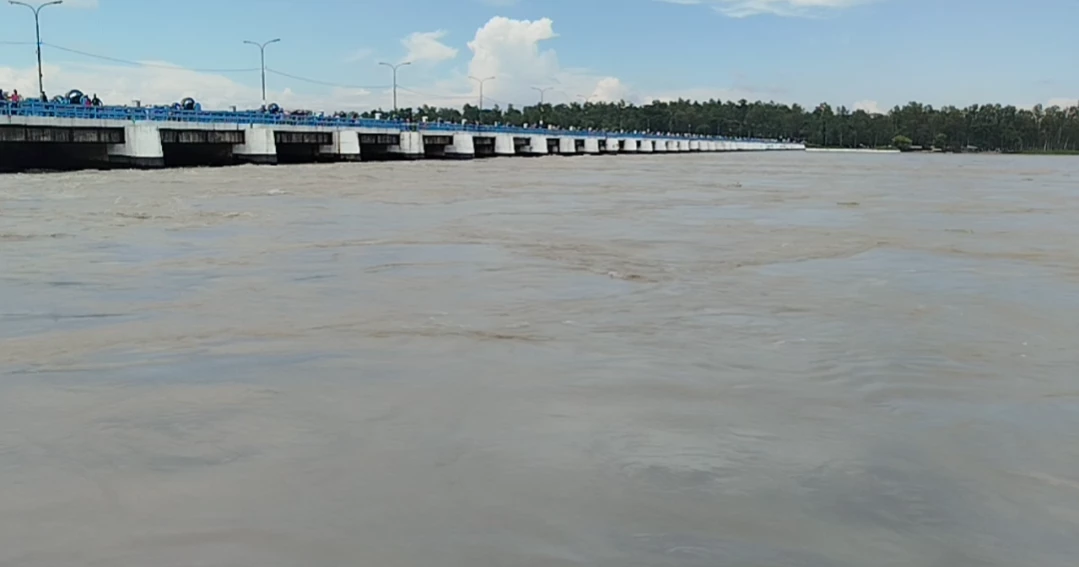
The water level of the Teesta River has started rising again due to incessant rainfall and upstream runoff from India, raising fresh fears of flooding in low-lying areas of Lalmonirhat district.
The Teesta River was flowing 7 centimetres above the danger level at the Dalia Barrage point at 6 pm on Sunday, inundating low-lying areas and riverine chars along its banks.
Earlier, at 3 pm, the river was flowing 12 centimetres below the danger level at the same point.
"A fresh flood has occurred along the Teesta due to a 19-centimetre rise in the water level within just three hours," said Amitabh Chowdhury, Executive Engineer of the Dalia Division of the Bangladesh Water Development Board.
He said the sudden rise followed the opening of 40 gates of India's Gazaldoba Barrage on Sunday afternoon. "The water level may rise further as more water continues to flow downstream," he added.
On June 23, the Teesta's water level briefly crossed the danger mark by one centimetre before receding quickly, returning the situation to normal. However, with the river rising above the danger level again, concerns are mounting among residents of the affected areas.
To cope with the increased inflow, all 44 gates of the Teesta Barrage have been opened.
The rising water level has sparked concerns among farmers in low-lying areas of Patgram upazila and Votmari and Kakina unions of Kaliganj upazila over possible flooding and crop damage.
Farmers living along the Teesta River in Hatibandha upazila also fear that peanut fields, Aman paddy seedbeds, sweet pumpkins and other standing crops on riverine chars may go under water if the river continues to swell.
Solaiman Gani, a farmer living on the Teesta riverbank, said the rising water has left them worried as flood may severely damage Aman paddy seedbeds.
Raisul Islam, a fish farmer from Gobardhan area under Mohishkhocha union, said he was worried that fish from his ponds could be washed away if the water continued to rise.
Sunil Kumar, executive engineer of the Bangladesh Water Development Board in Lalmonirhat, said the Teesta and Dharla rivers experience a rise in water levels almost every year due to upstream runoff and heavy rainfall, often causing floods and riverbank erosion.
The latest increase in water level has already created several vulnerable points along the rivers, prompting close monitoring of the situation, he said.