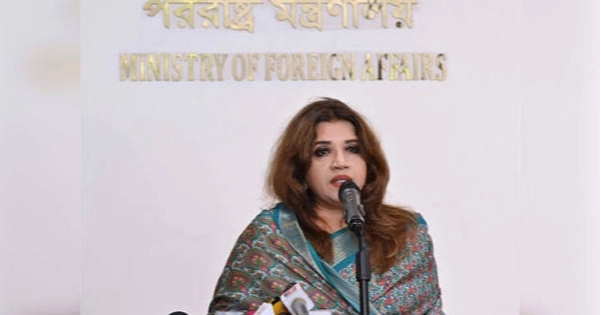
State Minister for Foreign Affairs Shama Obaed Islam on Tuesday said Bangladesh hopes to leverage its upcoming UN General Assembly (UNGA) presidency to strengthen international pressure for a political solution to the Rohingya crisis, which she said has grown increasingly complex, with security and other challenges requiring stronger global engagement.
“The matter is absolutely a political problem, it is a very sensitive matter and we need to solve this problem politically,” she told reporters, stressing that the Bangladesh government is in official and unofficial communication and dialogue with all stakeholders in Myanmar to solve this problem.
Talking to reporters at the Ministry of Foreign Affairs, Shama Obaed said unfortunately the Rohingya crisis has become more intense and the government is currently trying to solve this problem.
Bangladesh seeks to step up international pressure on Myanmar to find a durable solution to the Rohingya crisis and expressed hope that the country’s strengthened diplomatic position will help advance the issue.
“We are trying to involve the international community more,” Shama Obaed said, pointing to an upcoming high-level UN session on the Rohingya crisis where Bangladesh’s Prime Minister Tarique Rahman is expected to participate.
The Stated Minister said Bangladesh also needs to explore whether the Muslim world can exert greater pressure on Myanmar to create momentum for resolving the crisis.
Shama Obaed said an important high-level session on the Rohingya issue is expected to be held at the United Nations next September, where Bangladesh hopes to secure clearer guidelines for moving towards a solution.
“First of all, I must say that when the Rohingya influx started in 2017, the fascist government that was in power at that time could not play a strong role in solving the Rohingya problem, it failed. If they could have done that properly and involved the international community, then maybe we could have moved towards solving the problem within four-five years, since it started. That did not happen,” she said.
The State Minister said a new government has come in place in Myanmar and there is the Arakan Army and other stakeholders in Rakhine State.
She said the internal political situation in Myanmar is also very complicated now and there are many problems along the borders - security problems, various types of crimes being heard - human smuggling, drug trafficking, etc.
The State Minister said no one can say the exact number of Rohingyas now because more or less people are still coming every day and an average of 30,000 children are born there every year. “So in that case, we don't know the exact number right now, but it will definitely be over 1.3 million.”
During the recent visit of Prime Minister Tarique Rahman to China, the Chinese President said very strongly that he will try to solve this problem and will cooperate with Bangladesh, she said.
On the memorandum of arrangement concerning the Rohingya issue, Shama Obaed expressed scepticism about its likely impact unless the UN and other key stakeholders become more actively involved.
However, she said Bangladesh now has an additional diplomatic advantage through the position of its Foreign Minister Dr Khalilur Rahman as president of the UN General Assembly (likely from September 8).
“Now the UN and other stakeholders... and we have an added benefit or a power that now the President of the UNGA is our Foreign Minister,” Shama said.
She said Bangladesh should use the position more effectively to amplify its voice internationally.
“From that place, we have a power to speak for Bangladesh in the international community. We think that at least in the next year, we will be able to use this capacity a little better,” she said.
Shama Obaed also contrasted the current diplomatic environment with that of the previous government, accusing the then government of failing to exert sufficient pressure on China in pursuing a trilateral arrangement involving China, Bangladesh and Myanmar.
“The then government was not trying, I repeat,” she said, referring to efforts to resolve the Rohingya crisis through the trilateral framework.
She argued that the previous government lacked the political legitimacy and strength to put effective pressure on China.
Shama Obaed said Bangladesh’s current foreign policy is centred on protecting its own national interests while maintaining respectful and balanced relations with all countries.