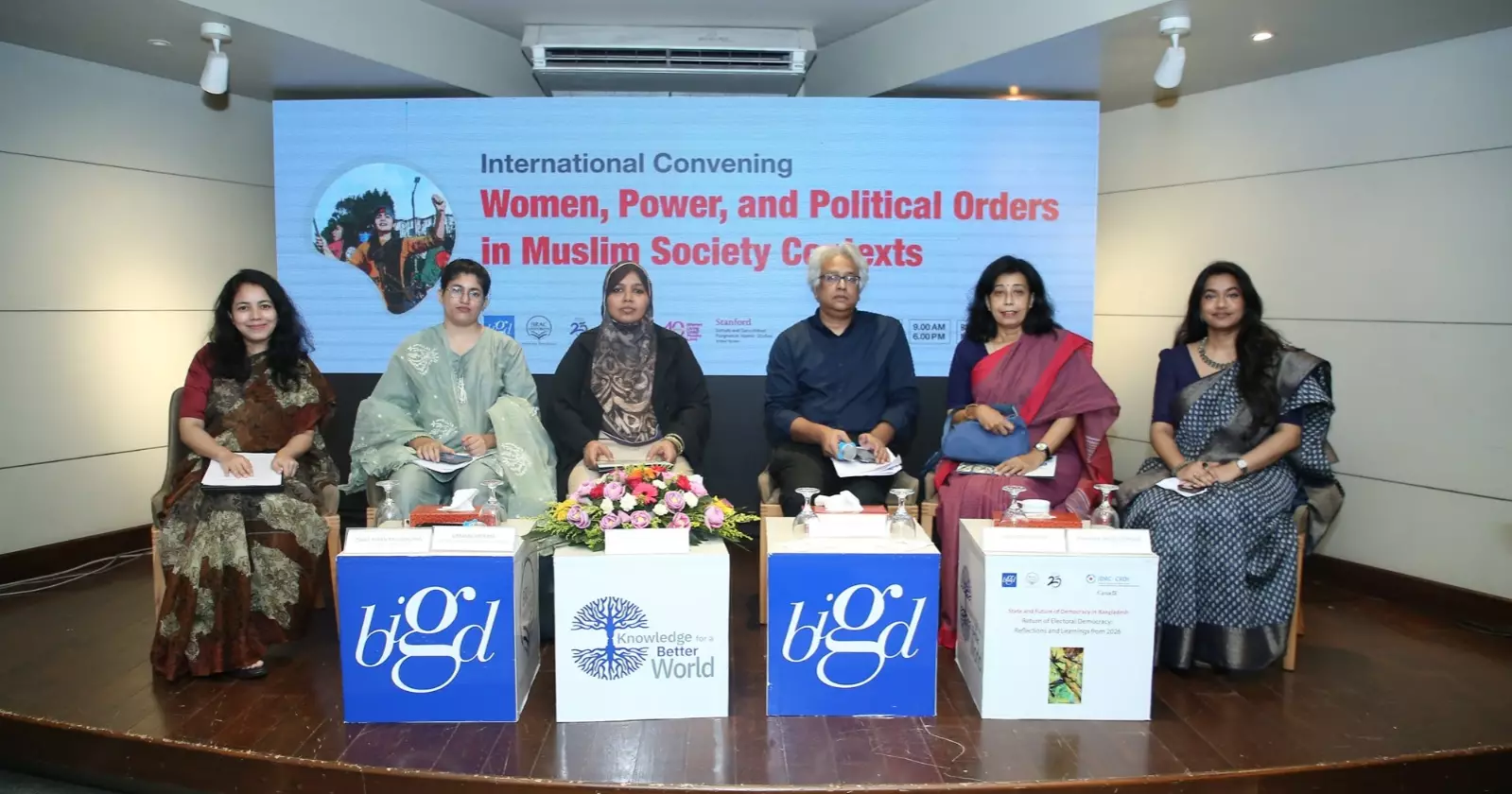
Women are often at the forefront of pro-democracy movements, but their leadership rarely translates into lasting influence over the negotiations, constitutions and institutions that follow political upheaval, speakers said at an international convening in the city on Tuesday.
The BRAC Institute of Governance and Development (BIGD) of BRAC University and Women Living Under Muslim Laws (WLUML) organised the event, titled "Women, Power, and Political Orders in Muslim Society Contexts."
Scholars, activists, lawmakers, legal practitioners and policy experts from Bangladesh, Afghanistan, Indonesia, Iran, Pakistan, Palestine and Syria shared experiences of how women shape, and are often sidelined from, political transitions, transitional justice and the institutions that follow.
The convening set out to identify concrete lessons and strategies for closing that gap, with particular attention to how religion legitimises or constrains women's participation in public life.
Opening the event, BIGD Executive Director Imran Matin said women have been both agents of change and victims of the new forces that emerge during transitions.
"Yet they can become a far more transformative force if we can organise better," he said.
Homa Hoodfar, professor emerita of anthropology at Concordia University, Canada, and WLUML executive board member, warned that women's rights won during political transitions are often traded away.
"Women must be present when the rules of a new political order are written," she said. "Constitutional equality must be backed by institutions able to enforce it."
Echoing her, Mona Tajali, lecturer in feminist, gender and sexuality studies at Stanford University and WLUML executive board member, said there is an assumption that gender equality will automatically follow democratisation.
"We may see some women in power in those moments; however, it is all temporary and very fragile," she said.
Barrister Sara Hossain, senior lawyer at the Supreme Court and honorary executive director of the Bangladesh Legal Aid and Services Trust, questioned whether the enthusiastic discussions after the July 2024 uprising had produced real change.
"We need to rethink women's position in society, or we can allow things to continue ad nauseam," she said.
Sara urged the women's movement to build alliances across political parties, including with those it disagrees with.
Reflecting on women's role within an Islamic political party, Bangladesh Jamaat-e-Islami women MP Mardia Mumtaz said, "We must introduce a cleaner, more visible way for women to participate in politics without exercising muscle power."
"We want to see men and women act as co-architects of political power. And we want this not only for Jamaat-e-Islami, but for all political parties," she added.
Closing the event, Samia Huq, dean of the School of General Education at BRAC University, stressed the need for transnational solidarity in advancing women's progress in Muslim societies.
"By taking into account the diversity of personhoods, allowing women to move beyond the political, social, and economic forces that seek to control them, and letting them speak by centering their choices and aspirations, we can make room for the lived realities of women and men in Muslim societies," she said.