Despite a legal requirement for political parties to ensure 33 percent representation of women at all levels of party committees by 2030, progress remains largely limited to policy commitments, with women continuing to have inadequate influence in political decision-making processes, according to a new study.
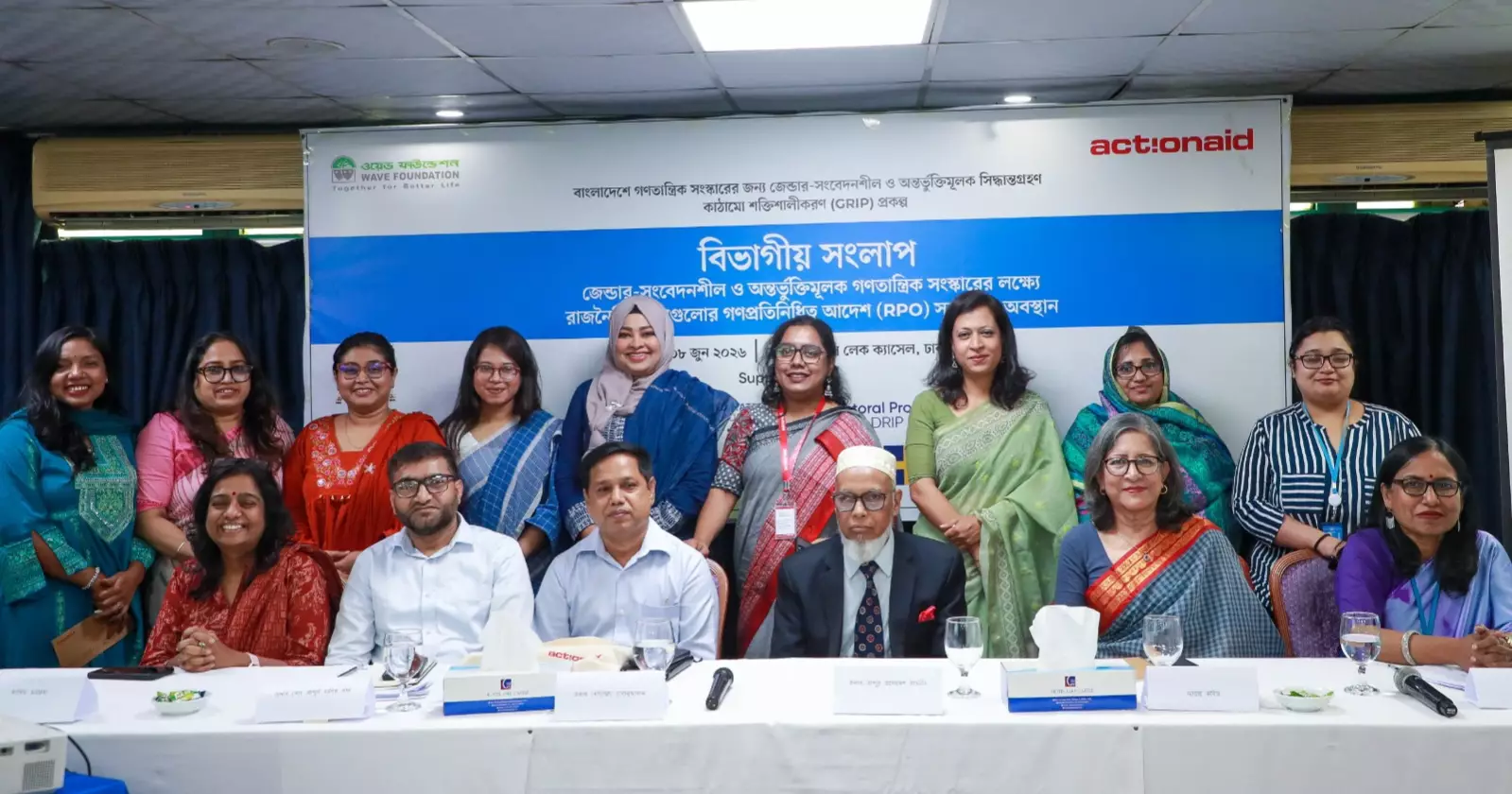
The findings were unveiled at a divisional dialogue in a city hotel on Monday, where the results of a study titled “Political Parties’ Position on the Representation of the People Order (RPO)” were presented.
The dialogue was jointly organised by Wave Foundation and ActionAid Bangladesh under the Gender Responsive and Inclusive Participation (GRIP) Project, implemented as part of the United Nations electoral assistance initiatives BALLOT and DRIP.
The study found that while awareness of the provision is high, implementation remains weak. Around 87.3 percent of respondents said they were aware of the requirement for 33 percent women's representation in political parties, but 72 percent believed the provision is not being effectively implemented.
Researchers also highlighted concerns over the capacity of the Bangladesh Election Commission to monitor compliance. Only 1.4 percent of respondents considered the Election Commission fully capable of ensuring implementation of the provision, while 9.9 percent viewed its capacity as partially sufficient.
The research, conducted by Sanaia Fahim Ansari and presented by consultant Mansura Akhtar, drew on the opinions of 191 stakeholders from 11 districts across six divisions of the country.
According to the study, patriarchal political culture remains the most significant barrier to women's participation, identified by 60.6 percent of respondents.
Other major obstacles include a lack of political commitment (56.3 percent), family and social pressures (49.3 percent), absence of democratic practices within political parties (45.1 percent), and limitations in the Election Commission’s monitoring mechanisms (39.4 percent).
The challenges are even greater for young women seeking to enter politics. Fear of insecurity and online violence emerged as the most significant deterrent, alongside male-dominated political culture, negative social attitudes, limited opportunities within political parties and economic constraints.
To address the gaps, participants recommended regular audits of political parties by the Election Commission, publication of annual gender-disaggregated reports on women’s representation and candidate nominations, and greater inclusion of women in key policy-making and nomination bodies within political parties.
The dialogue also proposed introducing state-funded incentives for political parties that nominate more women candidates in direct elections and reducing nomination fees for female candidates.
Participants further stressed the need for stronger internal accountability mechanisms and structured mentorship and training programmes to develop future women leaders.
Speaking at the event, Tapati Saha, Programme Manager for Gender Responsive Governance at UN Women Bangladesh, said participation from stakeholders across different regions enriched the discussion and reaffirmed the organisation’s commitment to promoting gender-responsive and inclusive democratic structures.
Chief Guest Election Commissioner Abdur Rahmanel Masud said the Election Commission's responsibility extends beyond conducting elections to ensuring that people's representation and democratic aspirations are reflected in the political process. He called for collective efforts to create a more inclusive political environment.
In her remarks, Farah Kabir, Country Director, ActionAid said the objective of the initiative was not merely to identify shortcomings in the Election Commission, political parties or the RPO, but to develop a sustainable roadmap enabling all stakeholders to contribute positively to democratic reforms.
Representatives from the Bangladesh Nationalist Party, National Citizen Party, and AB Party, along with officials from the Election Commission, UN agencies, civil society organisations, media, legal professionals, researchers and youth groups, took part in the discussion.
Participants agreed that women's political representation should go beyond reserved seats and quotas and be ensured at every level of decision-making through stronger political commitment, social awareness and institutional reforms.