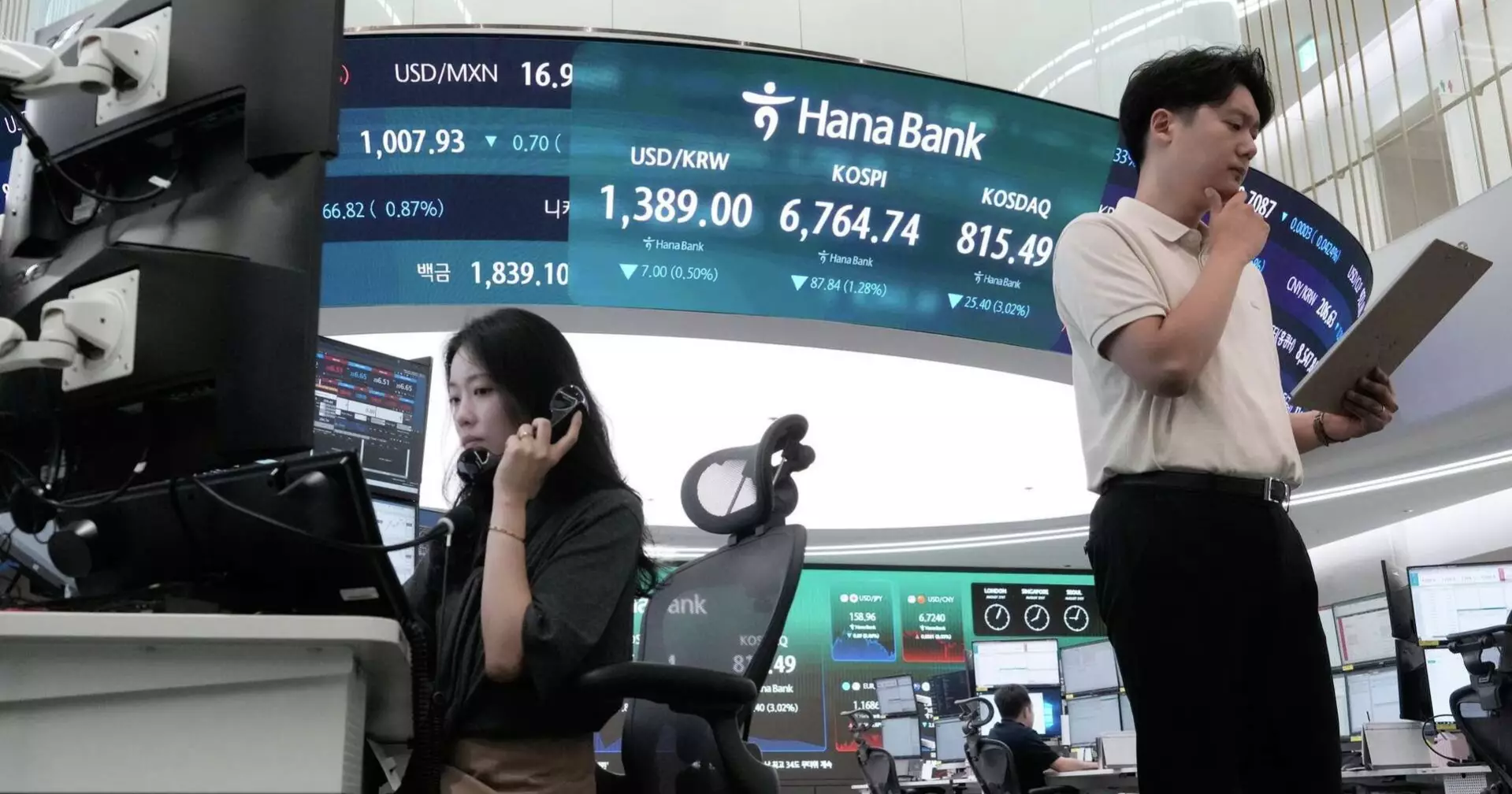
Asian shares mostly declined and oil prices slipped Monday as investors remained cautious ahead of a key gathering of top US economic officials at Jackson Hole later this week.
US stock futures also edged lower.
Japan’s Nikkei 225 fell 0.5% to 65,678.45, while South Korea’s Kospi dropped 3.5% to 6,664.36. Hong Kong’s Hang Seng Index declined 2.1% to 25,465.23 and the Shanghai Composite lost 0.7% to 3,877.30.
Australia’s S&P/ASX 200 bucked the regional trend, rising 0.5% to 9,107.40. Taiwan’s Taiex fell 0.5%.
Markets are awaiting the US inflation report for July, due Wednesday. The personal consumption expenditures (PCE) price index is the Federal Reserve’s preferred inflation gauge and, like the consumer price index, has indicated that inflation remains above 3%.
The Fed has struggled to bring inflation back to its 2% target. Inflation had moved closer to the goal in early 2025 before rising again following the introduction of broad US tariffs. It increased further in early 2026 after the Iran war disrupted oil shipments through the Strait of Hormuz.
Bond markets have also remained under pressure. Last week, rising Treasury yields prompted an unusual intervention by the US Treasury Department and raised concerns that higher borrowing costs could weaken consumer spending.
Treasury Secretary Scott Bessent announced that the government would double its purchases of longer-term bonds in an effort to reduce yields and mortgage costs. However, the 10-year Treasury yield climbed back to 4.73% Friday, its highest level in more than a year, and stood at 4.71% early Monday.
The 30-year Treasury yield also rose and remained close to its highest level since 2007.
Higher bond yields can weigh on economic activity and reduce the value of various investments.
Investors will closely watch Federal Reserve Gov. Kevin Warsh’s speech at the annual Jackson Hole gathering later this week for clues about interest rates and other policies.
On Friday, the S&P 500 gained 0.4%, marking only its second rise in six sessions after reaching a record high last week. The Dow Jones Industrial Average advanced 1%, while the Nasdaq composite rose 0.4%.
Strong corporate earnings have helped support US stocks, with most companies reporting better-than-expected spring profits.
Uncertainty over when oil tankers will again be able to move freely out of the Persian Gulf has also unsettled markets, pushing oil prices higher and raising inflation concerns.
The situation remained uncertain Monday after Iran’s new top security official warned that Tehran would regard support for fresh US economic measures against Iran as an “act of war.” Iran’s president, meanwhile, defended a memorandum of understanding with the United States as the best way to resolve the stalled conflict.
Brent crude fell 1.4% to $93.10 a barrel early Monday, while US benchmark crude dropped 1.6% to $85.63.
Bitcoin, which often benefits from lower interest rates and increased liquidity, was trading near $77,000 early Monday, according to CoinDesk.
In currency trading, the US dollar bought 158.89 Japanese yen, down from 158.94 yen late Friday. The euro was unchanged at $1.1678.