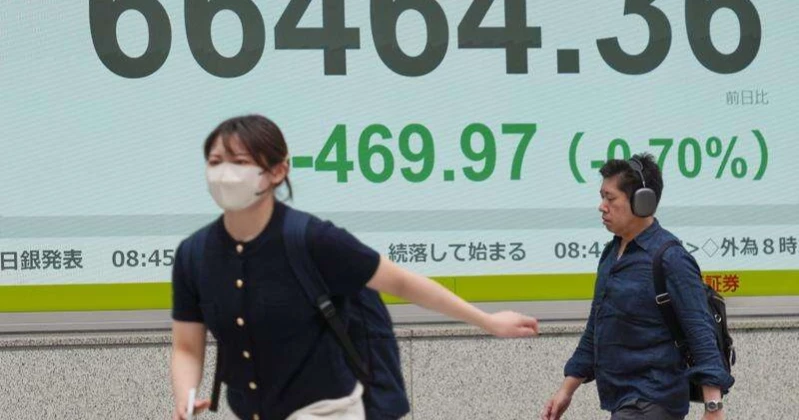
Asian stock markets mostly declined on Tuesday as fresh fighting raised doubts over the stability of the US-Iran ceasefire, while US futures also slipped.
Japan’s benchmark Nikkei 225 fell 0.3% to close at 66,734.24, while South Korea’s Kospi dropped 0.2% to 8,772.08. Australia’s S&P/ASX 200 edged down less than 0.1% to 8,724.40.
In contrast, Hong Kong’s Hang Seng index rose 2.2% to 25,956.72 and China’s Shanghai Composite gained 0.4% to 4,075.34.
On Wall Street, US stocks had earlier reached new record highs on Monday. The S&P 500 rose 0.3% to 7,599.96, the Dow Jones Industrial Average gained 0.1% to 51,078.88, and the Nasdaq Composite climbed 0.4% to 27,086.81.
In bond markets, the yield on the 10-year US Treasury briefly climbed to 4.52% before easing to 4.46%.
Oil price movements continued to influence global markets. Airlines in the US came under pressure as fuel costs rose, with United Airlines shares falling 2.6% and Alaska Air Group down 3.3%.
In Asian trading, US crude oil fell 94 cents to $91.22 per barrel, while Brent crude dropped 90 cents to $94.08. Despite the decline, prices remain significantly higher than pre-conflict levels of around $70 per barrel.
Market analysts say much depends on whether Washington and Tehran can reach an agreement to reopen the Strait of Hormuz, a key route for global oil shipments from the Persian Gulf.
Analyst Stephen Innes said crude shortages have already forced refiners in Asia and Europe to cut production, warning that the impact is spreading across fuel supplies including petrol, diesel, jet fuel and other products.
The latest tensions follow ongoing military exchanges, with the United States saying it struck Iranian radar and drone facilities after an American drone was downed, while Iran claimed it targeted US forces in Kuwait—claims Washington says were intercepted.
In currency markets, the US dollar edged up to 159.72 Japanese yen, while the euro rose to $1.1654.
Meanwhile on Wall Street, Nvidia shares jumped 6.2% after new product announcements by CEO Jensen Huang, helping lift broader market sentiment.