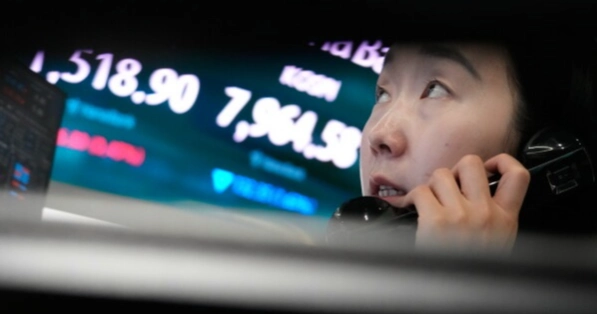
Asian shares mostly fell on Wednesday after a sharp sell-off in technology stocks on Wall Street, while global oil prices climbed following fresh U.S. airstrikes linked to escalating tensions with Iran.
The U.S. military carried out attacks early Wednesday after the crash of an Army helicopter near the Strait of Hormuz, an incident President Donald Trump blamed on Iran. Tehran rejected the accusation and warned it would respond, saying it “will leave no attack or threat unanswered.”
The renewed escalation has raised concerns over prospects for a lasting ceasefire in a conflict that has already dragged on for more than three months. The uncertainty has further unsettled global markets, which were already under pressure from heavy selling in technology firms tied to the artificial intelligence boom.
Oil prices resumed their upward trend amid fears over disruptions to the Strait of Hormuz, a key global shipping route. Brent crude rose 0.9 percent to 92.30 dollars per barrel after earlier fluctuations, having traded near 70 dollars before the conflict escalated in late February. U.S. benchmark crude gained 1 percent to 89.04 dollars per barrel.
ING commodities strategists Warren Patterson and Ewa Manthey said the situation remains “highly volatile,” noting that efforts by Iran and the United States to secure a stable ceasefire and ensure free movement through the Strait remain uncertain. They also pointed out that seasonal demand typically supports higher oil prices at this time of year.
In equities, U.S. futures edged lower after losses in major chipmakers including Micron Technology, Advanced Micro Devices and Marvell Technology.
In Asia, South Korea’s Kospi dropped 4.7 percent to 7,720.59 after a strong rally in the previous session. Samsung Electronics fell 5.8 percent, while SK Hynix slid 6.3 percent.
Japan’s Nikkei 225 declined 1.4 percent to 64,524.84 after data showed producer prices rose 6.3 percent in May, the fastest increase in more than three years. SoftBank Group shares fell 8.9 percent, while Tokyo Electron rose 5.3 percent.
Hong Kong’s Hang Seng lost 1.1 percent to 24,296.62 and the Shanghai Composite slipped 0.7 percent to 3,980.24. Official figures showed China’s producer prices climbed 3.9 percent in May, close to a four-year high.
Australia’s S&P/ASX 200 edged up 0.2 percent to 8,624.50. Taiwan’s Taiex was down 1.6 percent in early trade, while India’s Sensex rose 0.6 percent.
On Wall Street on Tuesday, the S&P 500 fell 0.3 percent, the Dow Jones Industrial Average gained 0.2 percent, and the Nasdaq composite dropped 1 percent as technology stocks led losses. Micron, Marvell Technology and AMD all declined sharply during trading.
Investors are also watching upcoming U.S. inflation data, with energy prices rising due to ongoing geopolitical tensions.
In currency markets, the U.S. dollar was steady at 160.36 yen, while the euro traded at 1.1550 dollars.