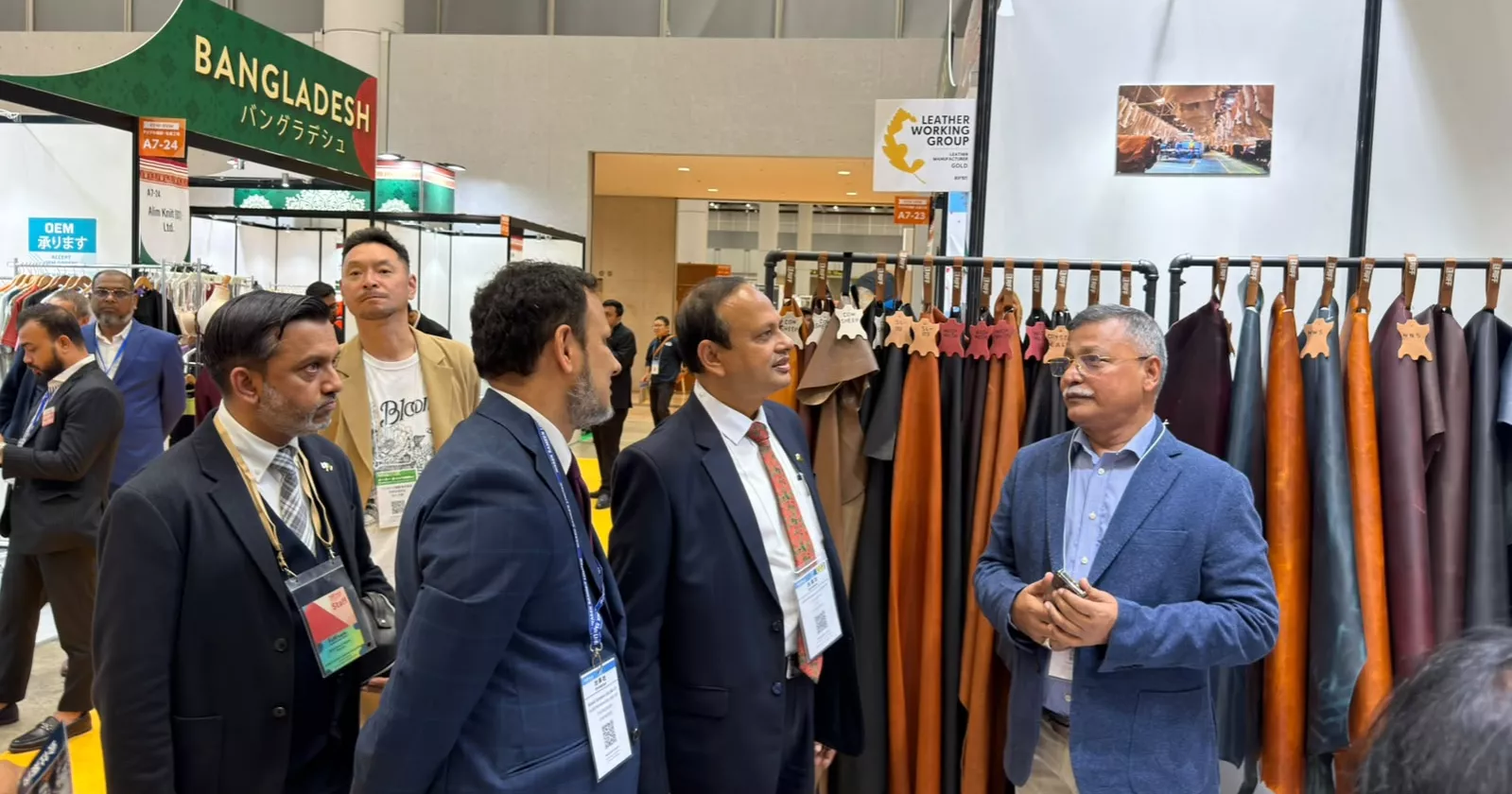
The Bangladesh Pavilion at 'Fashion World Tokyo (Autumn) 2026' officially inaugurated on Wednesday at Tokyo Big Sight in Japan to showcase the country's manufacturing capabilities in apparel, home textiles, and leather goods to the global market.
Under the initiative and financial support of the Export Promotion Bureau (EPB), 25 Bangladeshi companies are participating in the three-day international exhibition across 27 booths, while five additional Bangladeshi firms are taking part under their own management.
Bangladesh Ambassador to Japan Md. Daud Ali inaugurated the pavilion as the chief guest by cutting a ribbon. He later inspected various stalls, expressing satisfaction with the high quality of Bangladeshi products on display and engaging with participating entrepreneurs.
Following the pavilion visit, a seminar titled "Bangladesh: Sourcing Excellence for Apparel, Home Textile and Leather Products" was held at the exhibition hall.
Jointly organized by the Embassy of Bangladesh in Tokyo and the EPB with support from the Japan External Trade Organization (JETRO), the seminar brought together Japanese importers, investors, trading houses, and trade representatives from both nations.
Addressing the seminar, Ambassador Daud Ali highlighted Bangladesh not merely as a manufacturing hub, but as a highly dependable sourcing and investment partner for Japanese businesses. He noted that Bangladesh has established a strong foundation across multiple sectors, including apparel, textiles, leather and footwear, pharmaceuticals, ceramics, ITES, and agro-processing.
Elaborating on the ready-made garment (RMG) sector, the Ambassador stated that Bangladesh remains the world's second-largest RMG exporter, generating approximately $39 billion annually in export revenues. He emphasized that global fashion giants such as Uniqlo, H&M, Zara, and Walmart rely on Bangladesh, which also leads globally in sustainable manufacturing with over 230 LEED-certified green garment factories.
He further pointed out that the leather and footwear sector is Bangladesh's second-largest export earner after RMG, generating nearly $1.5 billion annually, with a clear target to scale up exports to $5 billion over the next five years. He also expressed optimism that the proposed Economic Partnership Agreement (EPA) would significantly reinforce bilateral trade and economic cooperation between Bangladesh and Japan.
Presenting at the seminar, Yuji Ando, Senior Director of JETRO's Global Strategy Department, underscored the quality and price competitiveness of Bangladeshi exports, particularly in apparel, home textiles, and leather products.
He noted that Bangladeshi products strictly comply with international standards while offering competitive pricing, positioning Bangladesh as an ideal sourcing destination for Japanese buyers and brands, according to a press release.