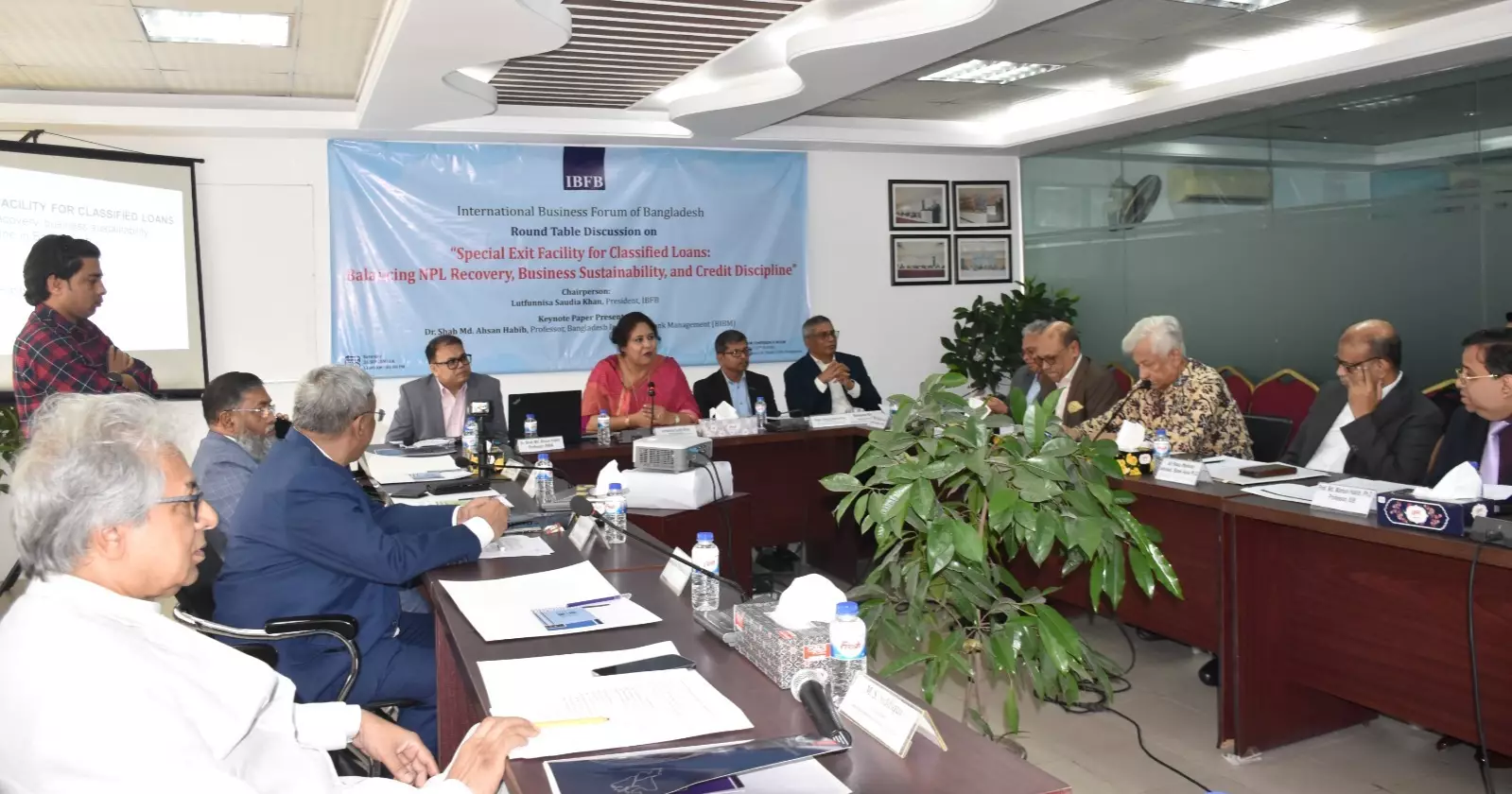
Bankers, economists and business leaders on Saturday called for wider stakeholder consultation before Bangladesh Bank issues a major regulatory circular on a proposed special exit facility for classified loans, warning that rushed implementation could undermine both recovery efforts and business sustainability.
The call came at a roundtable titled "Special Exit Facility for Classified Loans: Balancing NPL Recovery, Business Sustainability, and Credit Discipline," organized by the International Business Forum of Bangladesh (IBFB) at its conference room in the capital.
Shah Md Ahsan Habib, professor at the Bangladesh Institute of Bank Management (BIBM), presented the keynote paper, outlining key features of the proposed exit facility and stressing the need to strike a balance between non-performing loan (NPL) recovery, business sustainability and credit discipline.
IBFB President Lutfunnisa Saudia Khan, in her opening remarks, underscored the importance of constructive dialogue among policymakers, banks, businesses and other stakeholders before any major policy shift.
Ali Reza Iftekhar, Adviser at Bank Asia PLC, said consulting stakeholders before issuing such a significant circular was essential to avoid unintended consequences for the banking sector.
Prof Md Mamun Habib of IUB emphasized good governance and fair practices in handling classified loans, while Prof Dr Abu Yusuf of Dhaka University raised concerns over weak enforcement in cases of loan non-repayment. A representative of Pubali Bank PLC referred to the Money-Lending Act, 1832, calling for reasonable rescheduling provisions.
Toufic Ahmad Choudhury, former Director General of BIBM, said political commitment from the government was necessary to recover classified loans, and urged a case-by-case approach that distinguishes willful defaulters from unwilling ones.
Md Khairul Anam Mohiuddin, Executive Vice President of Southeast Bank PLC, and Syed Abu Naser Bukhtear Ahmed, Chairman of Agrani Bank PLC, spoke on loan recovery and institutional coordination, calling for closer engagement among Bangladesh Bank, the Ministry of Finance and other stakeholders.
Participants broadly agreed that wider consultation with banks, businesses and other concerned parties would help identify practical challenges and ensure more effective implementation of major regulatory measures. They also stressed the need to balance NPL recovery and repayment capacity with business sustainability, transparency and credit discipline.
The roundtable concluded with a call for continued dialogue among Bangladesh Bank, financial institutions, businesses and other stakeholders to develop practical and sustainable approaches to tackling the country's NPL challenges.