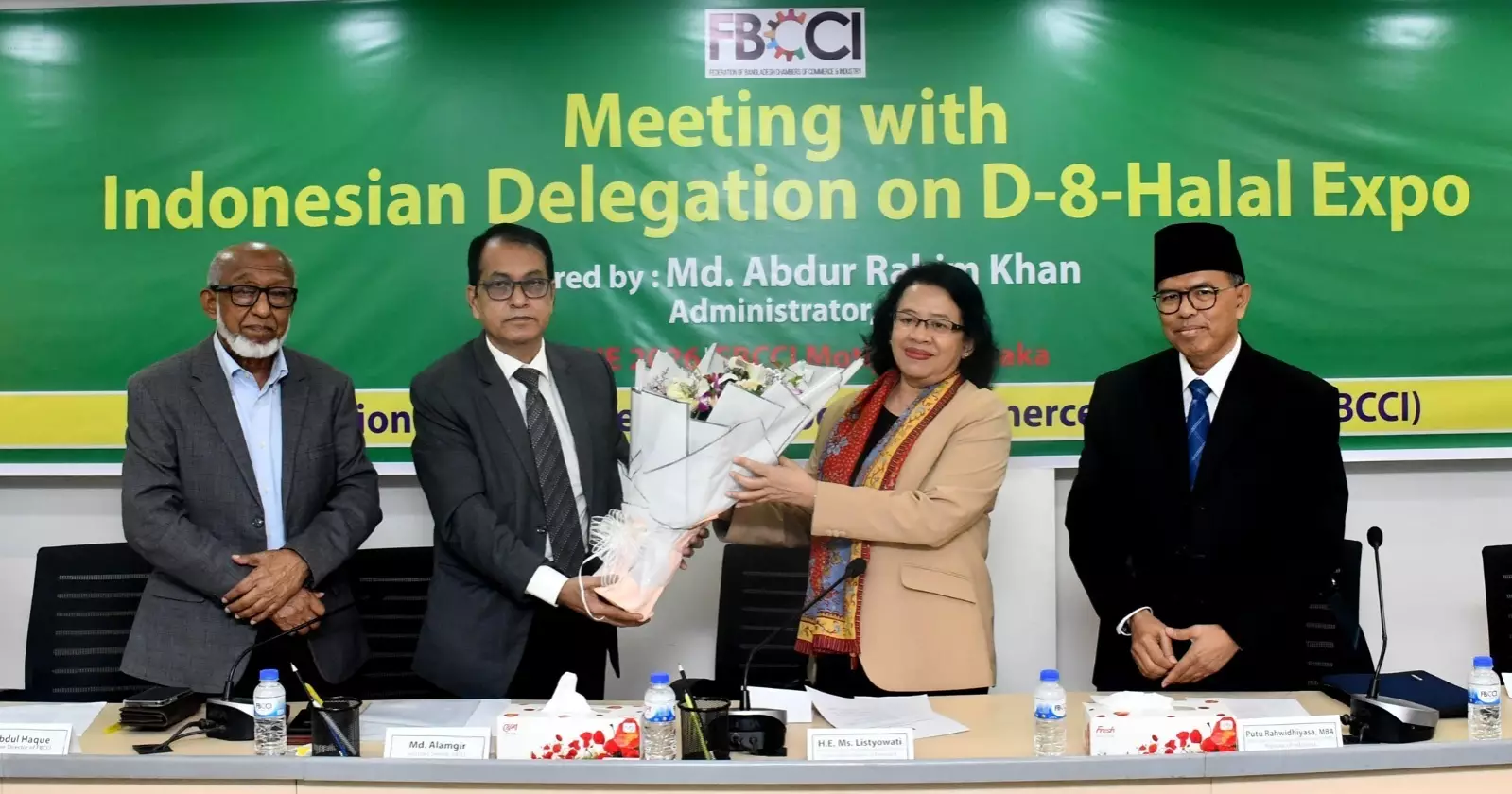
Bangladesh and Indonesia have significant untapped opportunities in the halal economy beyond their traditional trade relations, particularly in sectors such as processed food, fashion, pharmaceuticals, healthcare, medical equipment and digital technology, Indonesian Ambassador to Bangladesh Ms. Listyowati said on Monday.
Indonesian Ambassador made the remarks during a meeting between the Federation of Bangladesh Chambers of Commerce and Industry (FBCCI) and a high-level Indonesian business delegation at Motijheel office in the city.
Highlighting the growing scope of halal trade, the ambassador said halal products extend far beyond halal meat and food, encompassing apparel, cosmetics, medicines, healthcare services, medical devices, Islamic finance and tourism. “Bangladesh and Indonesia can explore extensive business opportunities in these sectors and further strengthen bilateral trade ties.”
The ambassador also invited Bangladeshi businesses to participate in the D-8 Halal Expo 2026, scheduled to be held in Jakarta from July 8 to 12, expressing hope that a high-level Bangladeshi trade delegation would attend the event with their products.
“The Indonesian Embassy in Dhaka will provide all possible support in this regard,” she added.
Describing the upcoming expo as more than a conventional trade fair, Listyowati said it would serve as a unique platform for strengthening the halal ecosystem among D-8 member countries, expanding trade and investment, and fostering new partnerships across sectors.
A report on the D-8 Halal Expo 2026 was presented at the meeting by Putu Rahwidhiyasa, Director General of Indonesia’s National Committee for Islamic Economy and Finance (KNEKS).
He said Indonesia is not only focusing on halal product exports but is also actively developing a comprehensive halal value chain. “Bangladesh and Indonesia can further expand bilateral trade by leveraging this halal value chain and enhancing collaboration in the halal economy.”
Citing the report, Rahwidhiyasa noted that Indonesia ranked among the top 10 exporters in intra-OIC trade in 2022, trailing only Türkiye and the United Arab Emirates among the leading exporters.
According to the report, Indonesia currently ranks sixth globally in the Halal Economy Trade and Investment Index. The country holds the fourth position in the halal food sector and ranks sixth in the modest fashion and apparel segment, reflecting the strength and diversity of its halal market.
The report also highlighted the rapid growth of the global halal economy. Among all halal sectors, halal food remains the largest contributor, with spending across OIC member countries reaching approximately $1.24 trillion in 2023, supported by a projected annual growth rate of 6.2 percent.
The halal fashion sector ranked second, with Muslim consumer spending estimated at $277.9 billion and an annual growth rate of 6.8 percent.
Speaking at the event, Mohammad Riyad Ali, President of the Indonesia-Bangladesh Chamber of Commerce and Industry (IBCCI) and former FBCCI director, said the D-8 Halal Expo offers a valuable opportunity to observe how member countries integrate halal practices into daily life and commerce.
“It will also provide Bangladesh with an opportunity to learn from their experiences in developing and strengthening halal certification systems,” he said.
Earlier, FBCCI Secretary General Md Alamgir delivered the welcome address, describing Bangladesh and Indonesia as long-standing trade partners with strong economic ties.
While acknowledging Bangladesh’s relatively limited share in bilateral trade, he said participation in major international platforms such as the D-8 Halal Expo could diversify trade cooperation and open new avenues in the rapidly expanding halal market.
He also assured the Indonesian delegation that FBCCI would work sincerely to facilitate the participation of a Bangladeshi business delegation in the D-8 Halal Expo 2026.