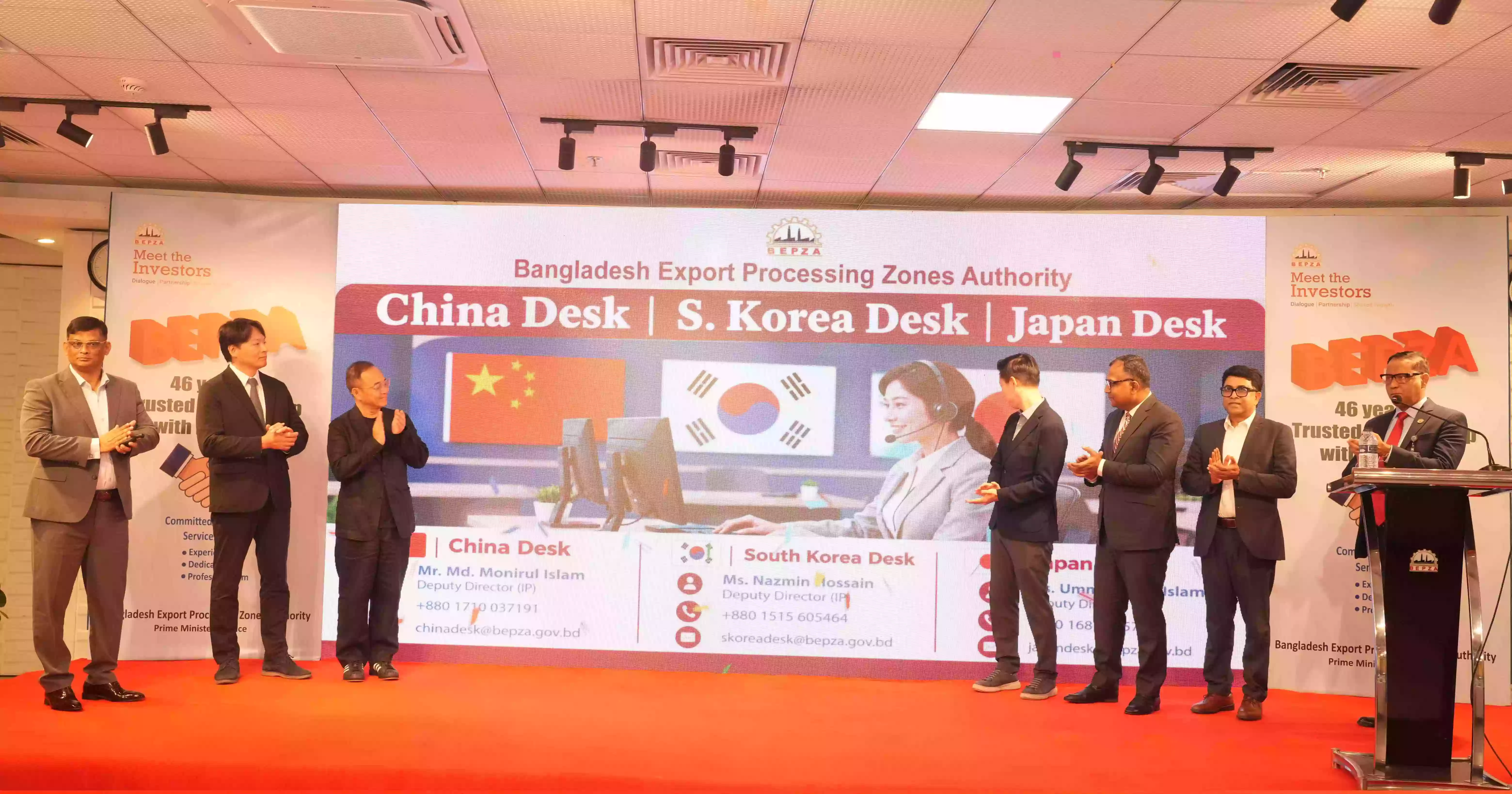
The Bangladesh Export Processing Zones Authority (BEPZA) has launched dedicated country desks for investors from China, South Korea and Japan to facilitate investment, improve services and encourage business expansion in its export processing zones (EPZs) and economic zones.
The desks were inaugurated at a ‘Meet the Investors’ event in Dhaka on Saturday, attended by more than 100 local and foreign investors and representatives of business chambers from the three countries.
Investors from 38 countries have invested in BEPZA’s eight EPZs and two economic zones, with China, South Korea and Japan emerging as the top three investor countries.
The new desks will provide existing and prospective investors with direct assistance, investment-related information and guidance tailored to their needs, helping simplify the investment process.
Speaking at the event, BEPZA Executive Chairman Major General Mohammad Moazzem Hossain said the initiative would help strengthen partnerships with investors, address their concerns and make the investment environment more competitive and business-friendly.
Despite global trade uncertainties and economic challenges, BEPZA signed investment agreements with 36 enterprises in the fiscal year 2025-26, he said.
Exports from BEPZA’s zones reached US$8.41 billion in FY26, marking a 2.22 per cent increase from the previous fiscal year.
The executive chairman also cited the declaration of BEPZA Economic Zone-1, BEPZA Economic Zone-2, Jashore EPZ and Patuakhali EPZ as full-fledged zones as a major development during the year.
He urged investors to expand their operations in the new zones in partnership with their supply-chain partners.
Moazzem said BEPZA was promoting environmentally responsible industrialisation through the principles of Reduce, Reuse and Recycle, renewable energy and circular industrial practices.
The authority was also improving investor services through better power supply, Investors’ Clubs, fire stations, healthcare facilities and streamlined One Stop Service, he said.
The dedicated country desks would help existing investors expand their businesses while attracting fresh investment to BEPZA’s zones, he added.
During the event, BEPZA Member (Investment Promotion) Md Tanvir Hossain presented the authority’s achievements in investment attraction, export growth, employment generation and workers’ welfare during FY26.
He also outlined measures to simplify investor services, improve policies and procedures, and develop the economic zones and new EPZs in Jashore and Patuakhali.
Referring to limited land availability in operational zones, Tanvir said BEPZA was contributing to the national economy by ensuring the optimal use of this resource.
BEPZA Additional Executive Director (Enterprise Services and Industrial Relations) Nazmul Islam Bhuiyan presented an overview of workers’ welfare, employer-worker relations, amendments to the EPZ Labour Act and emerging labour-related challenges.
An open discussion followed, with investors and BEPZA officials exchanging views on investment expansion, service delivery, business challenges and opportunities. The Bangladesh EPZ Labour Act, 2019, was also discussed, with BEPZA reaffirming its commitment to protecting the interests of both investors and workers while maintaining international labour standards.
Million Park, general secretary of the Korea-Bangladesh Chamber of Commerce and Industry, said Bangladesh had significant potential to expand business partnerships with South Korea. He stressed the need for infrastructure development and simpler policies to attract more Korean investment.
Pintu Kumar Shaw, vice-president of EPIC Group, praised BEPZA’s support services and expressed interest in investing in the new EPZs in Jashore and Patuakhali.
R N Paul, managing director of PRAN-RFL Group, shared his experience in the food-processing sector and urged investors to explore opportunities beyond ready-made garments, particularly in high-value-added industries, renewable energy and backward-linkage industries.
Representatives of the Bangladesh-China Chamber of Commerce and Industry, the Korea-Bangladesh Chamber of Commerce and Industry, and the Japan-Bangladesh Chamber of Commerce and Industry attended the event.
Established in 1980, BEPZA oversees eight EPZs and two economic zones, which have attracted around US$7.5 billion in investment and generated cumulative exports of approximately US$130 billion.
The zones account for around 20 percent of Bangladesh’s total exports.