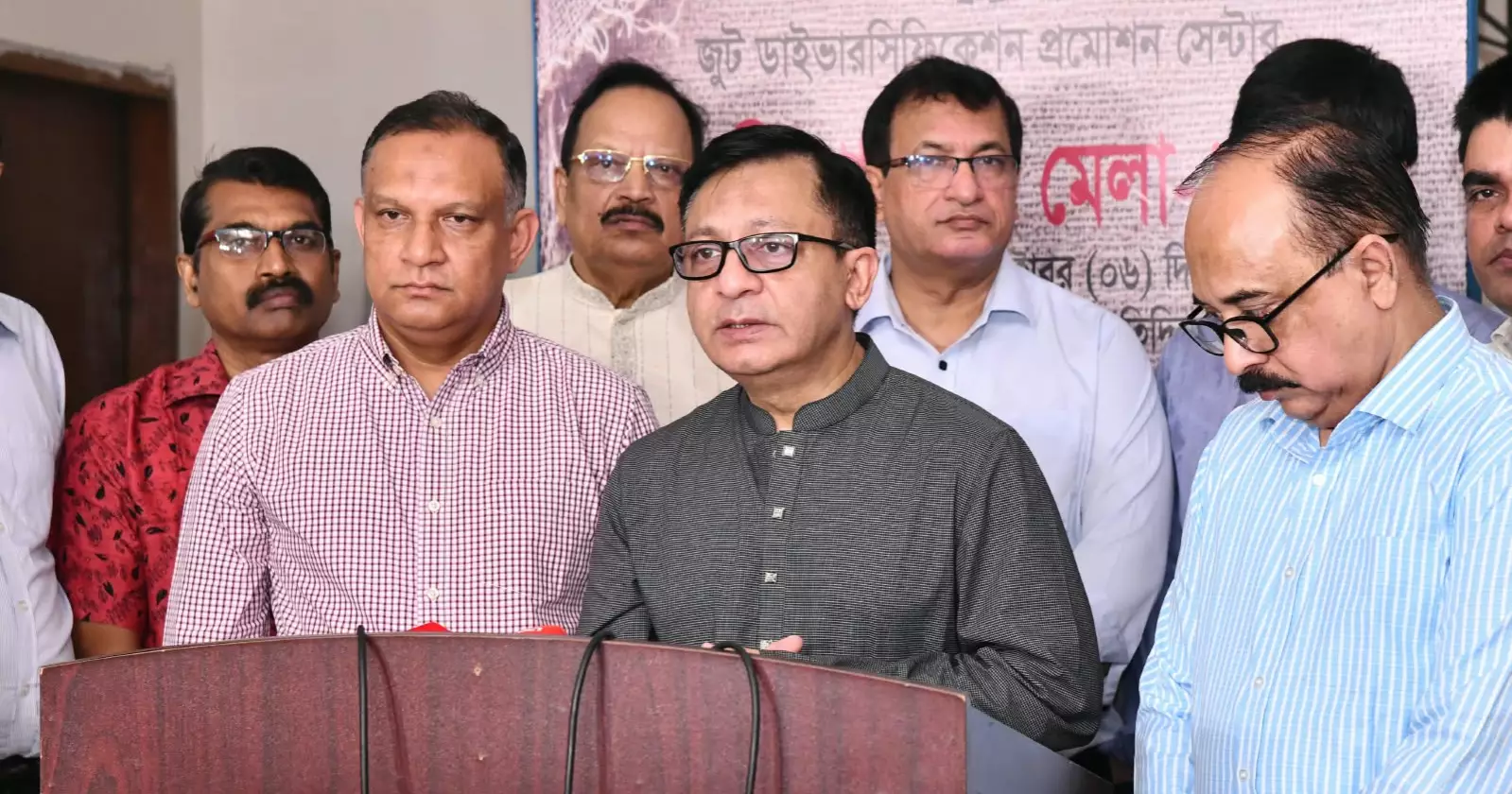
Textile and Jute Minister Khandakar Abdul Muktadir Saturday said the government is working to convert raw jute into the highest possible value-added products to increase foreign exchange earnings and revenue.
"It is also promoting promising sectors beyond readymade garments (RMG), including silk, handloom and jute goods," Muktadir made the remarks while addressing the inauguration of a six-day "Multipurpose Jute Products Fair" and a new sales outlet, "JDPC EXPRESS," as chief guest on Jute Diversification Promotion Centre (JDPC) premises in Tejgaon.
A permanent showroom is being launched at JDPC to promote these products and expand their market, he said.
The government aims to attract local buyers through fairs and exhibitions while raising awareness of these products among foreign buyers, he added.
The minister said the products include both machine-made and a large number of handmade items, the latter mostly coming to market as cottage and small industry output.
Replying to a question on diversification and export expansion of jute goods, Muktadir said a plan is being drawn up in coordination with JDPC and private-sector entrepreneurs' associations.
There is no value addition in exporting raw jute, but its value can be multiplied by gradually converting it into high-value products such as sliver, packaging materials and blended fibre, he said, expressing optimism.
"At the peak of the market last year, raw jute was priced at around Tk 1.5 lakh, or about $1,200, per tonne," the minister said.
He said the same quantity of jute could fetch around $2,400-$2,500 if converted into packaging products.
Blended fibre products made by mixing jute with cotton or other fibres could earn around $4,000-$5,000 per tonne, he added.
The government's goal is to convert the largest possible share of the country's jute output into value-added products, Muktadir said. “Work is under way in coordination with relevant institutions and entrepreneurs to determine how much jute can be used in which sectors and for what kinds of products.”
He expressed hope that this would allow the maximum foreign exchange and revenue to be earned from jute.
State Minister for Textiles and Jute Shariful Alam said the fair aims to promote local products in the domestic market, expand the use of eco-friendly goods and discourage the use of polythene.
The government is also working to make the country's GI products, multipurpose jute goods, Rajshahi silk, handloom and other textile products better known and more widely used, he said.
"The golden fibre jute was once tied to the country's pride and people's emotions, but much of that heritage has been lost over time," he said.
Such fairs are being organised as part of efforts to increase jute production, expand the use of diversified jute products, create markets at home and abroad, and turn the fibre into more value-added products, he added. "JDPC organises such fairs at various places across the country every year."
Shariful Alam said "JDPC EXPRESS" will operate as a permanent sales and display centre, offering diversified jute products along with handloom and silk items. There are plans to set up similar showrooms at other important locations in the future.
He also said there are plans to set up showrooms or display centres for local products at international airports and at Bangladesh missions abroad.
To raise awareness and use of these products at home and abroad, they need to be effectively promoted in the international market, he said. "With the cooperation of entrepreneurs and the media, the government wants to showcase local products more widely in the global market."
The six-day fair will run from October 3 to 8, daily from 10am to 8pm. The new outlet, "JDPC EXPRESS," will remain open seven days a week from 11am to 8pm.