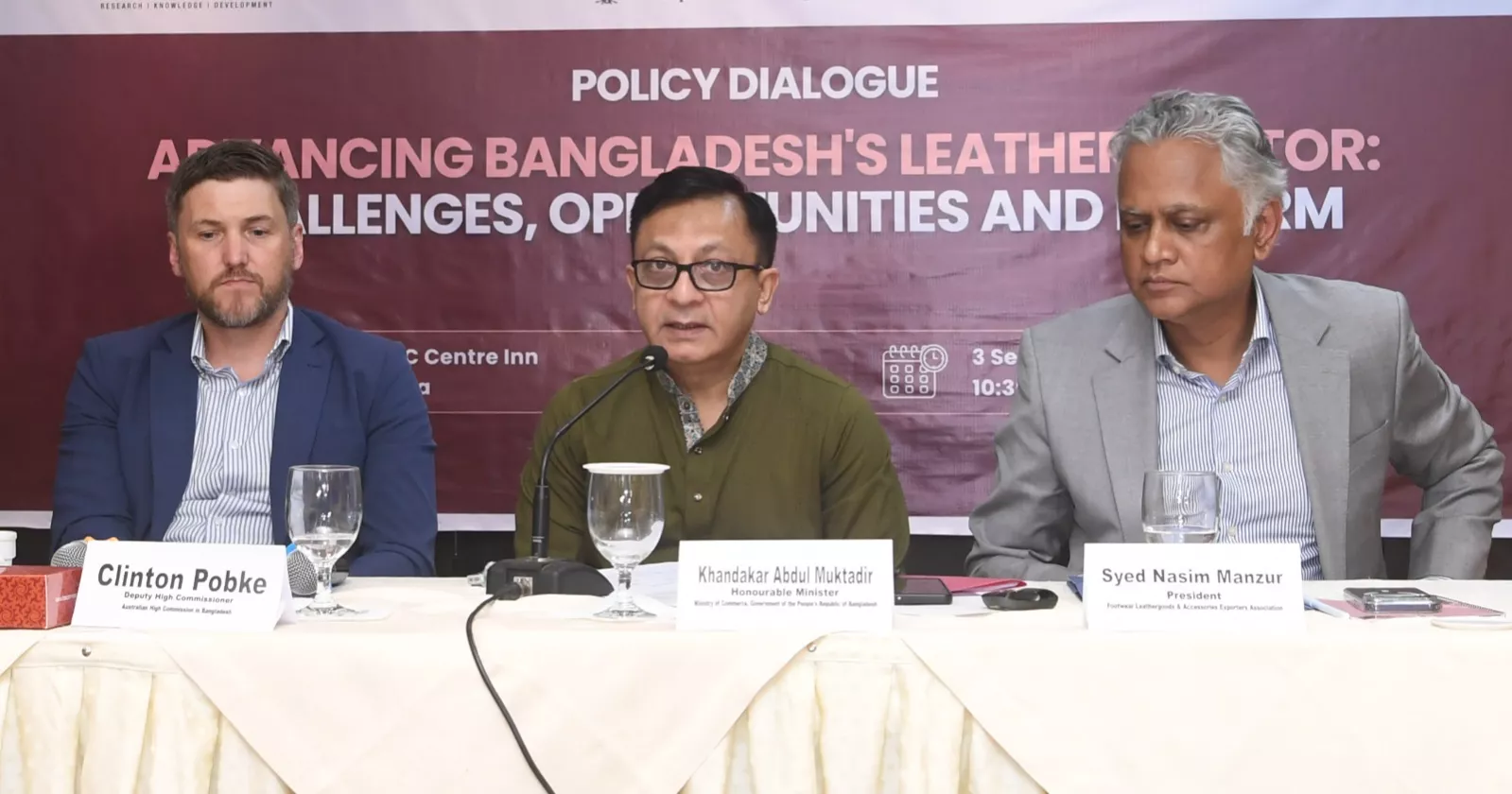
The government is working on an integrated reform plan to revive Bangladesh’s leather industry and restore its position in the global market by reforming the tannery sector, attracting new investment and ensuring internationally compliant production systems.
Commerce, Industries, and Textiles and Jute Minister Khandakar Abdul Muktadir said this while speaking at a policy dialogue titled “Advancing Bangladesh’s Leather Sector: Challenges, Opportunities and Reform” at BRAC Centre Inn in the capital on Thursday.
He said the decision to relocate tanneries from Hazaribagh to Savar was right, but weaknesses in implementation and management have pushed the industry into difficulties.
The minister said the government will create opportunities for a “graceful exit” for tannery owners who, despite years of investment, are no longer interested in or capable of making fresh investments.
“This will create space for new entrepreneurs and investors to enter the sector,” he said.
Muktadir said 100 percent compliance will have to be ensured in the tannery sector, while obtaining certification from the Leather Working Group (LWG) will be made mandatory to improve Bangladesh’s acceptance in international markets.
The government also aims to build a “Bangladesh Leather” brand by exporting finished leather goods such as shoes, bags and other high-value products instead of exporting raw hides, he said.
On one of the sector’s major challenges, the Central Effluent Treatment Plant (CETP) in Savar, the minister said an initiative has been taken to build a new world-class CETP, while renovation of the existing facility is also being considered.
The existing system can effectively treat only around 14,000-15,000 cubic metres of waste against its projected capacity of 25,000 cubic metres, he said.
Large tanneries will be required to install their own effluent treatment plants (ETPs), while smaller ones will have to ensure full compliance by operating in coordination with the central CETP system, Muktadir said.
The government also plans to establish several plants to turn solid tannery waste into usable products, including tallow and bone meal. The initiative aims to transform the Savar Tannery Industrial Estate into an integrated waste-management industrial zone, he said.
To expand markets for leather and leather goods, the government is working to secure greater trade facilities in Japan, South Korea and Europe, the minister said.
It also plans to encourage major leather industry companies from Spain and Italy to invest in Bangladesh, he said, adding that the government aims to establish a skills and design development centre in Savar by 2027 for the leather and other industries.
Muktadir said the government will seek to restore the leather sector’s strong position in global markets by improving workers’ skills, strengthening design capabilities, promoting environment-friendly production, facilitating investment, ensuring proper ETP facilities and resolving complications related to bonded warehouse facilities.
The policy dialogue brought together policymakers, industry representatives and other stakeholders to discuss the challenges and prospects of Bangladesh’s leather sector.