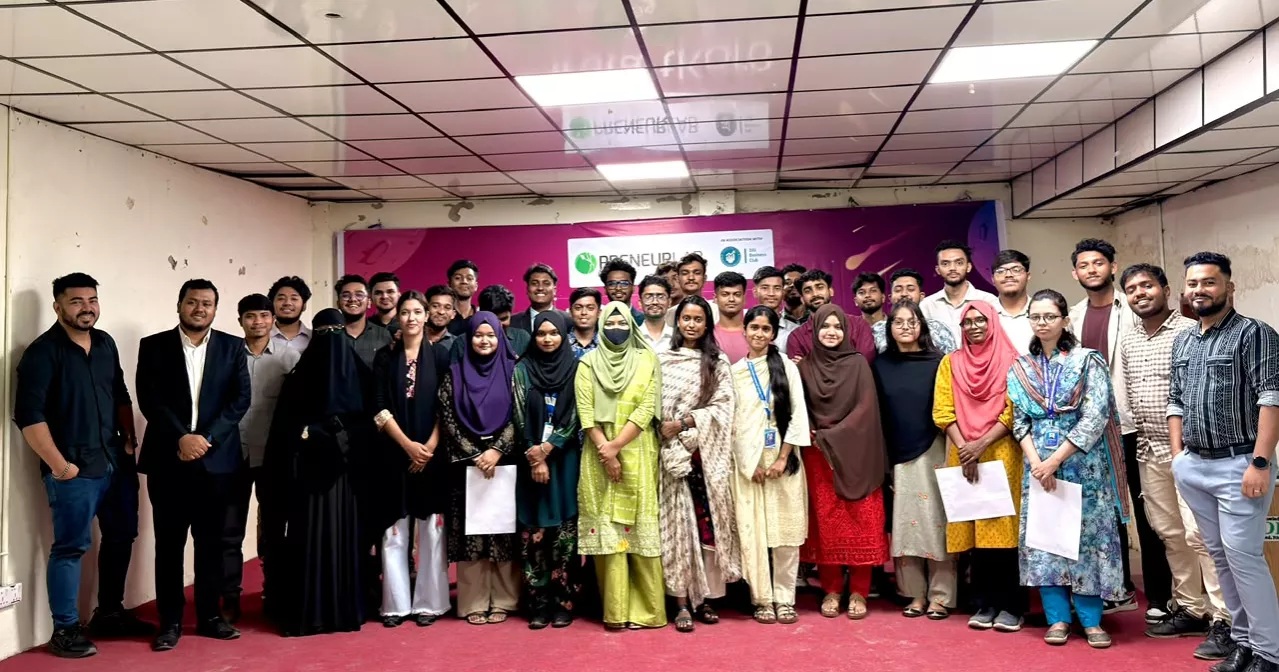
Around 60 university students and aspiring entrepreneurs took part in a daylong programme at Dhaka International University (DIU) on Tuesday, learning how to test business ideas and understand the policy and regulatory factors that can affect their ventures.
The Campus Incubation Bootcamp and Smart Policy Reform Lab, organised by Preneur Lab Youth & Innovation Trust with support from Atlas Network, was held as part of StartKoro Season 5.
The programme focused on helping participants identify problems worth solving and test whether potential customers need their proposed solutions, according to a press release.
Mentors Alamin Pranto, director of Start2Scaleup, and M. Ashraful Tanvir, head of operations and administration at Preneur Lab, led the sessions, while university faculty members joined as guest speakers.
Participants worked through ideation, market research, customer needs, product validation and the development of a minimum viable product (MVP).
In the Smart Policy Reform Lab, they discussed the policy and regulatory environment for young businesses and put forward recommendations on issues that could affect startups and small businesses.
StartKoro aims to support young people from the idea stage through validation and development of a first product to establishing a running business capable of creating employment.
The fifth season has so far engaged more than 365 entrepreneurs, who have launched more than 60 new businesses, while Preneur Lab estimates that around 200 new jobs have been created.
The organisers said entrepreneurship training alone may not be enough if licensing, taxation and access to finance create barriers for young businesses.
Across five Smart Policy Reform Labs, participants have submitted more than 260 recommendations, which will be synthesised into policy research focusing on business registration, licence validity and SME finance.
In July, the programme launched the StartKoro AI Hub, an AI-powered platform providing guidance on business registration, licences, taxation and business planning in the Bangladeshi context. By September, 100 entrepreneurs had accessed the platform.
The organisers plan to expand the incubation programme from five cities to 10 and publish the policy research.
The initiative aims to contribute to a startup ecosystem that is less concentrated in Dhaka and encourage young entrepreneurs to view policy engagement as part of running a business.