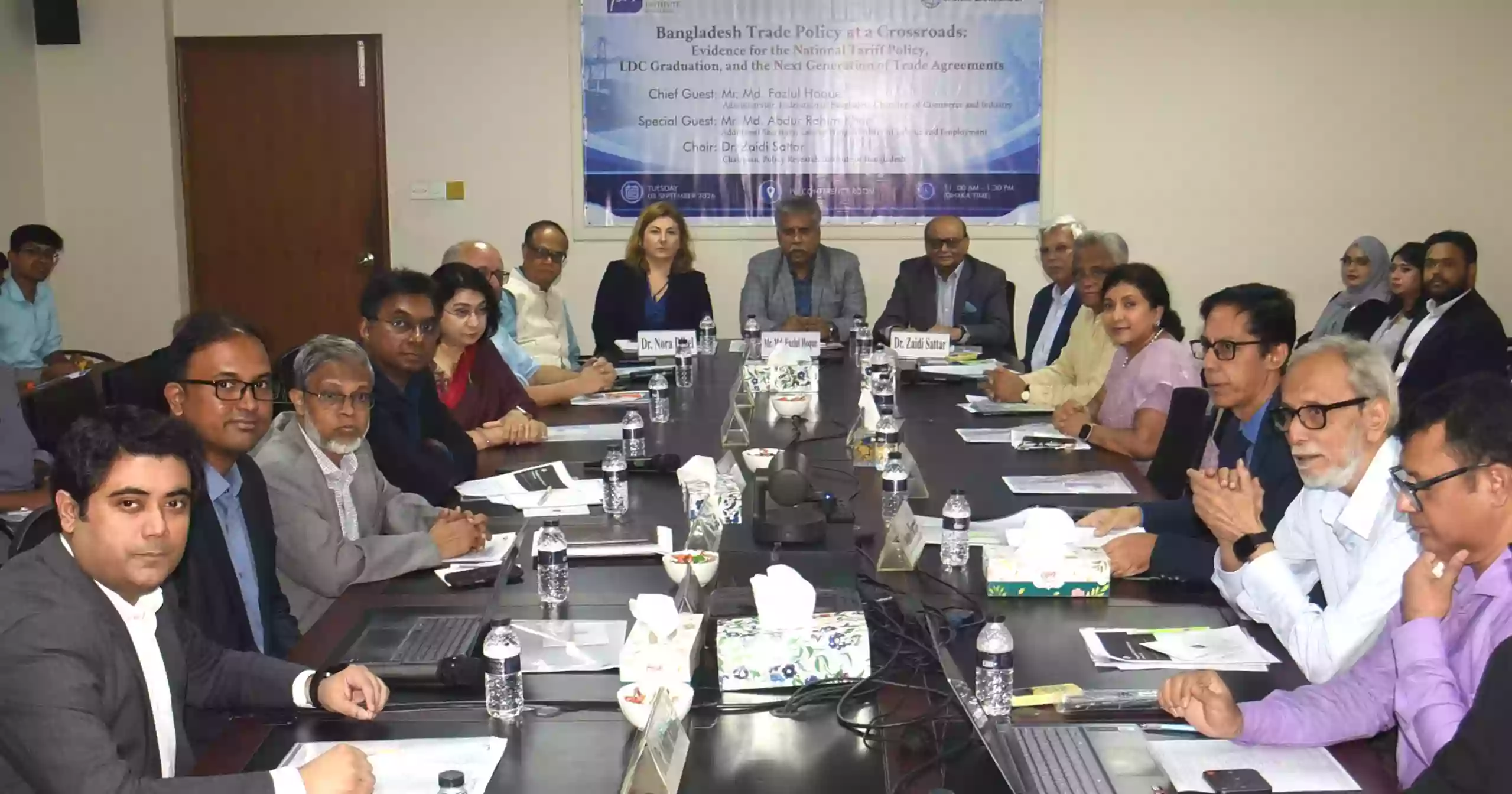
Policy Research Institute (PRI) Chairman Zaidi Sattar on Tuesday said Bangladesh's trade policy is at a crossroads, warning that deep tariff protection continues to punish exporters outside the readymade garment (RMG) sector while economy-wide reforms would ultimately pay for themselves without lasting revenue loss.
Speaking at a workshop jointly organised by PRI and the World Bank at the PRI office in Banani, Sattar said the country's high tariff and protection regime has made selling in the domestic market far more profitable than exporting for non-RMG industries, a divergence he described as significant rather than marginal, the "anti-export bias" that PRI has long highlighted in policy circles.
He said the widely-used import-weighted tariff measure understates the true scale of protection, since restrictive tariffs suppress the imports being measured in the first place.
Citing PRI's three-decade repository of disaggregated tariff data, he put Bangladesh's ex-ante average Nominal Protection Rate (NPR) for FY2027 at 28 percent, half of it stemming from para-tariffs, with average trade taxes at 55 percent.
Sattar said proposed measures under the Special Trade System (STS) and the FY2027 budget fall short of commitments made under the National Tariff Policy (NTP) 2023, a term he noted he had coined a decade ago while serving on the Tariff Rationalization Committee set up by the Prime Minister's Office.
He questioned why NTP implementation, a key part of preparations for Bangladesh's Least Developed Country (LDC) graduation, remains stuck at the proposal stage.
On tariff rationalization, he cautioned that cutting tariffs on intermediate goods alone, a measure the World Bank has said would improve competitiveness, could actually raise effective protection and intensify anti-export bias for non-RMG exporters unless matched by commensurate cuts in output tariffs.
He said the approach does not apply to RMG exporters, who already operate under a duty-free import regime.
On rationalizing exemptions, Sattar argued that end-user tariff concessions across numerous industrial sub-sectors should be eliminated first, with capital machinery as the only exception, noting protective MFN output tariffs average 42 percent against MFN input tariffs of 17 percent, a gap wide enough to already ensure significant protection.
Laying out a phased reform roadmap, he said Regulatory Duty (RD) and Supplementary Duty (SD) must be gradually eliminated before Customs Duty (CD) is touched, noting the effective top CD is actually 28 percent once the 3 percent RD is included.
In the first round, he proposed removing RD entirely and scrapping all SD above 20 percent, except on automobiles, firearms and tobacco. By 2029, in a second round, he proposed bringing CD down to 15 percent and SD down to 10 percent while making it fully trade-neutral.
He said protection remains concentrated in consumer goods industries, keeping domestic prices of durables and non-durables well above international levels, while non-RMG exporters are often forced to sell below domestic prices at world market rates.
TRIST (Tariff Reform Impact Simulation Tool) and GTAP (Global Trade Analysis Project) models, he added, remain the most useful tools for simulating reform scenarios, and he cited the 1990s tariff reforms as evidence that deep cuts need not erode customs revenue.
On World Trade Organization (WTO) reporting, Sattar said comparative assessments based on Bangladesh's WTO tariff policy reviews can be misleading, since notifications often omit distortive measures and para-tariffs are largely overlooked in such reviews.
He also warned that Bangladesh's current tariff structure rules out free trade agreements (FTAs), leaving only Economic Partnership and Comprehensive Economic Partnership Agreements within reach.
With Vietnam's FTA with the European Union already in effect and India's set to take effect by early 2027, he said Bangladesh risks falling behind regional competitors if it cannot pursue similar deals.
"Doing nothing will be costly, and reform will pay for itself," he said, though Sattar added the open question remains whether deeper trade agreements are feasible for Bangladesh at all.