President of Bangladesh Economic Zones Investors' Association (BEZIA) MA Jabbar said that despite many entrepreneurs paying significant amounts for plot allocations, sluggish infrastructure and utility development have fueled uncertainty in the economic zones.
As a result, only 27 industrial units are currently in production across 39,000 acres of land in these five zones, accounting for just 37 percent of the total allocated land currently in operation, he pointed out.
The BEZIA president highlighted during a with Bangladesh Garment Manufacturers and Exporters Association (BGMEA) held on Monday to boost investment momentum and resolve existing infrastructure and policy challenges in the economic zones.
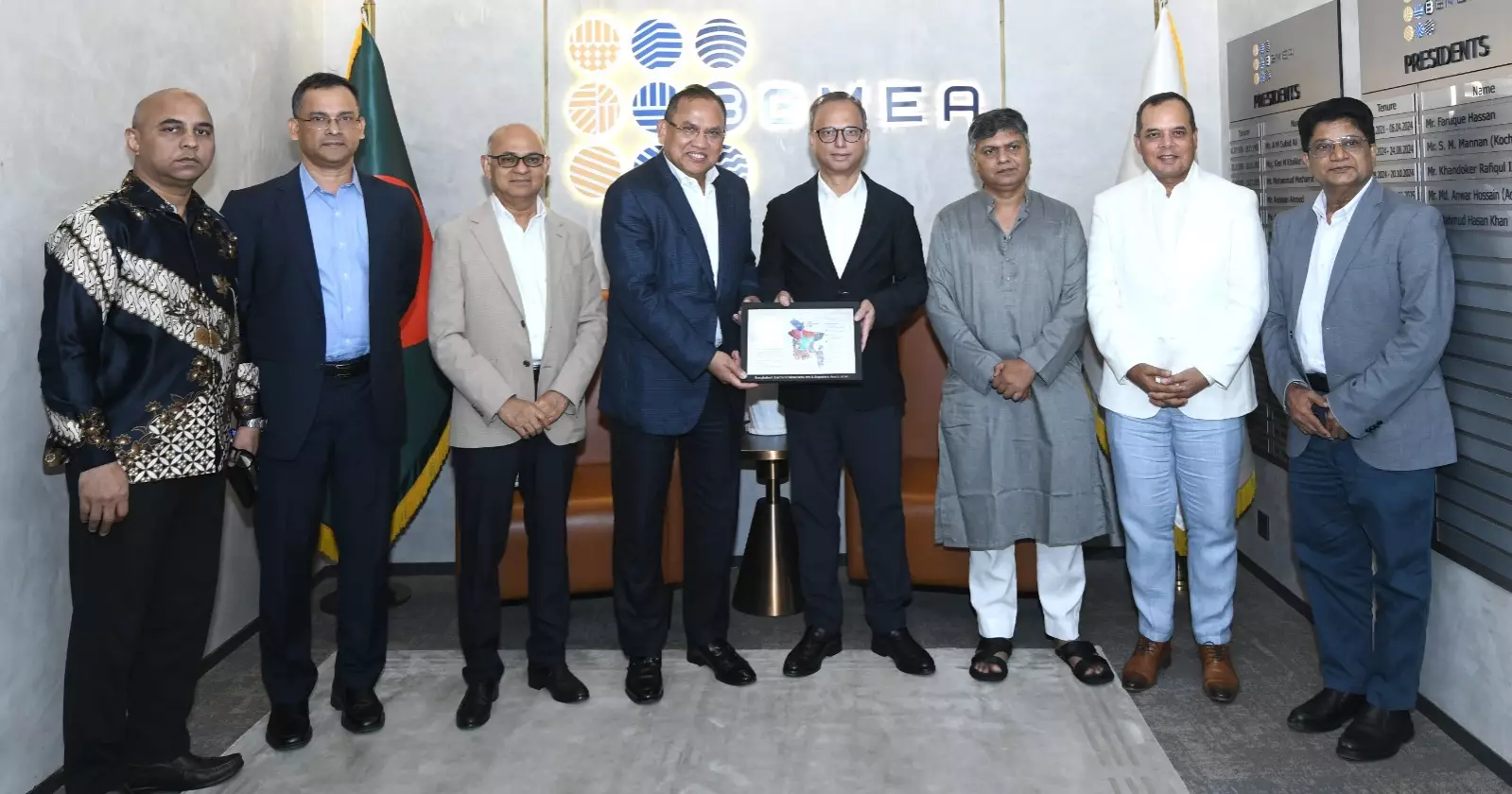
The meeting was held at the BGMEA Complex in Uttara, Dhaka. The BEZIA delegation was led by its President, M A Jabbar, alongside Vice President Md. Halimuzzaman, Director Delwar H Titu, CEO Dr. Aporup Chowdhury, and Member Md. Mustafizur Rahman. BGMEA President Mahmud Hasan Khan led the apparel trade body's delegation, accompanied by Vice President (Finance) Mizanur Rahman.
During the meeting, leaders from both trade bodies engaged in discussions regarding the progress of plots allocated across five public economic zones prioritized by the government for full operationalization in the first phase, as well as various policy bottlenecks faced by investors.
Emphasizing joint advocacy, the leaders called for addressing acute shortages of uninterrupted gas and industrial water, while opposing additional service charges imposed before factories become fully operational.
To ensure an investment-friendly environment, both organizations agreed to jointly submit several key policy demands to high-level government authorities. Some of these are:
Service Charge Waiver: Complete waiver of service charges imposed by the Bangladesh Economic Zones Authority (BEZA) on utility bills until guaranteed uninterrupted utility supply is ensured.
Cash Incentives: Providing sectoral cash incentives to unit investors in economic zones equal to those granted to units operating outside the zones to ensure parity.
Vat Exemption on Lease Tariff: Eliminating double taxation by waiving the 15 percent VAT on lease tariffs at both master leaseholder and sub-lessee levels.
Streamlining Deemed Exports: Allowing bonded-license domestic exporters to execute deemed export activities without requiring EXP and EP forms to eliminate administrative delays and hassle.
Operational Ease: Enhancing One-Stop Services (OSS) and making 99-year lease mutations bankable for securing financing.
BEZIA President MA Jabbar specifically noted that BGMEA has 41-unit investors in the National Special Economic Zone located in Mirsarai, Chattogram, making joint collaboration logically sound and vital for national and policy-level interests of the readymade garment (RMG) sector.
Against this backdrop, Jabbar invited BGMEA to nominate a representative to sit on the BEZIA Board of Directors to ensure sustainable industrialization and strengthen mutual coordination. BGMEA President Mahmud Hasan Khan welcomed the proposal and committed to nominating a qualified representative shortly.
The meeting concluded with leaders of both associations expressing optimism that their joint policy advocacy would encourage BEZA to take swift, groundbreaking steps to overcome infrastructural and policy bottlenecks.