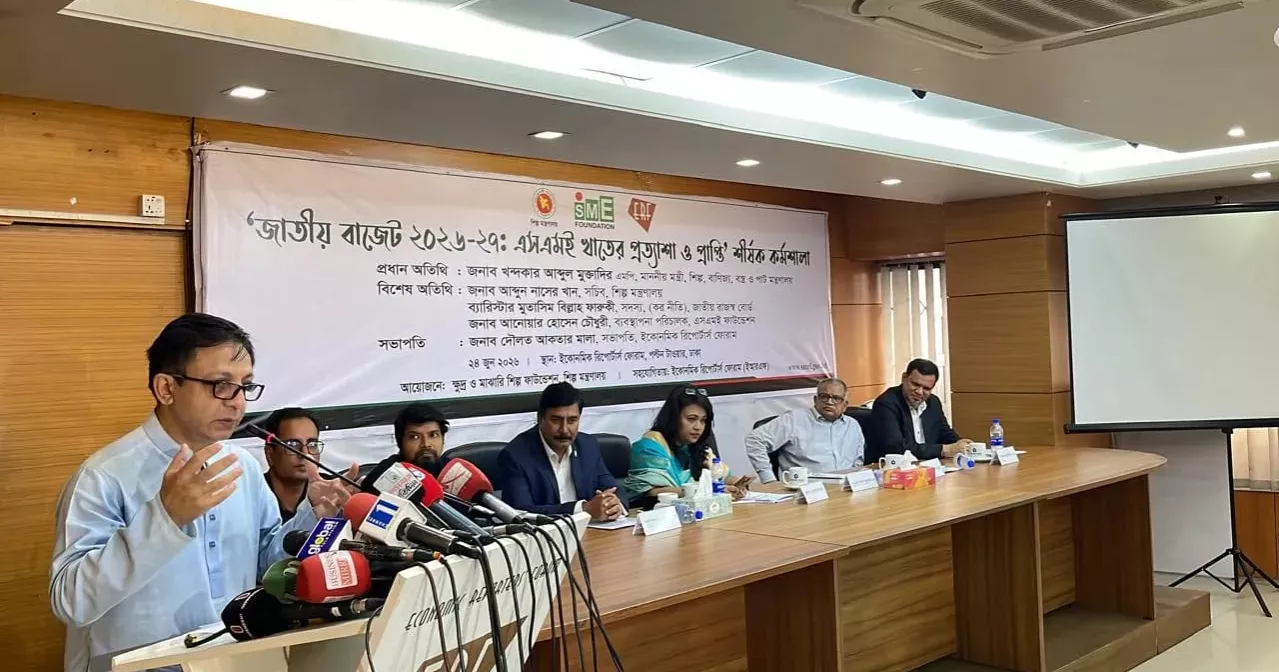
Khondker Abdul Muktadir, Minister of Industries, Commerce, Textiles, and Jute said on Wednesday that the government has made the stimulation of the Small and Medium Enterprise (SME) sector a top priority to accelerate economic growth and expand national employment opportunities,
Speaking as the chief guest at a seminar titled "National Budget 2026-27: Expectations and Achievements of the SME Sector," the Minister revealed that the government is working to reduce the time required for a business to secure all operational permissions and certifications from 355 days down to just 14 days.
He also assured that the government aims to ensure an uninterrupted energy supply for industrial enterprises to lower production hurdles.
The discussion was jointly organized by the SME Foundation and the Economic Reporters' Forum (ERF) at the ERF Auditorium in Paltan, with ERF President Daulat Akhter Mala in the chair and ERF General Secretary Abul Kashem moderating the session.
To boost industrial investment, the Minister announced that the government has reserved Tk 5,000 crore out of a Tk 60,000 crore stimulus package specifically for the SME sector. Furthermore, the government has planned dedicated SME hubs, setting aside 200 acres of land each in Sylhet, Pabna, and Thakurgaon to establish product modeling and training laboratories.
Addressing structural economic issues, Muktadir noted that a decade ago, Bangladesh's debt-to-GDP ratio was low, but subsequent administrations took random foreign loans for unproductive sectors, which failed to expand the economy or improve the tax-to-GDP ratio.
Referring to the upcoming Least Developed Country (LDC) graduation, he stated that as the largest economy among LDCs, Bangladesh has formally sought a three-year transition grace period.
He also pointed out logistical inefficiencies, stating that while global logistics costs average 10 percent of product value, it stands at 16 percent in Bangladesh. The government is actively monitoring this to lower costs, alongside initiatives to reopen closed state industries for private-sector operation.
Presenting the keynote paper, SME Foundation General Manager Mohammad Jahangir Hossain shared that out of 113 proposals submitted by the foundation for the fiscal year FY2026-27 budget, the National Board of Revenue (NBR) accepted 36 proposals—including 12 on income tax, 5 on VAT, and 19 on customs duties. For the first time, a dedicated allocation of approximately Tk 7,800 crore has been proposed for the CMSME sector in the national budget.
The keynote speaker, however, highlighted that policy incentives outlined in the National Industrial Policy 2022 and the draft National SME Policy 2026 are not being fully executed by the NBR. To bridge this gap, the foundation urged the formulation of a unified "Preferential Tax Regime for MSMEs" through a separate SRO.
The foundation also recommended increasing the current Tk 2,000 crore refinancing fund for easy-term loans, requesting at least Tk 5,000 crore exclusively for the SME Foundation. Additionally, it sought a Tk 100 crore allocation from the proposed Tk 300 crore creative economy fund under the "One Village-One Product" initiative, alongside an annual allocation of Tk 2,000 crore for holistic cluster-based SME development.
Speaking as a special guest, NBR Member (Tax Policy) Barrister Mutasim Billah Faruki stated that the government has delivered an industry-friendly budget that transitions toward a progressive minimum tax payment system. SME Foundation Managing Director Anower Hossain Chowdhury also spoke as a special guest, while Deputy General Manager Muhammad Morshed Alam delivered the welcome address.
According to latest data, the SME sector contributes nearly 30 percent to Bangladesh's GDP. The Bangladesh Bureau of Statistics (BBS) Economic Census indicates that out of 1.17 crore industrial units in the country, roughly 99 percent belong to the Cottage, Micro, Small, and Medium Enterprise (CMSME) sector, accounting for over 85 percent of total industrial employment by employing more than 3 crore people.