Business leaders, government officials and development partners on Thursday called for sweeping regulatory reforms to reduce administrative burdens on micro, small and medium enterprises (MSMEs), saying business formalisation is essential for Bangladesh’s smooth graduation from Least Developed Country (LDC) status.
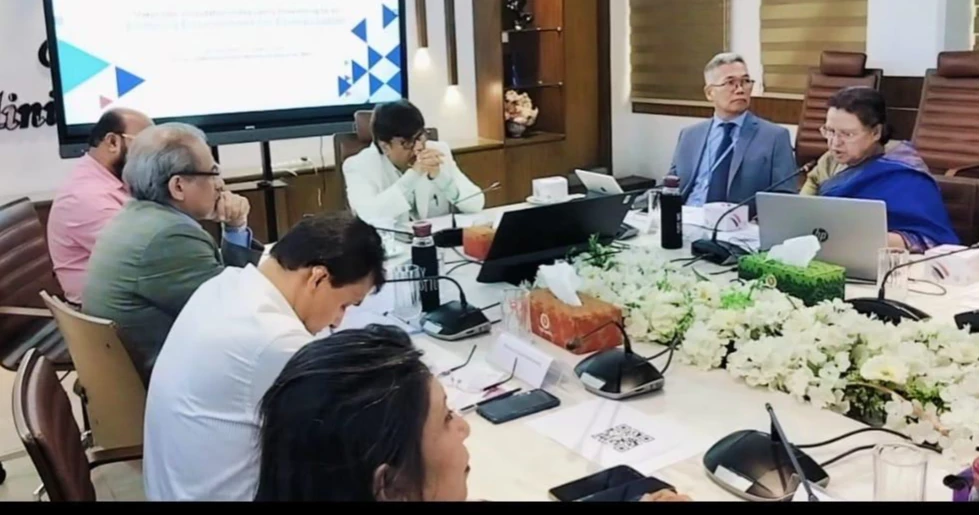
The call came at a stakeholders’ consultation titled “Regulatory Streamlining for an Enabling Business Environment for Formalization”, jointly organised by Business Initiative Leading Development (BUILD), the Ministry of Industries (MoI) and the International Labour Organization (ILO) at the ministry’s conference room in Dhaka.
Sweeping deregulatory measures in budget to lower cost of doing business: NBR Chairman
The consultation brought together senior government officials, business chamber representatives, employers’ and workers’ organisations, development partners and researchers to discuss BUILD’s newly launched business licensing guidebooks and identify priority regulatory reforms.
Speaking as the chief guest, Industries Secretary Abdun Naser Khan said simplifying regulations is crucial for accelerating enterprise formalisation and easing the challenges faced by SMEs.
He said a high level committee headed by the Minister for Industries, Textiles, Jute and Commerce has already been formed to speed up regulatory reforms, expressing hope that businesses would see simplified procedures soon.
Referring to BUILD’s proposal for a deregulation action plan within the next 90 days, he said the government remains committed to reducing administrative hassles and making the One Stop Service (OSS) more effective through digitalisation. The Ministry of Industries is working closely with the Prime Minister’s Office in this regard, he added.
Opening the session, BUILD Chairperson Abul Kasem Khan said the organisation’s newly published business licensing guidebooks would help investors better understand permit and approval requirements.
He also proposed a unified utility connection application system, joint inspection mechanisms and legally enforceable Service Level Agreements (SLAs) to reduce delays in government services.
Noting the government’s target of creating one million jobs, he said Bangladesh would need at least 100,000 new entrepreneurs to achieve that goal, making regulatory simplification indispensable.
Presenting the keynote paper, BUILD Chief Executive Officer Ferdaus Ara Begum said excessive regulation continues to impose significant costs on businesses.
Citing Bangladesh Bureau of Statistics (BBS) data, she said around 65 percent of economic units remain informal, although registered enterprises account for more than half of total employment.
Based on more than 50 key informant interviews, she said plastic waste management businesses currently require up to 31 licences, submission of more than 235 documents and approval processes stretching to around 650 days.
Similarly, light engineering enterprises need around 30 licences, more than 200 documents and processing periods of up to 600 days, while nearly 50 to 60 percent of paperwork is duplicated across government agencies, she added.
To address these challenges, BUILD proposed introducing a Single Digital Business Identity Number, a One Stop Licensing Platform and multi year licence validity, which it said could reduce compliance costs by 30 to 50 percent.
Representing the ILO, Peter Jr. Bellen said eight out of every ten workers in Bangladesh are employed in the informal economy.
He stressed that transitioning informal workers into formal and decent employment would be vital as Bangladesh prepares for LDC graduation and export diversification, adding that the ILO would continue providing technical support for the reform process.
During the panel discussion, Additional Secretary and Registrar of Joint Stock Companies and Firms (RJSC) A K M Nurunnabi said company registration now takes less than 48 hours, provided all required documents are submitted, at a fee of Tk 2,500.
He also said amendments to the Companies Act, 1994 are underway and physical signatures for share transfers are gradually being replaced with fully digital processes.
Joint Secretary Md Shamsul Hoque of the Ministry of Local Government, Rural Development and Cooperatives said more than 5,500 autonomous local government bodies currently issue trade licences.
He identified the absence of a centralised trade licence database as a major challenge and supported further discussions with BUILD, ILO and the Ministry of Industries to streamline the licensing process.
Deputy Managing Director of SME Foundation Nazem H Sattar called for time bound deregulation measures and urged a review of the existing 4 percent SME lending interest rate cap, arguing that it discourages banks from extending loans to small businesses because of high monitoring costs.
Dr Nadia Binte Amin, President of Women Entrepreneurs Network for Development (WEND), highlighted concerns over advance income tax collected during trade licence renewals, mandatory audit costs for small businesses and the absence of a simple business exit policy. She also called for issuing trade licences in both Bangla and English to support exporters.
Saifur Rahman, Chairman of SKB Stainless Steel Mills Limited, proposed forming a joint public private task force to remove regulatory bottlenecks and suggested that regulators focus on product quality standards rather than prescribing specific production machinery.
Concluding the event, Additional Secretary Nurruzzaman thanked participants and requested BUILD and the ILO to compile the reform proposals generated during the consultation. The Ministry of Industries said follow up meetings would be held to translate the recommendations into concrete policy actions.