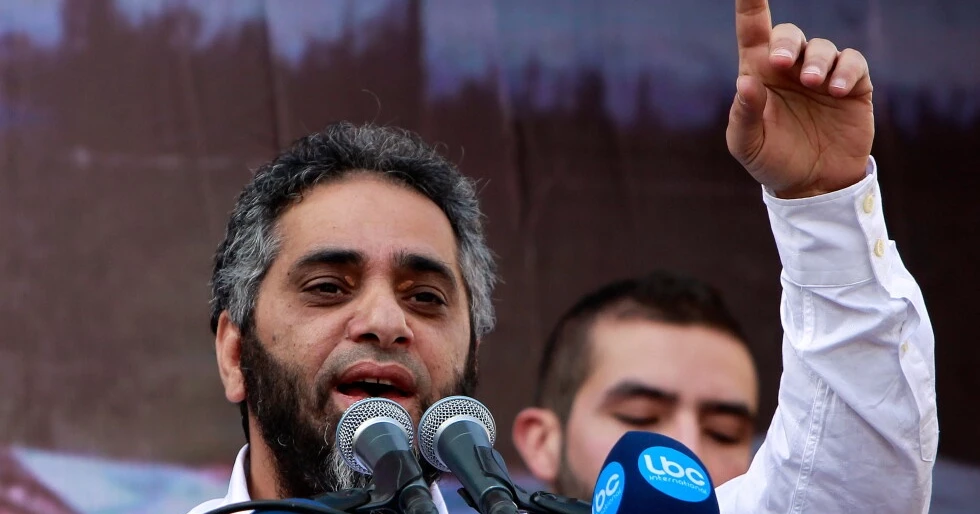
Lebanese authorities on Wednesday released singer-turned-militant Fadel Shaker on bail after he spent several months in custody awaiting a retrial on charges including membership in an armed group and money laundering, judicial officials said.
Shaker surrendered to Lebanon's military intelligence in October last year after spending 12 years in hiding in the Palestinian refugee camp of Ein el-Hilweh near the southern port city of Sidon.
He had been convicted in absentia in 2020 and sentenced to 22 years in prison for supporting what authorities described as a terrorist group following deadly clashes between Sunni militants and the Lebanese army near Sidon in 2013.
According to four judicial officials, Shaker paid bail of 500 million Lebanese pounds (about $5,500) before being released on Wednesday.
Before his release, he was questioned over several allegations, including belonging to an armed group, financing militant groups, money laundering and his alleged involvement in the 2013 Sidon clashes.
The officials said the investigation is still ongoing and none of the cases against him has been closed. They spoke on condition of anonymity because they were not authorised to discuss the case publicly.
After leaving the military facility on the outskirts of Beirut where he had been detained, Shaker moved into a rented apartment, the officials said. Neither Shaker nor his lawyer responded to requests for comment.
Under Lebanese law, Shaker's earlier conviction was cancelled after he surrendered, allowing him to face a new trial that began in January.
During the court proceedings, Shaker said he had once been close to Sunni cleric Ahmed al-Assir but claimed he had later fallen out with him before the 2013 violence. He also testified that he had received threats from Hezbollah and supporters of former Syrian President Bashar Assad.
Shaker repeatedly denied taking part in the fighting near Sidon.
In 2017, al-Assir was convicted and sentenced to death for his role in the clashes, which killed 18 Lebanese soldiers after a two-year trial. He remains on death row.
However, prosecutors have pointed to a video posted on YouTube during the 2013 fighting that appears to show a bearded Shaker insulting his opponents and mocking the Lebanese military while referring to the deaths of two pro-Hezbollah fighters.
The clashes intensified sectarian tensions between Lebanon's Sunni and Shiite communities at a time when the civil war in neighbouring Syria was fuelling divisions. Hezbollah had backed Assad's government, while many Sunni militants supported rebel groups fighting to overthrow him.
Before becoming involved in militant circles, Shaker was one of the Arab world's most popular singers, rising to fame with a hit song released in 2002.
Many fans were surprised when he later appeared alongside al-Assir at public rallies and announced he was giving up music to focus on religion.
Despite remaining a fugitive for years, Shaker continued releasing songs, including one with his son Mohammed last July that became widely popular across the Arab world.