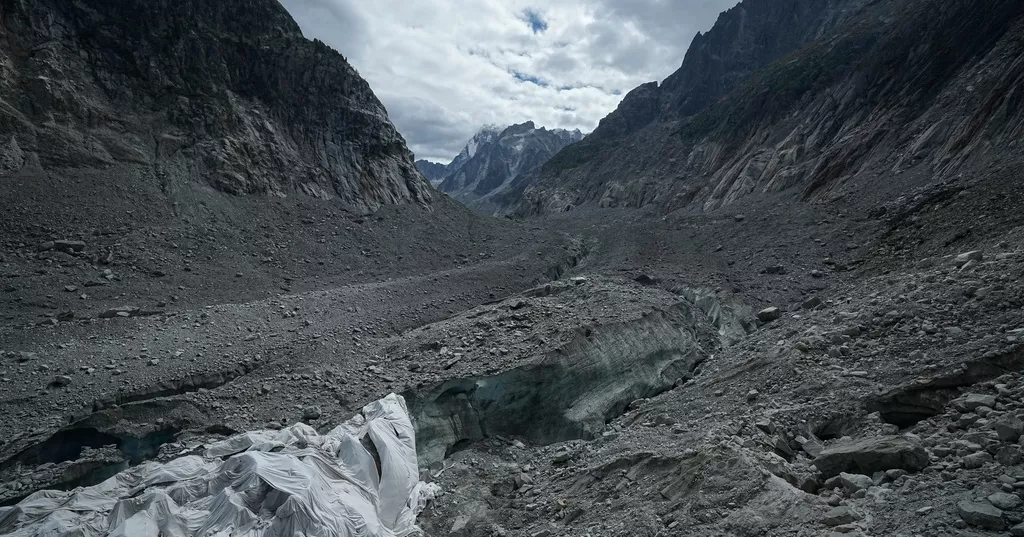
Climate change is rapidly transforming the landscape around Mont Blanc, Western Europe’s highest peak, as retreating glaciers, melting snow and thawing permafrost increase the risks of rockfalls and other hazards.
Communities and researchers on both the French and Italian sides of the mountain say this summer’s record heat has accelerated changes that are already reshaping the Alpine environment.
At 4,805 meters, Mont Blanc has long been known for its glaciers and snow. But rising temperatures have weakened permafrost that has helped hold steep mountain slopes together for thousands of years.
Stéphane Bozon, deputy mayor of Chamonix-Mont-Blanc and responsible for safety, said rockfalls increased from mid-July, while glacier retreat and snowmelt created more crevasses and made some areas difficult to access.
At Aiguille du Midi, which rises to 3,842 meters in the Mont Blanc range, the average temperature this July reached 3.3 degrees Celsius, the highest July average on record, according to Meteo France. The previous figure was 1.6 C in July 1994.
Bozon said the unusual heat had left the mountain exceptionally dry and raised concerns about future glacier or rock collapses affecting populated areas.
Himalayan disaster highlights wider risks
The changes in the Alps have drawn renewed attention following devastating floods in Nepal and China on Aug. 26, triggered by the collapse of bedrock and glacier ice that sent water and debris through Himalayan rivers.
Scientists have said climate change likely contributed to the conditions that made the Himalayan disaster possible, with warming temperatures increasing the risk of similar events.
Researchers in the Alps are observing comparable climate-related changes, although the hazards and circumstances differ.
In Italy’s Lombardy region, Alpine glaciers have lost more than 40% of their surface area since 1991, according to the regional glacier service.
Vanda Bonardo, head of the Italian branch of the International Commission for the Protection of the Alps, said rain is increasingly replacing snowfall at high elevations, affecting the stability of mountain terrain.
Rockfalls surge
Ludovic Ravanel, a Savoie Mont Blanc University researcher who studies the effects of climate change on mountain snow, glaciers and permafrost, said thawing ice is weakening rock faces that were previously stabilized by frozen ground.
He expects around 400 major rock collapses in the Mont Blanc massif this year, roughly 10 times the number recorded two decades ago. A major collapse is defined as involving more than 100 cubic meters of rock.
The previous particularly severe year was 2022, when nearly 300 such collapses were recorded, Ravanel said.
He described the sharp increase in rockfalls as one of the defining features of the summer of 2026.
Climbers face growing dangers
Chamonix-based mountain guide Stuart MacDonald said the rapid retreat of glaciers has been striking, with some routes changing dramatically within just a few years.
Melting ice and falling rocks made guiding particularly difficult this summer, forcing him to cancel plans to take a group to the summit of Mont Blanc last week.
MacDonald said climbers can sometimes hear rocks falling before seeing large cascades rushing down slopes. Some routes that were regularly used in July and August in previous years have now become too dangerous or inaccessible.
Bozon said Chamonix must prepare quickly for potentially serious scenarios as the effects of glacier retreat continue to intensify.
“We have to move quite quickly,” he said, noting that each summer has brought new warnings about the changing mountain environment.