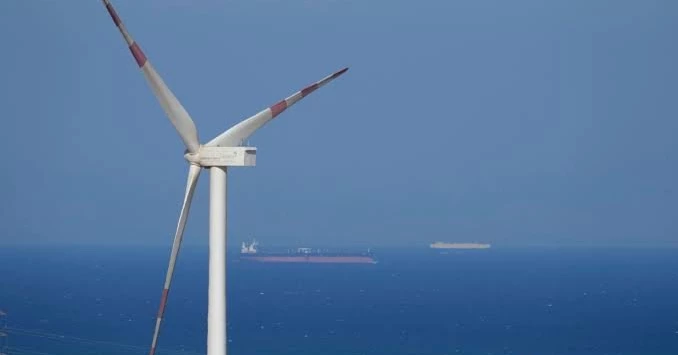
Egypt is seeking to build its renewable energy industry by manufacturing wind turbines domestically, a strategy that could offer lessons to other African countries trying to expand clean-energy production.
Egypt has signed an agreement with Chinese company SANY Renewable Energy to develop a 2,000-megawatt wind power project in the Gulf of Suez, along with the country's first wind turbine manufacturing plant.
The wind project is expected to be connected to Egypt's national grid within 23 months after the final agreements are signed. The factory is expected to supply turbines for the Egyptian market and potentially export equipment to other countries in Africa and the Middle East.
Although the project is still in its early stages, energy experts say its focus on large-scale production, local manufacturing and technology transfer could provide useful lessons for African countries that have struggled to turn renewable energy plans into working infrastructure.
Nigeria's experience shows the challenge. A 10-megawatt wind farm there took nearly two decades to begin generating electricity. The contrast highlights a wider problem for Africa: moving beyond imported equipment and project announcements to developing the financing, industrial capacity and stable policies needed to deliver renewable energy projects.
“The contrasts are stark,” said Fadhel Kaboub, an associate professor of economics at Ohio's Denison University. “We have a project in Nigeria that took two decades to come online, whereas we have this one project in Egypt that looks like it's going to really take off.”
Egypt's plan brings opportunities and risks
Kaboub cautioned that Egypt's project has not yet proved successful. However, he said its large scale, manufacturing component and partnership with a Chinese technology company could improve its chances of attracting investment and being completed quickly.
“For manufacturing anything to be profitable, efficient and successful, you need economies of scale,” he said. “The problem with every African country is that our internal markets are too small. We don't have the economies of scale to industrialize one country at a time.”
Egypt's plan is part of a wider effort to develop renewable energy technology locally, increase domestic production and use the country's trade connections to export equipment.
The government has said the factory will reduce dependence on imported equipment while creating an industrial base around renewable energy.
However, the plan also carries risks.
Kaboub said Egypt must ensure that its partnership with SANY includes genuine technology transfer rather than creating another form of dependence on foreign manufacturers.
“If the Chinese partner fully retains control over the technology and there's really no transfer of technology, then we're looking at another cycle of dependence,” he said.
Nigeria's experience shows importance of project design
Nigeria's experience demonstrates that how a renewable energy project is structured can be as important as the technology used.
The 10-megawatt Lambar Rimi wind farm in Katsina state was awarded to French turbine maker Vergnet in 2010, with completion planned for 2012.
Funded by the Japan International Cooperation Agency, the project was designed to use 37 turbines, each capable of producing 275 kilowatts.
The project remained stalled for years before the Katsina state government took it over. It was finally commissioned in September 2025 after the state added 10 megawatts of solar power capacity.
Dr Dola Oluteye, founder of the PATNA Initiative and a senior fellow in energy and transport policy at University College London's Bartlett School of Environment, Energy and Resources, said the comparison should not simply be presented as a failure by Nigeria and a success by Egypt.
“The useful question is what Egypt has built into its project structure that Nigeria left unresolved for years,” Oluteye said. “The cost of capital is the binding constraint, not the resource.”
The International Energy Agency says the cost of capital for utility-scale clean-energy projects in Africa is at least two to three times higher than in advanced economies and China.
Africa receives about 2% of global clean-energy investment despite being home to roughly one-fifth of the world's population.
Oluteye said Egypt's decision to structure the new wind project in local currency is particularly important because it can reduce the currency mismatch that affects African power projects financed in US dollars but generating revenue in local currencies.
Africa could use its market to secure better terms
The manufacturing component could also affect the economics and future negotiations surrounding renewable energy projects.
“While Nigeria purchased 37 turbines, Egypt is attempting to buy the capability to make them,” Oluteye said.
African countries could combine their markets to negotiate better conditions with technology providers, including agreements on local manufacturing and technology transfer.
“If we form a negotiating bloc with a joint industrial policy, we can probably get better terms for technology transfer and joint ventures that could transform the continent at scale,” Kaboub said.
For Nigeria, the challenge is not simply finding more wind resources.
“If something is new, especially in Africa, you want to pilot it first,” Kaboub said, stressing the need for stronger feasibility studies, affordable financing, clear project ownership and consistent policies.
“The implementation of policy is what is critical, not the fact that you have 50 policies on your website or in your government documents,” he said.