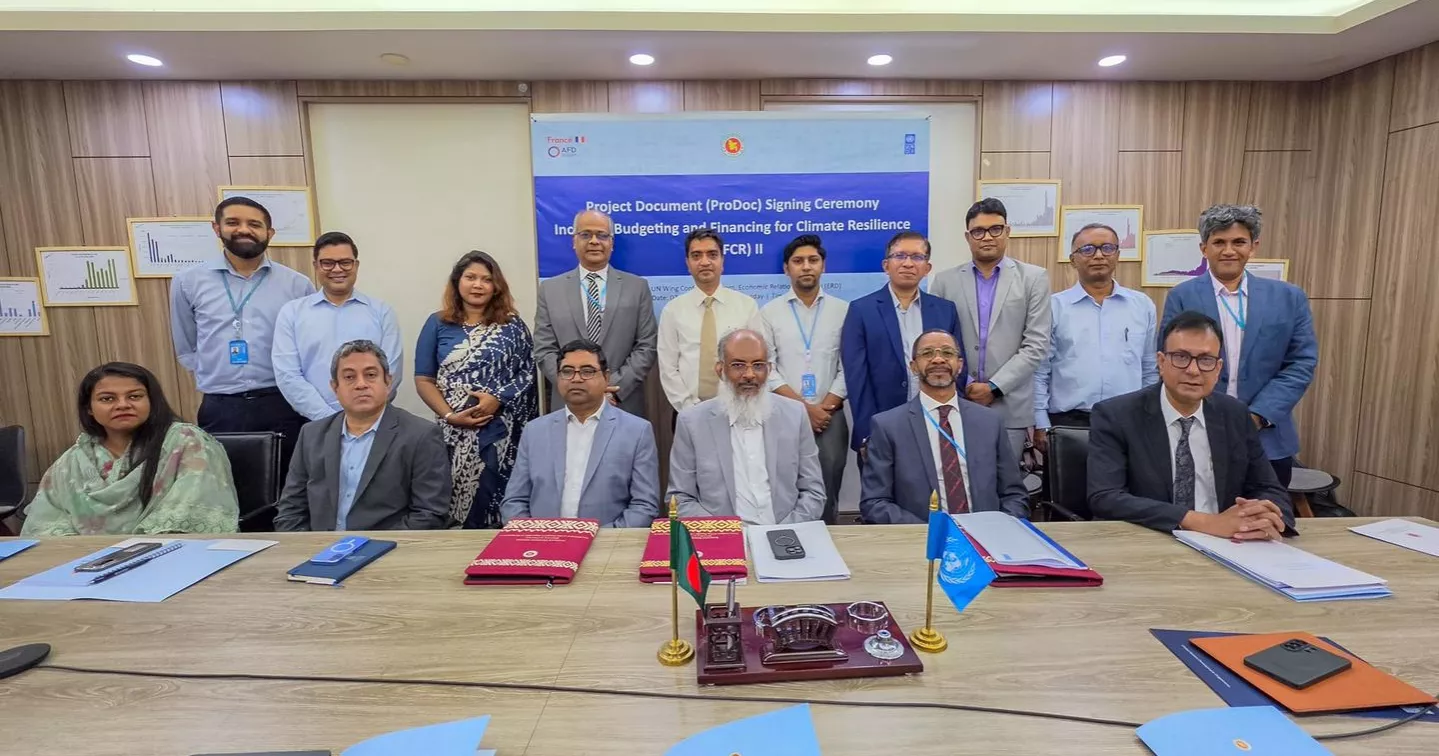
The government of Bangladesh and the United Nations Development Programme (UNDP) on Wednesday signed the Project Document for the second phase of Inclusive Budgeting and Financing for Climate Resilience (IBFCR II), marking a renewed effort to strengthen how climate priorities are integrated into public planning, budgeting and financing.
The Project Document was signed at the Economic Relations Division (ERD) by ERD Secretary Md Shahriar Kader Siddiky, Additional Finance Division Secretary Md Hasanul Matin and Resident Representative of UNDP Bangladesh Stephen Rodriques on behalf of their respective organisations.
Financed by Agence Française de Développement (AFD), the initiative will be led by the Finance Division, with technical and implementation support from UNDP.
Building on the first phase, IBFCR II will strengthen climate-sensitive public financial management and help ensure that climate finance is planned, tracked and used more effectively, particularly for climate-vulnerable areas and communities, according to a press release.
Under the project, Bangladesh will update its climate finance tracking methodology, strengthen the Climate Fiscal Framework and develop a National Climate Finance Strategy.
It will also strengthen ex-ante climate budgeting and project appraisal, introduce climate budget geotagging, and improve the tracking and reporting of climate finance reaching vulnerable areas.
The project will work across key government institutions, including the Ministry of Planning, Office of the Comptroller and Auditor General, Bangladesh Bureau of Statistics, Local Government Division and other relevant ministries, divisions and agencies.
Training, technical assistance and improved digital tools will support officials to use climate evidence more systematically in planning and financial decision-making.
The project will run until December 2027. It will also strengthen evidence on local climate finance and household expenditure related to climate shocks, helping policymakers better understand where resources are needed and how public finance can respond more effectively.
Shahriar Kader said, “Climate vulnerability is placing increasing pressure on our development efforts. We need a clear understanding of our financing needs, existing gaps and how resources are being used. Stronger tracking, reliable data and better coordination will help us align climate finance with national priorities and direct more resources to vulnerable areas.”
Drawing a direct connection between national financing systems and the realities facing climate-vulnerable communities, Stephen Rodriques said, “The needs of communities most affected by climate change must shape how we plan and spend public resources. Stronger systems should ultimately translate into practical improvements for people who are most in need. By strengthening the Government’s capacity to plan, track and account for climate finance, we can help ensure that resources respond more effectively to local priorities and climate risks.”