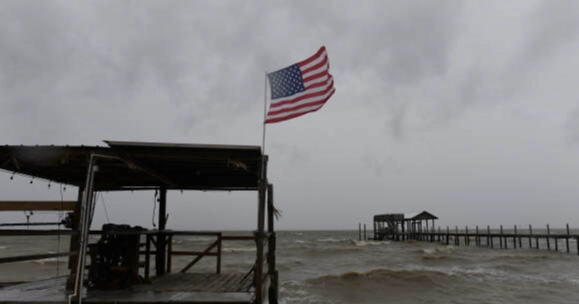
Hurricane Isaias struck the US Gulf Coast on Friday as a powerful Category 2 storm, bringing destructive winds, torrential rainfall, flooding and potentially deadly storm surges to parts of Alabama and Florida’s Panhandle.
The Atlantic season’s first hurricane made landfall near Destin, Florida, according to the National Hurricane Center in Miami. The storm had maximum sustained winds of 105 miles per hour (169 kilometres per hour). It weakened slightly below major hurricane strength before reaching the coast.
Florida Governor Ron DeSantis urged residents to remain indoors and avoid travelling as the storm moved ashore. Speaking at a news conference, he warned that flash flooding would pose a serious threat across the region.
Hurricane-force winds battered the low-lying Gulf coastline, an area famous for its white sandy beaches, holiday homes, waterfront bars and seafood restaurants. Meteorologists also warned that the storm could generate tornadoes.
Authorities in Mobile, Alabama, reported fallen trees and damaged power lines. Meanwhile, the Emerald Coast Utilities Authority, which provides services to parts of Florida, issued a boil-water advisory for its customers.
According to PowerOutage.com, more than 400,000 electricity customers across Florida and Alabama had lost power by Friday evening.
In Panama City, Florida, residents worked in heavy rain to fill sandbags and protect their homes from flooding. Corliss Stone, a fire department employee, said preparing for severe weather was part of living in Florida.
Residents prepare to face the storm at home
One of the greatest concerns was the possibility of storm surges reaching between 6 and 9 feet (1.8 to 2.7 metres), the National Hurricane Center warned. Areas considered particularly vulnerable included Pensacola Beach and the Gulf Islands National Seashore in Florida.
Anne Petzold, who lives with her husband in the coastal community of Gulf Breeze, said their neighbourhood residents intended to remain at home throughout the storm. The couple had fitted hurricane shutters and removed loose objects from their yard that could become dangerous projectiles in strong winds.
She said neighbours were helping one another by offering assistance and checking whether anyone needed support, describing the preparations as another challenge of coastal living.
The National Hurricane Center warned that hazardous conditions were expected across western Florida’s Panhandle, southern Alabama and southern Mississippi.
Several counties ordered mandatory evacuations, while officials in Mobile, Alabama, introduced a curfew beginning Friday evening and continuing until the following morning.
The seriousness of the situation was also reflected in the closure of dozens of Waffle House restaurants across Florida’s Panhandle. The popular Southern breakfast chain is widely known for remaining open during extreme weather, and its closures are often regarded as an informal indicator of a storm’s severity.
Kelsei Frazier, a Florida native living in Pace who has experienced hurricanes before, said she and others often use the so-called Waffle House Index to judge the seriousness of a storm. She noted that the closure of nearly all the locations near her community was an unusual and significant warning sign.
DeSantis cautioned that residents should prepare for electricity outages, possible gasoline shortages and the closure of bridges and highways.
About 5,000 National Guard soldiers and airmen were deployed to assist with emergency operations. Search-and-rescue teams were placed on standby, while some correctional facilities evacuated inmates as a precaution.
Heavy rainfall expected across a wider region
The National Hurricane Center forecast that Isaias would gradually lose strength and be downgraded to a tropical storm by Saturday afternoon.
However, the weakening system was still expected to produce substantial rainfall as it moved inland. Forecasts called for 4 to 8 inches (10 to 20 centimetres) of rain, with potentially higher totals, across areas extending from southern Alabama to southwestern Georgia through the weekend.
Isaias is the first hurricane to strike the eastern United States since Hurricane Milton devastated parts of Florida’s Gulf Coast in 2024.
The storm was also expected to bring heavy rain and possible flooding to much of the southeastern United States over the weekend before affecting portions of the Midwest and Northeast by Monday.
Flights cancelled, while major oil facilities expected to avoid direct impact
Hurricane Isaias disrupted air travel on Friday, forcing several airports across Florida’s Panhandle to cancel most flights. Destin-Fort Walton Beach Airport suspended all arrivals and departures.
US President Donald Trump also cancelled plans to attend Saturday’s football game between the University of Georgia and the University of Alabama in Tuscaloosa, saying he did not want his visit to interfere with emergency response operations.
Although forecasters expected the hurricane to bypass the Gulf Coast’s principal oil industry hubs, energy experts warned that fuel prices could increase if widespread power outages forced refineries to suspend crude oil processing.
On Dauphin Island, a barrier island off Alabama’s coast, Mayor Jeff Collier said he did not anticipate extensive damage but stressed that hurricanes could change direction or intensify unexpectedly. He said local authorities needed to prepare for the worst possible outcome.
Meanwhile, in the Pacific Ocean, Hurricane Simon strengthened into a Category 2 storm on Friday and was forecast to intensify further before reaching Mexico over the weekend.
Tropical Storm Rachel was also expected to bring strong winds and heavy rainfall to northern Mexico and Southern California during the same period.