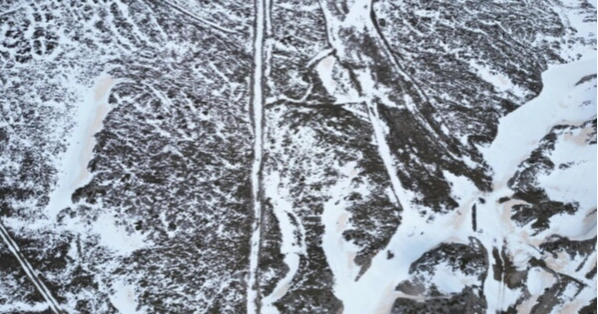
Greece’s mountain communities are facing growing concerns as snowfall continues to decline, threatening water supplies, increasing wildfire risks and hurting winter tourism-dependent businesses.
Residents of Arachova, a mountain village known for its popular ski resort on Mount Parnassos, say winters are no longer what they used to be.
Mayor Giannis Stathas recalled that heavy snowfall during his childhood often kept people indoors for days and schools closed.
“We couldn’t go to school because of the snow,” he said. “Now we don’t see that here anymore.”
According to Stathas, snow that once fell at lower elevations now appears only much higher up the mountain.
New research by the University of Cambridge’s Scott Polar Research Institute supports these observations, showing that snow cover across Greece’s mountains has dropped sharply over the past four decades.
Snow hydrologist Konstantis Alexopoulos, who worked on the study, said more than half of Greece’s snow cover has disappeared since the mid-1980s.
Researchers used 40 years of satellite images from NASA and the European Space Agency, along with machine learning technology, to study long-term snow trends.
Alexopoulos explained that snow acts as a natural water reserve because it stores water during winter and gradually releases it during the dry summer months when water is most needed.
Unlike rainfall, which quickly flows into rivers and the sea, melting snow helps maintain water supplies during Greece’s hot and dry summers.
He said rising global temperatures linked to greenhouse gas emissions are mainly responsible for the declining snowfall and shorter snow seasons.
“The current rate of climate change globally and especially in regions like the Mediterranean is much faster than before,” Alexopoulos said.
He added that although snow decline has also been recorded in regions such as the Himalayas and Andes, the speed of loss in Greece was unexpectedly high.
The impact is already being felt in Arachova, where local businesses and residents depend heavily on water from melting snow
Restaurant owner Aktida Koritou said locals are becoming increasingly worried about water shortages, especially during summer.
According to the mayor, springs are drying up and reservoirs are failing to refill properly.
“The biggest problem starts in late August and continues until early autumn,” Stathas said.
Authorities are now considering building small dams to save water, while the ski resort is taking measures to preserve snow for longer periods.
The lack of snow is also increasing fire risks as forests become drier.
Stathas said wildfires were once rare in northern Greece but are now a serious threat because of prolonged drought.
The changing climate is also affecting tourism in Arachova, where the local economy largely depends on skiing.
Koritou said the ski season now starts later than before, often beginning in January instead of December.
She said many tourists now choose countries with more reliable snowfall during Christmas holidays, causing business losses.
“This Christmas, business dropped by around 30% for me,” she said.
To reduce dependence on winter tourism, local authorities are promoting Arachova as a summer destination.
Despite these efforts, longtime residents say they deeply miss the heavy snowfalls of the past.
“There are some years when despair grips you,” Koritou said. “For those of us who know winter well, it’s disappointing not to see snow. The change is enormous.”