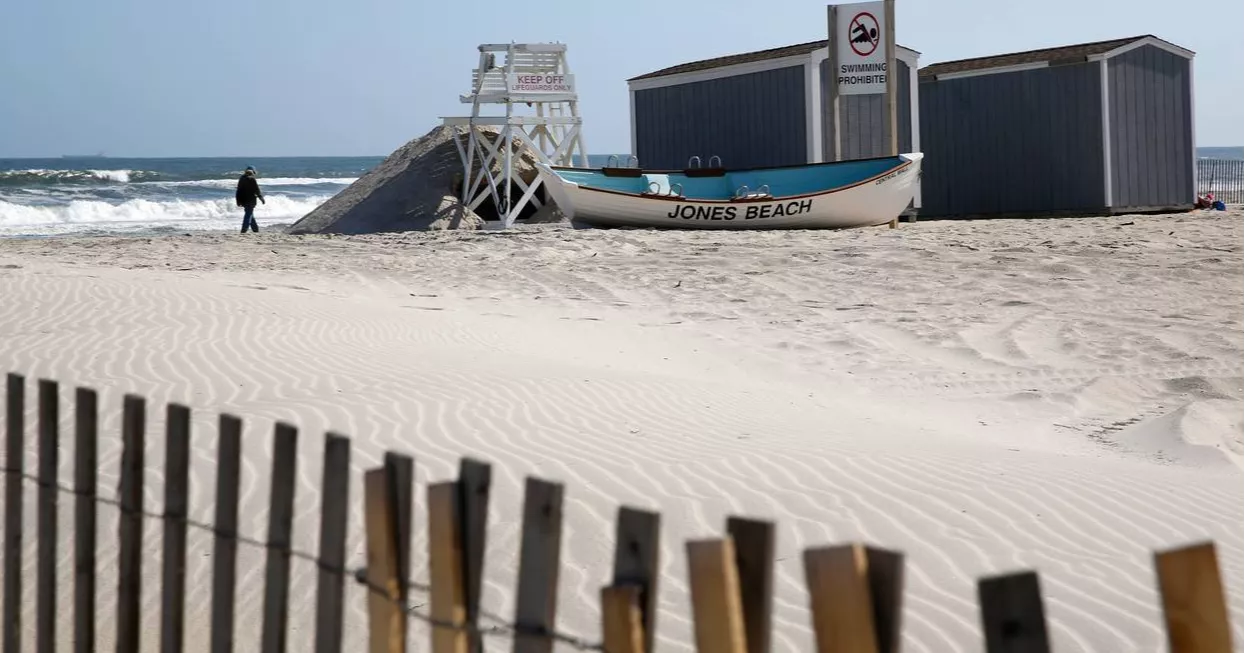
An amateur historian has uncovered new evidence that a prominent historical figure associated with one of New York's most popular beaches may have helped notorious English pirate Capt. Henry Every escape authorities after a massive raid on an Indian treasure ship more than three centuries ago.
James Bailey, who attracted attention five years ago after discovering ancient coins believed to be connected to Every, says colonial-era documents point to Thomas Jones, the namesake of Jones Beach State Park, as a possible accomplice of the infamous pirate.
Jones Beach, one of New York's most visited state parks after Niagara Falls, attracts millions of visitors each year.
Bailey said his latest research suggests that Jones played a significant role in what could be considered one of the largest robberies in the history of piracy.
His investigation focuses on the 1695 attack on the Ganj-i-Sawai, a royal Indian treasure ship travelling through the Red Sea. Historical accounts say Every and his crew tortured, killed and sexually assaulted passengers and crew members during the raid, triggering international outrage and one of the earliest major international manhunts.
Although several members of the pirate crew were eventually captured and executed, Every and many of his associates disappeared. They are believed to have fled to different parts of Europe and the American colonies.
According to Bailey, depositions from associates of Every and other historical records suggest that Jones acted as a getaway operator, helping the pirates avoid authorities after they seized gold and silver worth tens of millions of dollars.
Additional documents indicate that New York's colonial governor later investigated Jones over suspected links to piracy, even after he had established himself as a wealthy businessman involved in whaling on Long Island's coastal barrier island.
Mystery surrounding Jones' past
Bailey's findings, which he hopes to publish, offer further insight into the controversial history of Jones, whose possible involvement in piracy has long been mentioned in local historical accounts.
John Hanc, author of Jones Beach: An Illustrated History, said Bailey's research sheds light on an aspect of Jones' past that has never been fully established in local history books.
Jones previously served as a major in the English military before moving to the American colonies. He initially settled in Rhode Island and later became a prominent businessman and landowner in New York.
He owned thousands of acres across Long Island, which was largely rural at the time.
However, questions about the source of his wealth continued long after his death in 1713. His deteriorating mansion was associated with ghost stories and strange occurrences before being demolished in the early 19th century. His grave was also repeatedly disturbed by treasure hunters searching for hidden riches before his remains were moved to a family burial ground behind a nearby church.
A family history published in 1906 by one of his descendants rejected the allegations, describing the pirate stories as malicious rumours and unlikely inventions.
Was Jones involved in piracy?
Historians say Jones' possible involvement in piracy cannot be dismissed entirely because he had previously worked as a privateer.
Meagan Schulman, a doctoral candidate at Fordham University specialising in 17th-century piracy, explained that privateers were sailors authorised by the English crown to attack commercial vessels belonging to rival countries during wartime.
However, when conflicts ended, such authorisation was withdrawn. Those who continued attacking ships could then be regarded as pirates.
Schulman noted that privateers and pirates often carried out similar activities, although their legal status depended on whether they had government backing.
After allegedly helping Every and his associates escape, Jones briefly returned to Rhode Island, according to documents cited by Bailey.
In 1696, his father-in-law, wealthy New Yorker Thomas Townsend, reportedly gave Jones and his wife a substantial piece of land along Long Island's southern coast, according to property records.
Bailey believes the land provided Jones with an opportunity to establish a new life while British authorities continued searching New England for Every and his associates.
Jones subsequently built a home, raised a family and developed his business interests on Long Island.
However, his suspected pirate connections resurfaced in 1698, when New York's colonial governor Richard Coote investigated allegations of piracy.
In a report based on witness statements, Coote described how a barrel of money had been transported from New York City to Long Island and delivered to Jones' residence.
Jones, whom the governor described as a former pirate, denied having any knowledge of the money.
Piracy and colonial-era wealth
Although Bailey's research presents an intriguing possibility, historians have cautioned against treating the findings as definitive proof.
Richard Blakemore, a maritime history professor at the University of Reading in the United Kingdom, said the evidence was compelling but noted that Thomas Jones was a relatively common name, making it difficult to establish the individual's identity conclusively.
Kevin McDonald, a history professor at Loyola Marymount University in Los Angeles who has written about piracy during the colonial period, said the alleged connection highlights how piracy helped generate wealth for influential families in northeastern America.
Blakemore also noted that pirates were not necessarily social outcasts, as commonly portrayed in popular culture. Historical evidence suggests that piracy was closely connected to the social and economic structures of early British colonies.