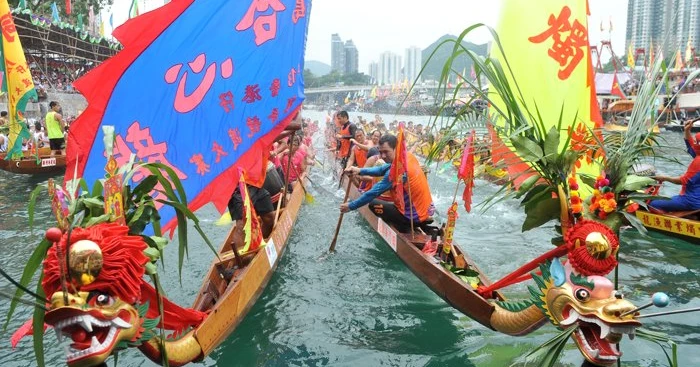
In Yutian County, on the edge of the vast Taklamakan Desert in northwest China's Xinjiang Uygur Autonomous Region, water is scarce. But every summer, the sound of drums and paddles brings a small pond to life as local villagers take part in dragon boat races.
The ancient Chinese sport, traditionally associated with the rivers and lakes of southern China, has found an unlikely home in this dry inland region.
Teams race in long dragon-shaped boats, paddling in rhythm to the beat of a drum. Success depends not only on individual strength but also on teamwork and coordination.
For many local participants, dragon boat racing was a completely new experience.
“Most of us used to play football or basketball,” said 25-year-old participant Adiljan Abduegni. “Before trying dragon boats, we didn’t know how to row. Some people couldn’t even swim.”
Yutian County, far from China's major rivers and coastal areas, had little opportunity for water sports. That began to change in 2022 when local authorities launched the county's first annual summer dragon boat race.
Nearly 20 townships soon formed teams, with participants including farmers, taxi drivers and construction workers. In the early days, villagers even built their own boats and paddles, often in different shapes and sizes.
The races were held on a small fishpond, one of the few suitable venues in the area. Although the competitions were initially far from professional, they quickly became popular among both participants and spectators.
As interest grew, local authorities provided standard dragon boats and paddles, helping the sport become more organised.
Last year, more than a dozen paddlers from Yutian travelled to Miluo in central China's Hunan Province to compete in the national Dragon Boat Super League. Despite limited experience and less advanced equipment, the team gained valuable exposure by competing against stronger and more experienced crews.
Dragon boat racing has since continued to spread across Xinjiang. In areas without suitable waterways, organisers have introduced land-based events, while frozen lakes in northern Xinjiang have hosted winter races using specially modified boats fitted with blades and brakes.
The sport reached another milestone in August when dragon boat racing was included in the Xinjiang Ethnic Traditional Sports Games in Kashgar, where 12 teams from across the region took part.
Adiljan's team finished fourth in the 200-metre race, but he said winning was not the only goal.
“The result is not the most important thing,” he said. “One person may paddle fast, but cannot go far alone. Only when everyone works together can we move faster and farther.”