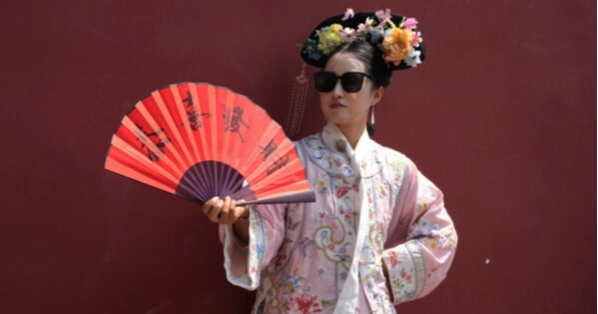
A growing number of young people in China are embracing traditional culture by dressing up as ancient emperors, empresses and princesses while visiting Beijing’s historic landmarks, creating a booming business for costume and makeup studios around the Forbidden City.
Among those benefiting from the trend is makeup artist Chen Jiao, whose job is to transform visitors into figures from imperial China. She is one of hundreds of stylists working near the Forbidden City, the former home of Chinese emperors during the Ming and Qing dynasties.
Every day, visitors arrive at studios to wear elaborate traditional outfits decorated with phoenix patterns and accessorized with jade, pearls and other ornaments inspired by royal fashion. Their makeup is carefully applied and their hairstyles recreated to match the period.
The experience typically costs around 300 yuan (about $45), although premium packages can cost more than 1,000 yuan ($150).
After getting dressed, many visitors head to the walls, gates and moat surrounding the Forbidden City to take photos and videos for social media. While some fully embrace the historical look, others mix traditional costumes with modern accessories such as sneakers, sunglasses and bubble tea.
Chen said demand is especially high during public holidays and weekends. She recently started work at 6 a.m. and styled around 24 customers in a single day.
"There is hardly an off-season," she said, noting that business only slows briefly when the Forbidden City is closed.
The trend reflects a broader interest among Chinese youth in immersive cultural experiences and traditional clothing inspired by the Ming and Qing dynasties.
The Ming dynasty ruled China for more than 270 years and built the Forbidden City, while the Qing dynasty, China's last imperial dynasty, ended in 1912, bringing more than 2,000 years of imperial rule to a close.
Many tourists say wearing period costumes enhances their experience at historical sites.
Chen Xiao, a university student from Shandong province, travelled overnight to Beijing during the recent Qingming holiday and chose to wear a pink outfit associated with a Qing dynasty princess.
"I feel that when you visit a historical place, it's nice to wear something that matches the setting," she said.
The popularity of the trend has fueled rapid growth in the costume-styling industry. Local media reports that a building housing Chen Jiao’s studio had only a few such businesses in 2020, but now hosts more than 100.
Cai Zehong, founder of Hanfu Beijing, said many young people are becoming interested in traditional Chinese clothing as they learn more about the country's cultural heritage.
He said historical costume dramas, which have long been popular in China, have also helped drive interest in traditional fashion.
Chen Xiao acknowledged that television dramas influenced her interest.
"I've watched many historical dramas, and they've definitely shaped my interest. Recently, I've become particularly fascinated by Qing dynasty history," she said.
Another visitor, Liu Ruitong from Hebei province, selected a black Ming-style outfit for her photoshoot.
She said she liked the costume's elegant appearance and felt its dark color complemented both the Forbidden City and traditional Chinese scenery.