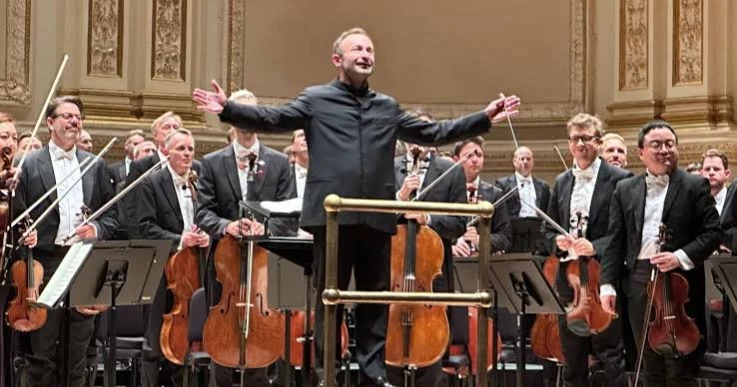
The Berlin Philharmonic and its chief conductor Kirill Petrenko are preparing to leave their home concert hall for several years as the venue undergoes a major renovation expected to run from 2032 to 2040.
The orchestra has performed at the Philharmonie since 1963. The hall, designed by Hans Scharoun, has 2,410 seats arranged in terraces and is known for its distinctive acoustics.
“It’s a huge challenge to have a different stage for us because the Philharmonie has this unique sound,” Petrenko said during a recent online news conference ahead of the orchestra’s four US concerts and its first South American tour in 25 years.
The orchestra is considering using hangars at the former Tempelhof Airport in Berlin as a temporary venue. The airport closed in 2008. The renovation and temporary hall are estimated to cost 1.15 billion euros ($1.28 billion), while the German federal government has pledged 225 million euros ($251 million).
The orchestra plans to move after celebrating its 150th anniversary in the first half of 2032.
Petrenko said the orchestra was negotiating to find a suitable venue and develop the acoustics needed for its large ensemble. He described the task as a major challenge but said a preliminary decision could come soon.
Five chief conductors in seven decades
Petrenko became chief conductor in the 2019-20 season, following Wilhelm Furtwängler, Herbert von Karajan, Claudio Abbado and Simon Rattle.
The orchestra opened Carnegie Hall’s season last week, marking its 26th US visit since 1955 and its third under Petrenko, 54, who holds an open-ended contract. It then travelled to Bogotá, Colombia, São Paulo and Buenos Aires, Argentina, for performances running through Oct 23. Its last South American tour was in 2000.
The Berlin Philharmonic has a global audience, with more than 45,000 active subscribers to its Digital Concert Hall.
Unlike the Vienna Philharmonic, which has no music director and performs under guest conductors, the Berlin orchestra is led by a single chief conductor.
Andrea Zietzschmann, its general manager since 2017, said each conductor had left a distinct mark on the orchestra.
She said Abbado encouraged a more collective approach, while Rattle brought a different musical perspective, expanding the repertoire from early Baroque works to modern music.
Petrenko, like Abbado and Rattle, works under the legacy of Karajan, who led the orchestra from 1955 to 1989 and left behind widely acclaimed recordings.
Petrenko said he was not afraid of comparisons with Karajan. He continues to study recordings and orchestral parts associated with his predecessor, learning his bowings and dynamics before deciding how the music should sound today.
A career shaped by Germany and Austria
Born in 1972 in Omsk, Russia, then part of the Soviet Union, Petrenko moved to Austria with his family at the age of 18.
He conducted at the Vienna Volksoper from 1997 to 1999 before serving as music director of Germany’s Meininger State Theater from 1999 to 2002, Berlin’s Komische Oper from 2002 to 2007 and Munich’s Bavarian State Opera from 2013 to 2021.
Petrenko said listening to older Berlin Philharmonic recordings allowed him to recognise differences in the styles of previous conductors, including Furtwängler’s approach, Karajan’s style, Abbado’s clarity and Rattle’s rhythmic strength.
He encourages the musicians to keep refining their performances rather than settling for a finished result.
Noah Bendix-Balgley, one of the orchestra’s first concertmasters, said before a Carnegie Hall performance that Petrenko continually pushes the musicians to improve.
He said the conductor’s approach inspires them to keep exploring the music, composers and art form, regardless of changes in the world, their careers or musical trends.