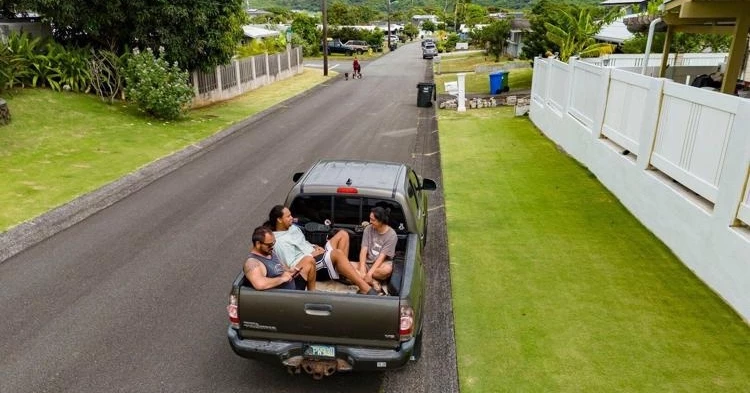
Hawaii has increased the minimum legal age for riding in the open bed of a pickup truck from 12 to 16, as growing traffic and faster roads have raised safety concerns over a long-standing island tradition.
Riding in the back of pickup trucks has long been a common sight across Hawaii, particularly in rural communities, where many people see it as part of the islands' unique lifestyle and culture.
For Kimeona Kane, a Native Hawaiian from Waimanalo on Oahu, riding in truck beds was a regular part of childhood, whether heading to sports practice or travelling around town.
"It's Hawaii culture," Kane said, explaining that the tradition reflects the islands' multicultural history rather than Native Hawaiian customs alone.
However, he now allows his family to ride in truck beds only on quiet back roads, citing increased traffic and higher-speed roads across Oahu.
After years of debate, state lawmakers passed legislation this spring raising the minimum riding age to 16. Democratic Gov. Josh Green signed the bill into law last month.
Green, who is also a physician, has witnessed the dangers firsthand. In 2023, he stopped to help a 25-year-old man who was thrown from the bed of a pickup truck following an accident.
At the time, Green said he would prefer that no one ride in truck beds because passengers should always be protected by seat belts.
Despite the safety risks, many residents continue to view riding in truck beds as an important part of island life.
Richard Landford Jr., an 80-year-old resident of Waianae, recalled riding in the back of farmers' pickup trucks in his youth. Although he acknowledges that modern roads are much faster and more dangerous, he believes truck beds should still be available for transporting passengers in rural areas.
"You drive to almost any church out here in the rural area, you'll see people in the back of trucks," he said.
Kane said the practice dates back to Hawaii's plantation era, when workers from countries including the Philippines, China, Japan, Portugal and Puerto Rico often travelled together in pickup trucks while working on sugar and pineapple plantations.
Even today, some families rely on truck beds because their pickup trucks do not have enough seats inside the cab, said state Representative Darius Kila.
Still, Kane follows strict safety rules, such as preventing passengers from sitting on the tailgate or on raised seats like coolers or chairs.
Some farmers have already moved away from the practice.
Dean Okimoto, chief operating officer of Nalo Farms, said the company now uses passenger vans equipped with seats and seat belts to transport workers.
"I wouldn't chance putting people in an open truck," he said, adding that he supports a complete ban.
The push for tighter rules gained momentum after a woman died earlier this year after being thrown from the bed of a pickup truck following a rear-end collision on a Honolulu freeway.
Kila, who introduced the legislation, said lawmakers tried to strike a balance between preserving a tradition many residents value and improving road safety.
He had originally proposed broader restrictions, including banning truck-bed passengers on certain highways, but strong public opposition led to a narrower measure.
Under the new law, people aged 16 and older may ride in a truck bed only if there is no available seat inside the vehicle. The law also includes exemptions for farm work, parades and emergency situations.
According to the Insurance Institute for Highway Safety, 29 US states and the District of Columbia have laws restricting passengers in pickup truck beds, although most allow exceptions for specific situations.
David Kidd, the institute's vice president of vehicle research, said riding in open truck beds is highly dangerous because passengers have no seat belts or other safety protections.
He welcomed Hawaii's new law as a positive step and said it could gradually change public attitudes.
Kila believes Hawaii may eventually ban truck-bed passengers altogether, although he expects such a move would face resistance before gaining wider public acceptance.