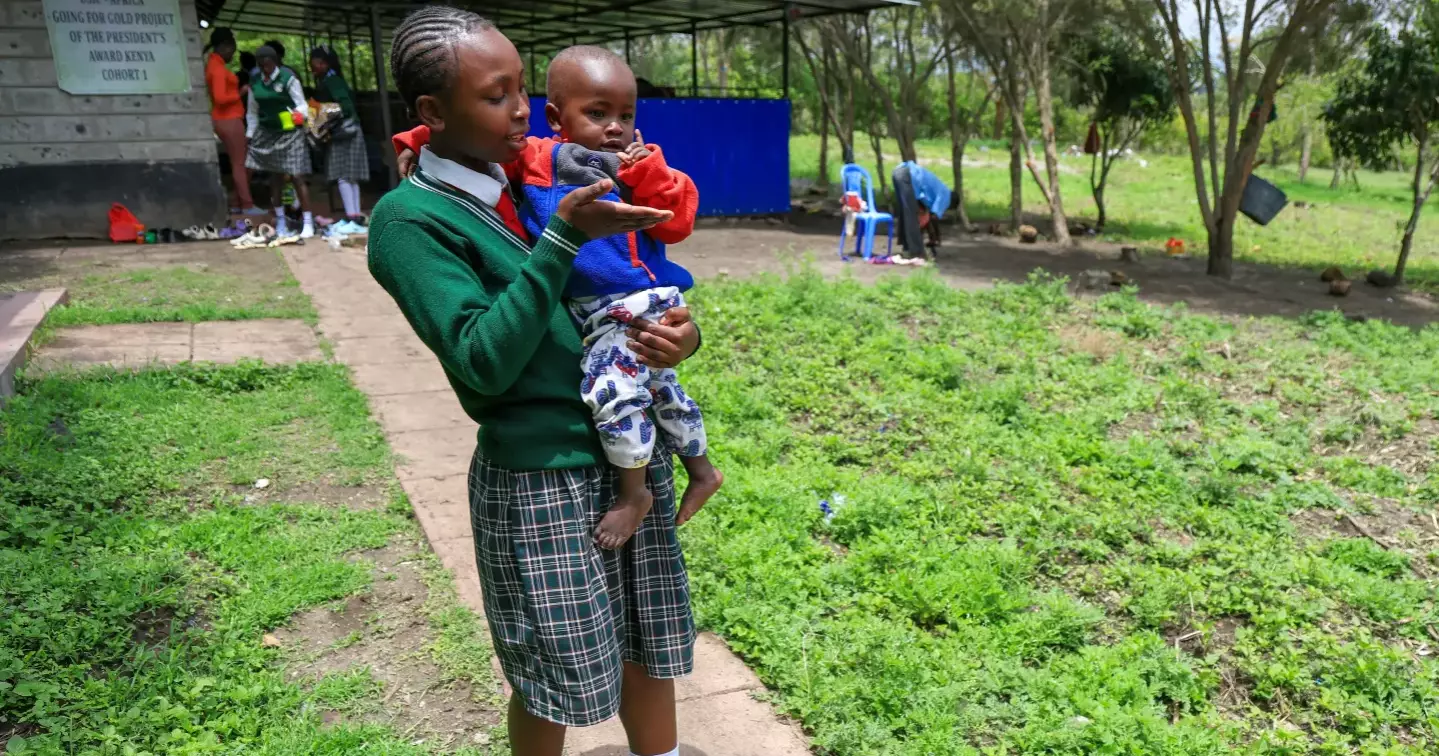
At Greenland Girls School in Kenya, 19-year-old Valerie Wairimu barely gets a break between classes. During recess, she grabs a quick snack before heading to the school’s on-site nursery to care for her baby, Kayden, who is looked after by a team of nannies while she attends lessons.
Greenland Girls School is the only institution in Kenya exclusively dedicated to teenage mothers, providing both education and child care. The school supports 310 students and more than 80 children, offering young mothers a second chance at education in an environment free from stigma. Experts consider it a model for reintegrating adolescent mothers into the school system.
“When I found out I was pregnant, I didn’t have anywhere else to go,” said Wairimu, who consistently ranks near the top of her class and dreams of becoming a doctor.
Founded in 2015, the boarding school has enabled hundreds of girls and young women to complete secondary education while supporting their children. Some graduates have pursued successful careers in fields such as government and medicine. The school is managed by the nonprofit organization Shining Hope for Communities, and many students attend through grants.
Most students come from Kajiado County, south of Nairobi, where Greenland maintains outreach officers to identify and refer pregnant girls. The school also works with social services and is recognized by teachers across Kenya, including in more distant regions such as Wairimu’s home in western Kenya. Her grandmother had referred her to the school because her family lacked the resources to care for a newborn.
Many students come from challenging circumstances, including pregnancies resulting from sexual assault or forced marriages. Paul Mukilya, the school manager, said parents are often unsupportive, and outreach officers must sometimes negotiate with community elders to allow students to attend.
“Some of the challenges the students face come from family and community. Most have not been accepted as they are,” Mukilya said. “Here, we provide psychological counseling and mentorship.”
In Kenya, sexual activity involving minors under 18 is illegal, but only the male partner is held criminally responsible. Teenage pregnancies frequently lead to legal proceedings, and Greenland supports students while coordinating with local authorities in cases of underage marriage.
While students are in class, the school’s staff manage child care and provide guidance on parenting. Caroline Mumbai, a caregiver at Greenland and mother of two, said, “Some of the mothers see their children as a burden. We also teach them how to mother.”
Making education accessible to teenage mothers remains a challenge in Kenya, a country with a rapidly growing youth population. National statistics report that over 125,000 births in 2024 involved adolescent mothers under 19. According to a 2015 Population Council study, two-thirds of teenage mothers cited pregnancy as the reason for leaving school, while research by IDinsight in 2022 showed that unintended pregnancy was the second-leading reason girls dropped out, after inability to afford school fees.
In response to growing demand along Kenya’s coast, Greenland Girls School plans to open a second campus in Kilifi County.
“Every girl who becomes pregnant and leaves school should be allowed to return,” said Dr. Githinji Gitahi, CEO of Amref Health Africa. “Special schools are critical in complementing scalable policy frameworks and helping close the education equity gap.”
Students at Greenland also value the school’s stigma-free environment, which encourages learning. Mary Wanjiku, 20, whose son is nearly 18 months old, said, “People used to judge me for getting pregnant. The moment I came here, I was received with love. Now, I hope to become a lawyer.”