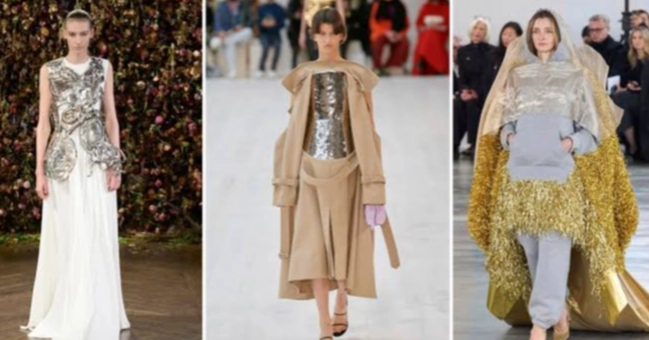
The Metropolitan Museum of Art's next major fashion exhibition will focus on everyday clothing and ordinary materials, including jeans, puffer jackets, paper and plastic, highlighting how designers transform familiar items into extraordinary creations.
The new exhibition, titled "extraORDINARY: Fashion and the Poetics of the Everyday," was announced Thursday as a replacement for a planned retrospective on British designer John Galliano, which was cancelled following controversy over his past antisemitic remarks.
The exhibition will be presented by the museum's Costume Institute and inaugurated during the 2027 Met Gala, traditionally held on the first Monday of May. It will feature pieces from the museum's collection, along with borrowed and newly acquired items, exploring how designers use craftsmanship, construction, material experimentation and creativity to reinterpret ordinary garments and objects.
Costume Institute head curator Andrew Bolton said the new concept had to be developed from scratch after the Galliano exhibition was abandoned. The original retrospective had been announced in late July, with the museum promising to address the designer's past racist and antisemitic remarks and their impact on his career and public image. However, the plan was dropped about a month later following pressure from donors, city officials and the Jewish community.
Bolton said he had no alternative exhibition ready when the decision was made, although the idea of exploring everyday clothing had occurred to him while working on the previous exhibition, "Costume Art".
He said ordinary clothes often carry deep personal significance through memories, movement and everyday use. Favourite T-shirts and jeans, for instance, can become meaningful possessions that people continue wearing until they fall apart.
Bolton hopes the exhibition will encourage visitors to view their everyday clothing differently. He is also considering encouraging visitors to wear their favourite jeans, T-shirts or bomber jackets.
Around one-third of the exhibition will come from the museum's own collection, while the remaining pieces will be borrowed from fashion houses or received as gifts.
Among the notable items will be an iconic 1930s puffer coat designed by Charles James, on loan from London's Victoria and Albert Museum. The exhibition will also feature designer Norma Kamali's well-known "sleeping bag coat".
Several designers are expected to contribute pieces to mark the Costume Institute's 80th anniversary next year, providing an opportunity to further diversify the museum's collection.
Another highlight will be a pair of Calvin Klein jeans donated by actress Brooke Shields, worn during her famous advertising campaign when she was just 15. The campaign featured her memorable statement that nothing came between her and her Calvins.
The exhibition will be launched through the 2027 Met Gala on May 3, a major fundraising event for the Costume Institute. The annual gathering attracts prominent personalities from entertainment, business, sports and politics. Organisers will announce the celebrity hosts and dress code at a later date.
New York City Council Speaker Julie Menin, one of the prominent critics of the original Galliano exhibition, had repeatedly raised concerns with museum officials. The proposed 2027 gala date would have coincided with Holocaust Remembrance Day.
Menin, whose mother or father survived the Holocaust, said in August that cancelling the exhibition was the right decision because the harm and pain it could cause were unacceptable.
Galliano, widely regarded as one of the fashion industry's leading creative talents, previously served as creative director of Christian Dior. He was dismissed after racist and antisemitic comments he made in 2010 and 2011 became public, leading to his conviction in a French antisemitism case.
After spending several years making public and private efforts to address the controversy, Galliano returned to the fashion industry in 2014 when he joined Paris-based fashion house Maison Margiela, where he worked for a decade.
Following the cancellation of the exhibition, Galliano expressed remorse and accepted responsibility for the hurt caused by his past remarks, particularly to Jewish and Asian communities.
Vogue Global Editorial Director Anna Wintour, who oversees the Met Gala and has long supported Galliano, described his decision to withdraw the exhibition as courageous in an August statement.