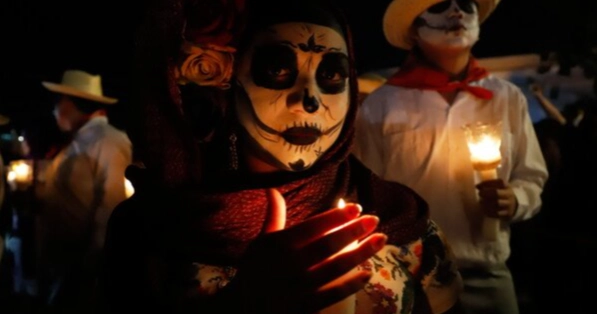
Mexico's streets are adorned with bright orange marigolds, flickering candles and people wearing makeup resembling elegant skeletons known as catrinas as the country celebrates its annual Day of the Dead festival.
The celebrations begin in October and reach their peak on Nov. 1 and 2, when people believe the spirits of deceased family members return temporarily to the living world to reunite with their loved ones.
Although the exact origin of the tradition remains unknown, it is rooted in agricultural beliefs dating back to Mexico's pre-Hispanic period. Catholic customs were later incorporated following the Spanish conquest in 1521.
Today, the festival features large-scale parades along Mexico City's main avenues. Streets, shops and markets are decorated with orange Mexican marigolds, locally known as cempasuchil, whose bright colours are believed to guide the souls of the dead back to earth. Bakeries also display traditional pan de muerto, or bread of the dead.
Families prepare special altars at home in memory of deceased relatives, placing photographs, food, sweets and mezcal as offerings.
On the night of Nov. 1, families across the country gather in cemeteries to honour and reconnect with their departed loved ones, continuing a tradition observed for centuries.
However, as the festival and Mexico's capital have attracted growing international attention, popular destinations such as Oaxaca and Michoacan have faced challenges linked to overtourism.
In Mexico City, some residents have questioned an annual parade featuring floats decorated with catrinas. The procession was originally created for the 2015 James Bond film Spectre and later became part of the city's official celebrations, despite not being an established element of the traditional festival.
Meanwhile, authorities on Janitzio, a small island in Lake Patzcuaro in the central state of Michoacan, barred tourists from entering its cemetery for the first time this year.
The island's Day of the Dead celebrations were recognised by UNESCO as Intangible Cultural Heritage of Humanity in 2008.
The decision followed a report by the community council that overcrowding had contributed to the collapse of damaged tombs, crosses and sections of the cemetery's boundary wall.
Under the new restrictions, only local families and friends of people buried in the cemetery will be permitted to enter.