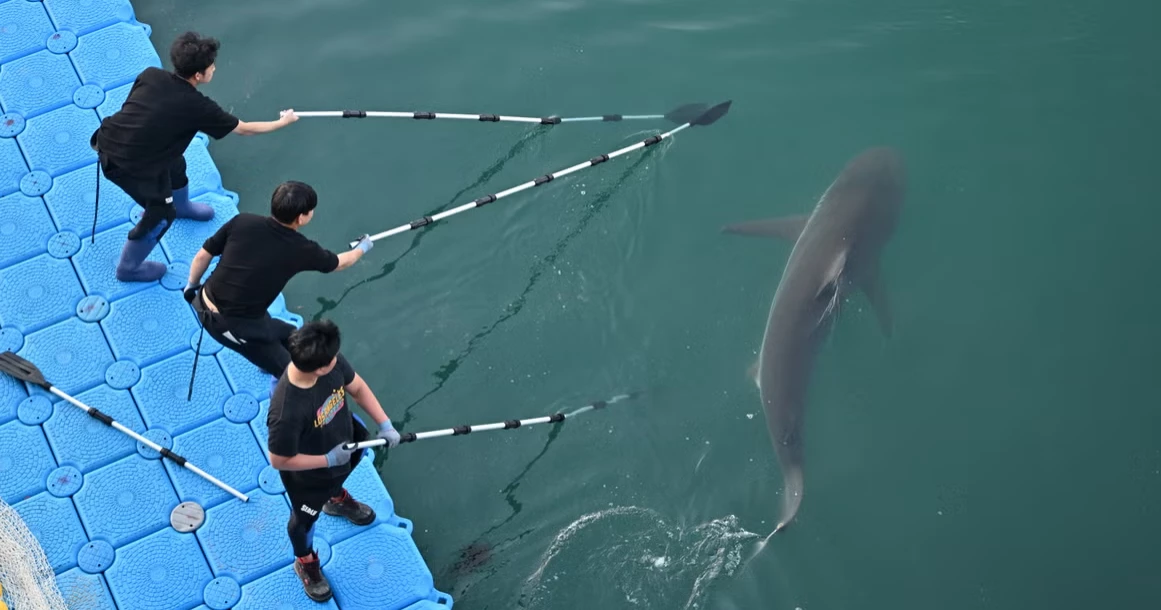
Authorities in South Korea’s port city of Busan were searching for a new way Thursday to guide a large dusky shark back to the open sea after it returned to a narrow canal just hours after a rescue operation appeared to have succeeded.
The 3-metre-long female shark, nicknamed Bukangi, was moved out of the canal on Wednesday following weeks of unsuccessful attempts. However, it swam beneath a protective net installed around the rescue platform and re-entered the waterway later that night.
Busan officials and the Oceans and Fisheries Ministry are now working to find a safer way to lead the shark into open waters, expressing concern over its health and survival.
During Wednesday’s operation, dozens of workers used a floating platform to push the shark towards the sea. After remaining in nearby waters for several hours, Bukangi slipped beneath the platform’s outer barrier net and returned to the canal.
Officials said the shark was now trapped between that net and another barrier about 50 metres from the canal entrance. Rescuers and inspectors at the scene were discussing possible solutions as the shark continued swimming around the confined area.
Lee Gwang-seok, an official at the Oceans and Fisheries Ministry, said the dense network of barriers and the narrow waterway made it unlikely that the shark would move farther into the canal.
Authorities are also concerned that Bukangi may not have been feeding regularly during its month-long stay and that falling water temperatures could further threaten its health. Busan officials have yet to announce when the next rescue attempt will take place.
Scientists Puzzled by Shark’s Unusual Behaviour
Bukangi, named after Busan’s North Port where it was first spotted in mid-September, has become a popular attraction as it swims in circles through the canal with its fins visible above the water.
According to city officials, more than 1.7 million people have visited the area to see the shark. Hundreds of spectators gathered along the canal on Wednesday to watch the latest rescue attempt.
Marine researchers remain uncertain about why the shark entered the canal and has continued to stay there.
Kim Hyun-woo, a senior researcher at South Korea’s National Institute of Fisheries Science, suggested that the busy port environment might have influenced the animal’s behaviour. The canal may offer a quieter refuge from the heavy container and cruise ship traffic at North Port.
Kim also said vessel noise, bright lights and electromagnetic fields generated by nearby equipment could interfere with the shark’s sensory systems.
Although officials want to return Bukangi to the sea as soon as possible, Kim stressed that patience may be necessary. He suggested allowing the shark time to adjust to the waters outside the canal before moving farther offshore.
“The shark has been staying inside the canal for an extended period, so I didn’t expect it to head straight out into the open water,” Kim said, adding that it would be better to give the animal about a week to leave on its own.
Previous Rescue Attempts Also Failed
Wednesday’s operation was the third attempt to free Bukangi. Earlier efforts on September 29 and October 2 failed despite the use of boats spraying water and nets positioned across the narrow canal.
The shark managed to evade the boats and swim over the barriers during those attempts.
Dusky sharks can reach lengths of up to 4.2 metres and inhabit tropical and temperate waters worldwide. They travel long distances in search of suitable habitats, generally preferring water temperatures between 18 and 26 degrees Celsius, and feed on fish and squid, according to the fisheries institute.
The species reproduces slowly, making it particularly vulnerable to population decline. The International Union for Conservation of Nature and Natural Resources lists dusky sharks as endangered.
Official data showed that water temperatures in the Busan area were around 20 degrees Celsius on Thursday morning.