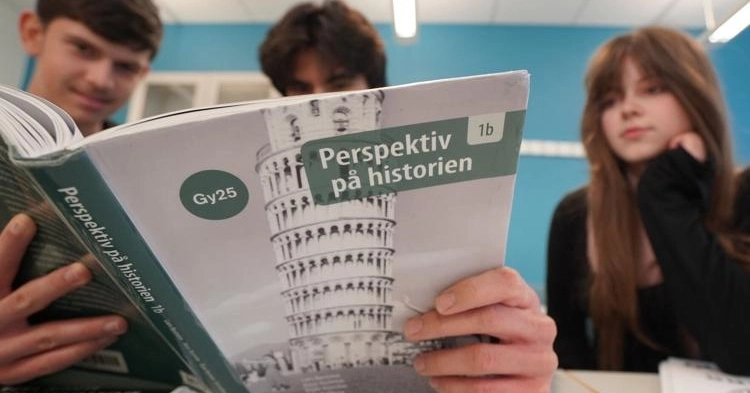
Sweden, once seen as a global leader in digital education, is set to ban mobile phones in schools from the upcoming academic year, joining a growing international trend to reduce screen use in classrooms and encourage more traditional learning methods.
Since 2023, Sweden’s center-right government has promoted policies aimed at increasing reading time and reducing screen exposure, particularly for younger children. The strategy places greater emphasis on books and conventional teaching materials instead of digital devices.
According to Joar Forsell, chairman of the Swedish parliament’s education committee, authorities have noticed a decline in reading and writing skills, especially among younger students.
“We are moving away from screens because we believe books and traditional learning methods are better for children,” Forsell said.
Sweden’s decision reflects a broader global reassessment of technology in education. After years of investing in laptops, tablets and learning apps, many countries are now questioning whether excessive screen use is helping or harming students’ learning. Parents, teachers and education officials in many places are calling for fewer digital distractions in classrooms.
Several Nordic countries are taking similar steps. Denmark is considering restrictions similar to Sweden’s, while Finland introduced a law last year limiting mobile phone use in schools. Countries including Spain and South Korea have also introduced measures ranging from classroom phone bans to limits on screen-based homework.
In the United States, the Los Angeles Unified School District has announced plans to restrict screen use for younger students, introduce daily limits on screen time and review educational technology contracts.
Despite being home to technology giants such as Spotify and Ericsson, Sweden is now encouraging schools to reduce students’ dependence on screens. The government has also allocated 555 million Swedish krona (about $59 million) this year to help schools purchase textbooks and teachers’ guides.
The shift follows concerns about declining reading performance. According to the 2022 Programme for International Student Assessment (PISA), 24.3% of Swedish ninth-grade students failed to reach a basic level of reading comprehension, only slightly better than the European Union average of 26.2%.
Magnus Haake, an associate professor of cognitive science at Lund University, said physical learning materials engage more parts of children’s brains and can improve learning outcomes.
Beyond schools, Sweden’s public health agency is also encouraging parents to set a good example by creating screen-free areas at home.
At Malmö Borgarskola high school, mobile phones are already banned during lessons. Students place their phones in a storage box before class and collect them afterward.
Seventeen-year-old student Melina Sallahi said the policy helps students stay focused.
“When you have a phone, there is always something to check. It becomes a distraction,” she said.
Her classmate Vasilije Stjepanovic agreed, noting that games and social media can easily draw students’ attention away from lessons.
Although students are provided with laptops, Deputy Headmaster Patrik Sander said teachers now encourage limited use of computers unless they are needed for specific classroom activities.
“We have learned that writing by hand with a pencil helps students remember better,” Sander said.
The government has already reduced the role of digital tools in early childhood education. Since last year, children under the age of two have been limited to non-digital learning materials such as books, while preschools are no longer required to use digital learning tools. A revised curriculum that places greater emphasis on books is expected to be introduced in 2028.
However, not everyone supports the move away from digital learning.
Industry group Swedish Edtech Industry argues that digital skills will be essential for most future jobs and warns that reducing technology use in schools could leave young people less prepared for the workplace.
Peter Carlsson, CEO of Malmö-based startup Imvi Labs, said some digital tools are valuable, particularly for students with reading difficulties or other learning challenges.
“Good technology can make teaching more effective,” he said.
Still, many students at Malmö Borgarskola appear unconcerned about losing digital learning opportunities. As they prepared for end-of-year exams using textbooks, several said they learn more effectively from printed materials.
“Everyone already uses digital devices in their free time, so I do not think schools need to teach that,” said Melina Sallahi.
Another student, Aslan Özhan Kilicasan, summed up the view shared by many of his classmates: “We learn much more easily when we use books.”